CURRENT AFFAIRS | 12 JUNE 2026
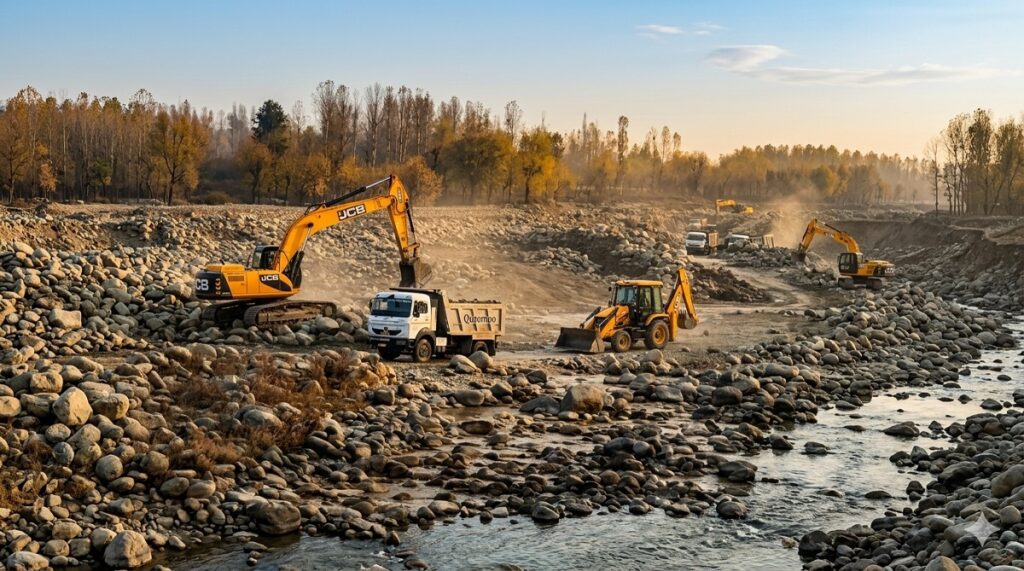
In the valleys of Kashmir, a once-pristine glacial stream now bears the scars of unchecked mining. The Sukhnag river in Budgam district, a 54-km tributary of the Jhelum, has suffered what experts call “irreversible hydrogeological damage.” The matter is now before the National Green Tribunal, putting environmental law and the principle of sustainable development squarely in the spotlight.
For CLAT aspirants, this case is a textbook illustration of how India’s green jurisprudence works: the role of the NGT, the doctrines of sustainable development and polluter pays, and the public trust over natural resources. Environmental law is a steadily growing presence in the Legal Reasoning and Current Affairs sections.
The story also captures a real-world tension between development and ecology, and how courts and tribunals try to hold the balance.
What Happened
A joint panel report submitted to the NGT estimated that between 10.6 and 15.3 lakh tonnes of riverbed material had been extracted from the Sukhnag, causing irreversible damage to its hydrogeology. Once spring-fed fields along its banks now lie barren. The contractor named was NKC Projects Pvt Ltd.
The Ministry of Environment, the National Institute of Himalayan Environment and the J&K Pollution Control Committee flagged the extraction as “indiscriminate and un-scientific.” The NGT had earlier ordered a moratorium on mining until the river system is “adequately restored.”
- Sukhnag river (54-km tributary of the Jhelum) in Budgam, J&K, damaged by riverbed mining.
- 10.6-15.3 lakh tonnes of riverbed material extracted; “irreversible hydrogeological damage.”
- Flagged by MoEFCC, NIHE and the J&K Pollution Control Committee as “indiscriminate and un-scientific.”
- Contractor: NKC Projects Pvt Ltd; report submitted around 6 May 2026.
- NGT ordered a moratorium on mining until the system is adequately restored.
Constitutional / Legal Framework
The key forum is the National Green Tribunal, constituted under the NGT Act, 2010. The governing statutes include the Environment (Protection) Act, 1986 and the EIA Notification, 2006, alongside the Sustainable Sand Mining Guidelines 2016 and Enforcement & Monitoring Guidelines 2020. The applicable doctrines are sustainable development, the precautionary principle, polluter pays and the public trust doctrine (the M.C. Mehta line of cases).
CLAT Angle
For CLAT 2027, this is rich Legal Reasoning territory: principle-application questions on the polluter pays and precautionary principles, the public trust doctrine, and the NGT’s jurisdiction under the 2010 Act. A static-GK trap may test which Act constitutes the NGT (2010) versus the umbrella Environment (Protection) Act (1986). Linking M.C. Mehta cases to the public trust doctrine is a high-value connection.
Key Facts
| Item | Detail |
|---|---|
| River | Sukhnag (54-km tributary of the Jhelum) |
| Location | Budgam district, J&K (Pir Panjal / Tosamaidan) |
| Material extracted | 10.6-15.3 lakh tonnes |
| Damage | Irreversible hydrogeological damage |
| Contractor | NKC Projects Pvt Ltd |
| Forum | National Green Tribunal (NGT Act, 2010) |
| NGT order | Moratorium until system adequately restored |
Mnemonic / Memory Hook
“SUKHNAG = Sustainable development, Un-scientific mining, Khashmir (Budgam), Hydrogeological damage, NGT 2010, Adequate restoration, Glacial Jhelum tributary.” For the four doctrines: “SPPP” = Sustainable development, Precautionary, Polluter pays, Public trust.
Conclusion
The Sukhnag case shows India’s environmental tribunals enforcing the idea that rivers are held in public trust, not for plunder. For aspirants, it ties together the NGT, the core green doctrines and the lived stakes of sustainable development.
Practice Quiz — 10 CLAT-Style Questions
Click an option to reveal the answer and explanation.