CURRENT AFFAIRS | 24 SEPTEMBER 2026
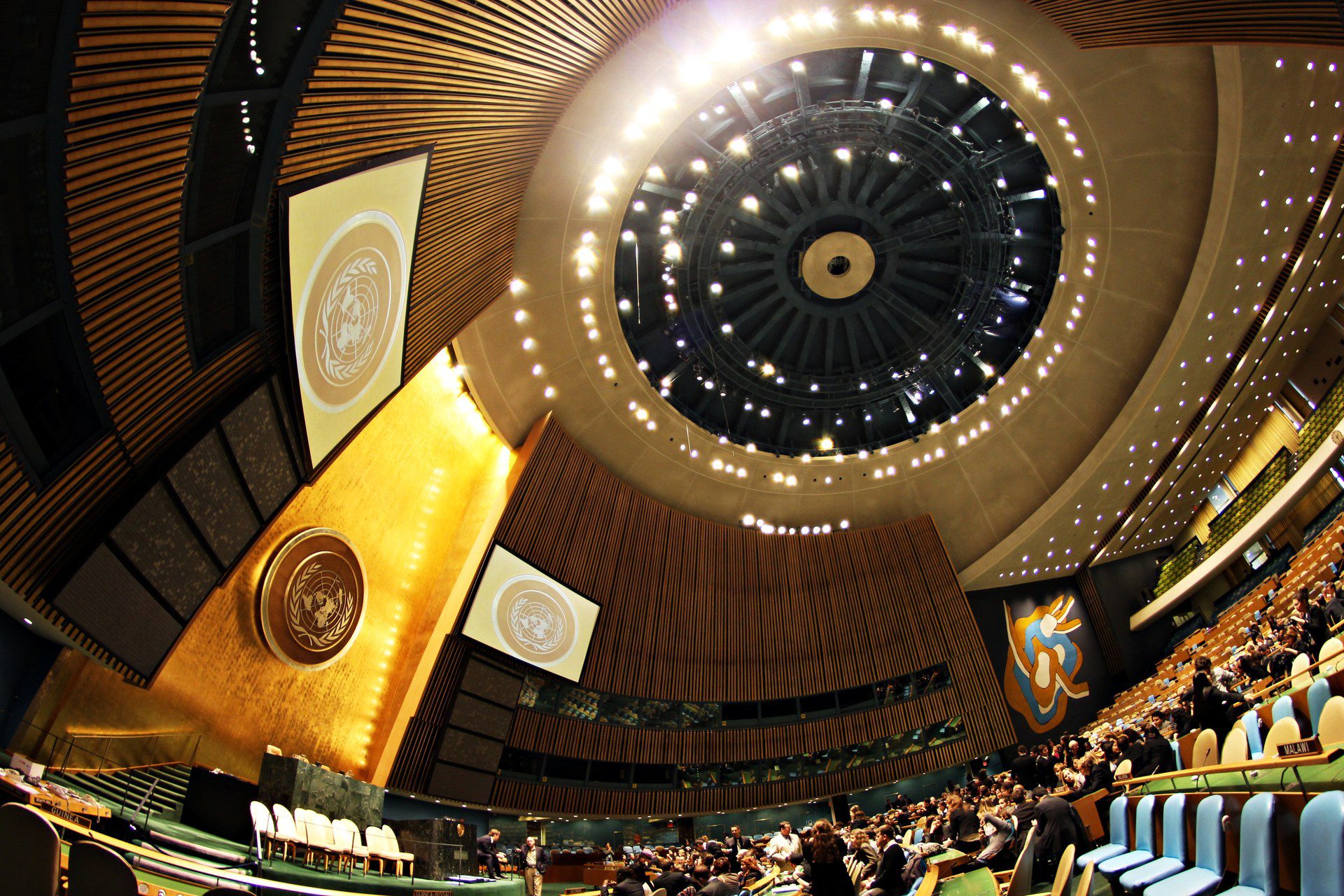
On 24 September 2026, on the margins of the 81st session of the United Nations General Assembly (UNGA 81) in New York, India co-hosted the launch of OneSCD — A Global Partnership to Advance Equity and Transform Sickle Cell Care. According to the report carried by News on AIR, the public broadcaster’s news service under Prasar Bharati, the event was addressed by Punya Salila Srivastava, Secretary, Ministry of Health and Family Welfare, who set out India’s domestic response to sickle cell disease through the National Sickle Cell Anaemia Elimination Mission (NSCAEM).
A subsequent ANI report dated 25 September 2026, carrying the official release, named the partners brought together for the launch: the Government of Nigeria, the World Health Organization (WHO), UNICEF, Africa CDC, the World Coalition on Sickle Cell Disease, and St. Jude Children’s Research Hospital. The stated purpose of OneSCD is to strengthen international cooperation and improve access to prevention, diagnosis, treatment and continuing care for people living with sickle cell disease. Beyond that, the public record so far is thin: no secretariat, no budget, no membership list and no governing instrument have been announced, and an exam-minded reader should note the absence rather than assume the detail.
For a CLAT aspirant the story is worth attention for two reasons. First, it sits at the intersection of international organisations, global health governance and India’s own flagship health missions — a combination that produces good comprehension passages. Second, sickle cell disease in India is inseparable from questions of tribal welfare, federal division of responsibility and the Directive Principles, which is where the legal-reasoning value lies.
What sickle cell disease actually is
Sickle cell disease is a haemoglobinopathy — a disorder of haemoglobin, the oxygen-carrying protein in red blood cells. It is inherited in an autosomal recessive pattern. “Autosomal” means the responsible gene sits on a non-sex chromosome, so boys and girls are affected equally; “recessive” means a person must inherit the variant gene from both parents to develop the disease. A person who inherits one copy is a carrier (often described as having sickle cell trait) and is usually healthy, but two carriers who have children face a statistical risk that some of those children will inherit both copies. This genetics is precisely why the Indian programme is built around screening, carrier identification and counselling rather than treatment alone — identifying carriers before marriage or before conception is the only preventive lever available.
The disease distorts red blood cells into a rigid, sickle-like shape. Those cells block small blood vessels, producing severe pain episodes (“crises”), chronic anaemia, organ damage and shortened life expectancy. Globally the disease burden is concentrated in sub-Saharan Africa and India — which explains why the Government of Nigeria, Africa CDC and India were all present at the same launch.
Background & Framework
Article 47 of the Constitution places on the State the duty to raise the level of nutrition and the standard of living and to improve public health, treating it as among the State’s primary duties. It is a Directive Principle under Part IV and is therefore not enforceable by any court under Article 37, though courts have repeatedly used the Directive Principles to interpret the scope of fundamental rights. Public health and sanitation, hospitals and dispensaries is Entry 6 of the State List under the Seventh Schedule, which is why a national mission of this kind operates through centrally sponsored schemes and the National Health Mission rather than by direct central command over hospitals.
On the international side, the UN General Assembly is the plenary organ of the United Nations under Chapter IV of the UN Charter, in which every member state has one vote. It meets in annual regular sessions — this is the 81st — and its high-level week generates a large number of side events and partnership launches. Partnerships announced at such side events are typically voluntary, non-treaty arrangements: they are not binding international agreements and create no obligations enforceable against members, a distinction worth remembering when an exam passage asks what a “global partnership” legally is.
India’s National Sickle Cell Anaemia Elimination Mission
Ms Srivastava told the launch that the Mission was launched in 2023 with the goal of eliminating sickle cell disease as a public health problem by 2047 — the year of the centenary of Independence, which is the horizon India has adopted for a family of long-range development goals. She described the approach as integrating population-scale screening, early diagnosis, counselling, treatment and follow-up into public health systems, adding that no person living with the disease should be left without timely and continued care because of place of residence or socio-economic circumstances.
The figures released with the ANI report are substantial. Under the Mission, more than 7.29 crore people have been screened, over 20 lakh carriers have been identified, 2.5 lakh people have been diagnosed with the disease, and more than 4.93 crore Sickle Cell Cards have been distributed. The Health Secretary also referred to efforts to expand access to affordable point-of-care diagnostics and hydroxyurea therapy, and to ongoing research towards an indigenous gene-editing therapy.
The machinery behind those numbers is set out in a PIB release of 19 August 2025, a reply by the Minister of State for Health in the Rajya Sabha. It records that screening runs across 17 identified tribal-dominated States, from district hospitals down to Ayushman Arogya Mandirs; that the ICMR has validated 30 point-of-care tests and 5 non-rapid diagnostic assays for screening; and that a standardised cost norm of ₹100 per person has been approved for screening, record-keeping and related costs. Crucially for the federal-and-welfare angle, it records that 15 Centres of Excellence across 14 States have been approved with funding support from the Ministry of Tribal Affairs, which has also developed and disseminated awareness and counselling material. The ICMR-National Institute for Research in Tribal Health (NIRTH), Jabalpur supports the programme on the research side.
Why a tribal-affairs ministry funds a blood-disorder programme
The involvement of the Ministry of Tribal Affairs is not incidental. The sickle cell variant is concentrated in populations that historically lived in malaria-endemic regions, because carrying a single copy of the gene confers partial protection against severe malaria — a classic example of a genetic variant that persists because the carrier state is advantageous even though the full disease is devastating. In India that distribution maps closely onto Scheduled Tribe populations in the central and western belt. A disease that concentrates in one social group turns a clinical problem into a distributive justice problem, and that is exactly the framing India used at UNGA 81: equity of access, not merely availability of treatment.
The CLAT Angle
Expect this in two shapes. In the Current Affairs & General Knowledge section, a passage on India’s health diplomacy at UNGA 81 can ask you to identify OneSCD’s partners, the Mission’s 2047 target year, or the ministry that funds the Centres of Excellence — a question that rewards noticing that Tribal Affairs, not only Health, is in the picture.
In Legal Reasoning, the more interesting version supplies a principle such as “the State shall regard the improvement of public health as among its primary duties, but Directive Principles are not enforceable by any court” and then tests whether a citizen can compel the State to extend a screening programme to a district it has not covered. The trap is to reason from moral desirability to legal enforceability. Remember the structural answer: Article 47 is a Part IV directive, Article 37 bars direct enforcement, and any enforceable claim must be routed through a fundamental right — typically Article 21 or an equality argument under Article 14 where the State has already created a scheme and then applies it unequally. A second trap is treating a UNGA side-event partnership as though it were a treaty; it is not, and nothing signed at such a launch is self-executing in Indian law.
Key Facts
- India co-hosted the launch of OneSCD: A Global Partnership to Advance Equity and Transform Sickle Cell Care on the margins of UNGA 81 in New York, reported by News on AIR on 24 September 2026.
- India was represented by Punya Salila Srivastava, Secretary, Ministry of Health and Family Welfare.
- Partners named in the official release: Government of Nigeria, WHO, UNICEF, Africa CDC, World Coalition on Sickle Cell Disease, St. Jude Children’s Research Hospital.
- The National Sickle Cell Anaemia Elimination Mission was launched in 2023, targeting elimination of the disease as a public health problem by 2047.
- Mission figures cited at the launch: over 7.29 crore screened, over 20 lakh carriers identified, 2.5 lakh diagnosed, over 4.93 crore Sickle Cell Cards distributed.
- Screening operates across 17 identified tribal-dominated States (PIB, 19 August 2025).
- ICMR has validated 30 point-of-care tests and 5 non-RDT assays for sickle cell screening.
- Approved cost norm for screening: ₹100 per person, covering screening and record-keeping.
- 15 Centres of Excellence in 14 States approved with funding from the Ministry of Tribal Affairs.
- Sickle cell disease is an autosomal recessive haemoglobinopathy; the carrier state offers partial protection against malaria, which explains its distribution.
- Treatment levers cited: point-of-care diagnostics, hydroxyurea, and research towards an indigenous gene-editing therapy.
- Article 47 makes improvement of public health a primary duty of the State; public health is Entry 6, State List.
Memory Hook / Mnemonic
“ONE SCD, TWO COPIES, 2047.” ONE partnership launched at UNGA 81; TWO COPIES of the gene are needed for the disease (autosomal recessive — one copy makes a carrier); 2047 is India’s elimination year.
For the partner list, use “N-W-U-A-W-S” — Nigeria, WHO, UNICEF, Africa CDC, World Coalition on SCD, St. Jude. And to remember the funding quirk: “Health screens, Tribal Affairs builds” — Health runs the screening, the Ministry of Tribal Affairs funds the Centres of Excellence.
Practice Quiz — 10 CLAT-Style Questions
Click an option to reveal the answer and explanation.