CURRENT AFFAIRS | 12 MAY 2026
CLAT GK + CLAT GK + SCHEMES & DPSP
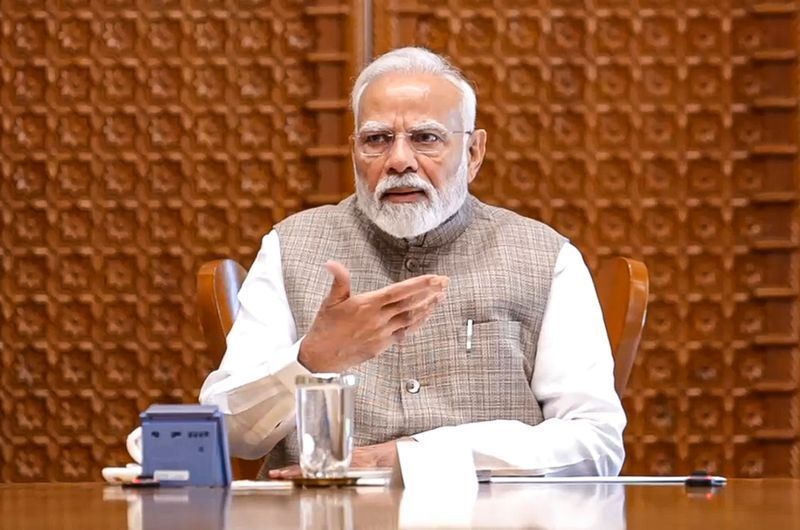
Speaking at the Patidar Sardardham in Vadodara on May 11, 2026 for the second consecutive day, Prime Minister Narendra Modi urged citizens to revert to “Covid-era habits” — work from home, online classes, car-pool, metro use, no foreign travel, no fresh gold purchase, and a switch to natural farming. Framing the West Asia conflict as “the biggest crisis of this decade,” the PM presented a 12-point austerity charter aimed at reducing India’s gold import bill (which has doubled in two years to $72 billion) and curbing foreign travel outflows under the Liberalised Remittance Scheme (which hit $15 billion in April–February FY26).
Constitutionally, the appeal sits at an unusual intersection. The Centre cannot legally compel citizens to forgo gold or travel; instead, it invokes the moral force of Article 51A — Fundamental Duties (especially 51A(g) protecting the environment and 51A(h) developing scientific temper) read with Article 47 (DPSP), which obligates the State to raise the standard of nutrition and public health. The strategy combines voluntary citizen action with statutory levers: a 20% TCS (Tax Collected at Source) on LRS remittances above Rs 7 lakh from October 2023, and the Gold Monetisation Scheme 2015 which incentivises mobilising idle household gold (estimated 25,000 tonnes).
Constitutional / Legal Framework
The legal scaffold is layered. FEMA 1999 empowers RBI to set LRS limits via Master Direction (latest 2024); Article 47 of the Constitution directs the State to prohibit consumption of intoxicating drinks and improve nutrition; Article 51A(g) & (h) impose fundamental duties of environmental protection and scientific temper — both inserted by the 42nd Constitutional Amendment 1976 on the Swaran Singh Committee recommendation. Initially 10 duties were added; an 11th (parental duty to provide education to children 6-14) came via the 86th Amendment 2002, mirroring Article 21A. Article 51A duties are non-justiciable — i.e., not enforceable by courts, unlike Fundamental Rights — but the Supreme Court in AIIMS Students Union v AIIMS (2002) held they are “equally important”.
Why This Matters for CLAT 2027
CLAT polity papers almost annually carry a question on Fundamental Duties — the 42nd Amendment (Swaran Singh Committee), the count (11 now), and their non-justiciability. Aspirants must distinguish Part IV (DPSP, Articles 36-51) from Part IVA (Fundamental Duties, Article 51A). The 42nd Amendment is the most-tested constitutional amendment in CLAT history — it added the words “Socialist Secular” to the Preamble, transferred Education to the Concurrent List, and birthed Part IVA. Legal reasoning may pair this with the Minerva Mills v Union of India (1980) verdict which struck down clauses 4 & 5 of Section 55 of the 42nd Amendment.
Key Facts at a Glance
| Aspect | Detail |
|---|---|
| PM speech venue | Patidar Sardardham, Vadodara |
| Date of speech | May 11, 2026 (Day 2) |
| Gold import bill (2026) | $72 bn (doubled in 2 yrs) |
| LRS outflow (Apr-Feb FY26) | $15 billion |
| Fundamental Duties added by | 42nd Amendment 1976 |
| Swaran Singh Committee | Recommended Part IVA |
| 11th Fundamental Duty | Added by 86th Amendment 2002 |
| Gold Monetisation Scheme | 2015 – 2.25-2.50% interest |
Mnemonic
WFH-LRS-GMS = Work From Home + LRS curb + Gold Monetisation. Fundamental Duties = 42nd (10) + 86th (1) = 11 duties, all non-justiciable.
Test Yourself — 10-Question Quiz
Practice Quiz — 10 CLAT-Style Questions
Click an option to reveal the answer and explanation.