CURRENT AFFAIRS | 22 JUNE 2026
Five 5,000-year-old skeletons from Rakhigarhi — the largest Harappan site — are being put through DNA tests and facial reconstruction to reveal what the people of the Indus Valley actually looked like.
What Happened
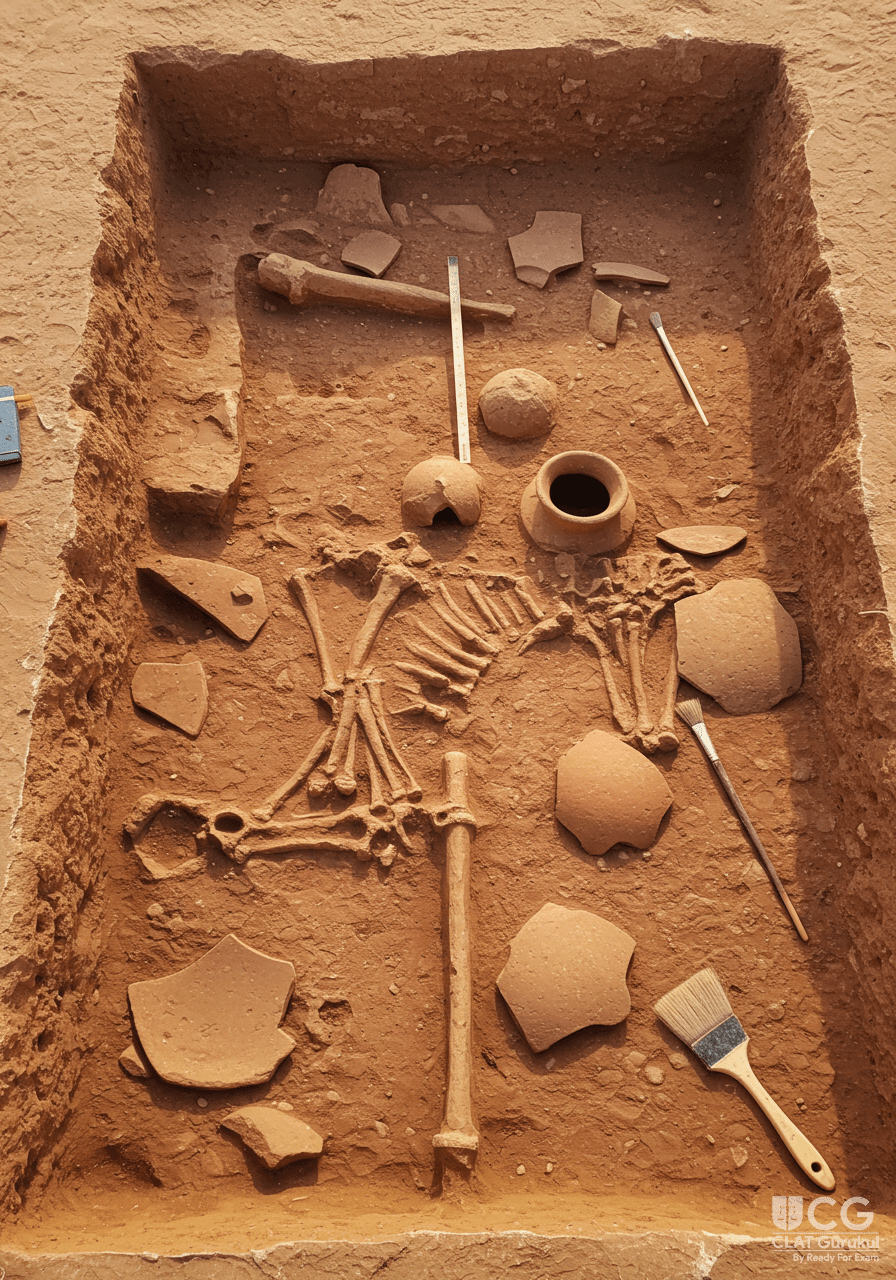
The Archaeological Survey of India (ASI) has sent nearly 5,000-year-old skeletons unearthed at Rakhigarhi, in Haryana’s Hisar district, for scientific examination and facial reconstruction. Rakhigarhi is the largest known site of the Harappan (Indus Valley) Civilisation. Of the five skeletons recovered in the latest excavation and analysed by the Anthropological Survey of India in Kolkata, three are female and two male, aged about 30-40 years; DNA from one was forwarded to the Birbal Sahni Institute of Palaeosciences (BSIP), Lucknow.
The aim is to reconstruct ancestry, height, diet and the palaeo-environment of the Harappan population. An earlier 2019 Rakhigarhi ancient-DNA study found no Steppe pastoralist ancestry — fuelling debate over the Aryan-migration narrative — and linked the genome to Iranian-related and Ancient Ancestral South Indian/Andamanese hunter-gatherer ancestry. The mature Harappan phase ran roughly 2600-1900 BCE, with other major sites at Harappa, Mohenjo-daro, Dholavira, Lothal, Kalibangan and Banawali.
🏛️ Heritage Framework
The ASI, under the Ministry of Culture, protects sites via the AMASR Act, 1958. Archaeogenetics reads ancient DNA to trace ancestry. The Indus Valley/Harappan Civilisation (mature phase ~2600-1900 BCE) is famed for grid town-planning, the Great Bath, advanced drainage and an undeciphered Indus script.
🎯 Why This Matters for CLAT
The Indus Valley Civilisation is core CLAT history/GK — sites, dates, town-planning features and the Rakhigarhi DNA debate are exactly the static-plus-current crossovers examiners favour.
📌 Key Facts
| Site | Rakhigarhi, Hisar, Haryana |
| Significance | Largest Harappan site |
| Skeletons | 5 — three female, two male, ~30-40 yrs |
| DNA lab | Birbal Sahni Institute, Lucknow |
| Agency | ASI (Ministry of Culture) |
| Mature phase | ~2600-1900 BCE |
🧠 Memory Hook
“Rakhigarhi = Largest, Latest, Lucknow.” The largest Harappan site, its latest skeletons going to Lucknow’s Birbal Sahni Institute for DNA.
📝 Test yourself — take the 10-question quiz below:
Practice Quiz — 10 CLAT-Style Questions
Click an option to reveal the answer and explanation.