CURRENT AFFAIRS | 23 SEPTEMBER 2026
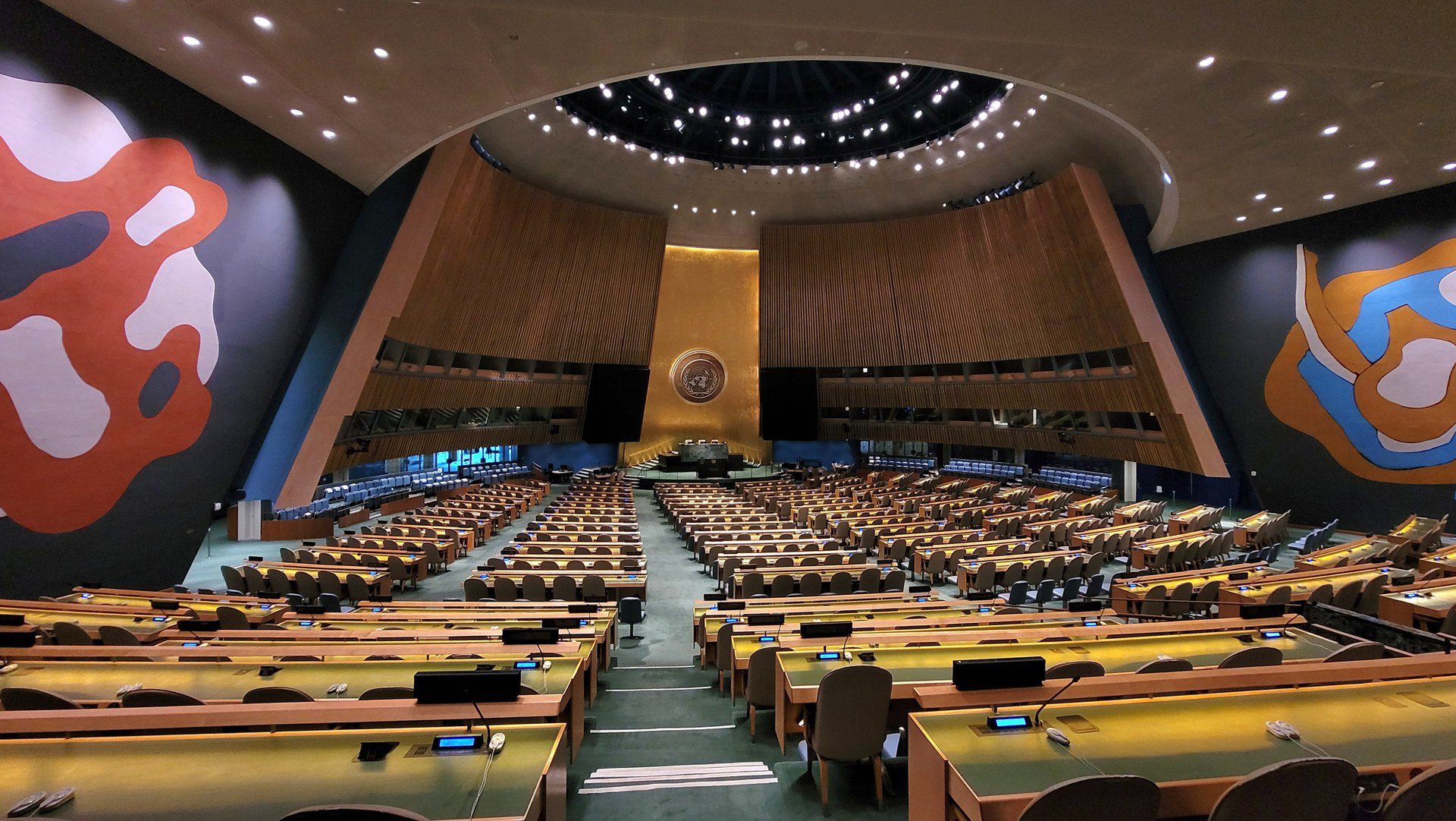
On Wednesday, 23 September 2026, in the margins of the general debate of its eighty-first session, the United Nations General Assembly convened a one-day high-level segment to commemorate the fortieth anniversary of the Declaration on the Right to Development. According to the concept note issued by the Office of the President of the General Assembly, the segment ran from 10 a.m. to 1 p.m. and 3 p.m. to 6 p.m. in Conference Room 4 at United Nations Headquarters, New York. It was mandated by two General Assembly resolutions — A/RES/79/170 of 17 December 2024 and A/RES/80/207 of 18 December 2025.
The Declaration being commemorated was adopted in resolution 41/128 of 4 December 1986. Forty years on it remains one of the most argued-over texts in the United Nations human rights canon: praised in the global South as the instrument that placed development inside the human rights framework, resisted in parts of the global North as a political claim dressed in the language of rights. For a CLAT aspirant that contest is the point. The anniversary is a date to remember; the quarrel underneath it — what a General Assembly declaration is worth in international law, and whether a right to development can ever be enforced — is what an examiner builds a passage from.
What the Assembly convened, and how
The concept note sets out the structure precisely. The opening segment, 10.00 a.m. to 10.50 a.m., carried statements by the President of the General Assembly, the Secretary-General, the High Commissioner for Human Rights and civil society representatives. The plenary segment that followed was given over to statements by Member States and observers. Time limits were three minutes in a national capacity, five minutes on behalf of a group of States, enforced by automatic microphone cut-off; the speakers’ list closed on 16 September 2026.
The note also frames what States were asked to address: how the right has shaped responses to development challenges over forty years; how it should guide emerging areas such as digital transformation, artificial intelligence and just transitions; and how discussions on a draft international covenant on the right to development can build common ground. That last item is the live one, because a covenant would convert a declaration into a treaty.
Constitutional / Legal Framework
The Declaration has ten articles. Article 1(1) proclaims that the right to development is an inalienable human right by virtue of which every human person and all peoples are entitled to participate in, contribute to and enjoy economic, social, cultural and political development in which all human rights and fundamental freedoms can be fully realised. Article 1(2) ties the right to self-determination and to sovereignty over natural wealth and resources. Article 2 identifies the human person as the central subject of development and gives States both the right and the duty to formulate appropriate national development policies. Article 3 places the primary responsibility for creating national and international conditions favourable to the right on States. Article 4 imposes a duty to take steps, individually and collectively, to formulate international development policies. Article 8 requires national measures ensuring equality of opportunity in access to basic resources, education, health services, food, housing, employment and the fair distribution of income. The roots run back to Articles 55 and 56 of the UN Charter, to the campaign for a New International Economic Order, to the Senegalese jurist Kéba M’Baye, who first argued for a right to development in 1972, and to Article 22 of the 1981 African Charter on Human and Peoples’ Rights (the Banjul Charter), where the right first received binding recognition.
A declaration, not a treaty
This is the distinction that decides most questions on the topic. A General Assembly declaration is a resolution, and under the Charter the Assembly’s resolutions on such matters are recommendatory. The United Nations Audiovisual Library of International Law puts it without hedging: the Declaration “does not represent a legally binding instrument”. It creates no treaty obligation, no reporting duty and no complaints mechanism. A treaty such as the International Covenant on Civil and Political Rights or the International Covenant on Economic, Social and Cultural Rights, both adopted in 1966, binds the States that ratify it; a declaration persuades.
That does not make it legally empty. Declarations evidence what States accept as normative, and they feed into customary international law and treaty interpretation. The Declaration’s language reappears in Principle 3 of the Rio Declaration on Environment and Development (1992), in the United Nations Millennium Declaration (resolution 55/2 of 8 September 2000), in the 2030 Agenda and the Sustainable Development Goals (resolution 70/1 of 25 September 2015), and in regional texts including the Arab Charter on Human Rights.
Most importantly for revision, the Vienna Declaration and Programme of Action, 1993, adopted at the World Conference on Human Rights, reaffirmed the right to development “as a universal and inalienable right and an integral part of fundamental human rights”, repeated that the human person is the central subject of development, and added the sentence that answers the most common objection: the lack of development may not be invoked to justify the abridgement of internationally recognised human rights.
The CLAT Angle
Expect this as a legal-reasoning passage on sources of international law. A typical setter states the rule — treaties bind parties; General Assembly declarations are recommendatory but may evidence emerging custom — and then tests application. Variants to rehearse: a State that voted against a declaration is still not bound by it as treaty law (the correct answer is not “bound because 146 States voted yes”); a declaration repeatedly reaffirmed in later consensus instruments has stronger normative weight but still no enforcement machinery; a right recognised in a binding regional charter is enforceable within that regional system. In GK, memorise the pairing 1986 / 41/128 / 4 December and the vote 146–1–8. And watch the trap that the right to development is a “fundamental right” in India — it is not; it enters Indian law only through judicial reading of Article 21 and through the Directive Principles.
The vote, and why it still matters
The Declaration was adopted by a recorded vote of 146 in favour, 1 against and 8 abstentions. The single negative vote was the United States of America. The abstaining States were Denmark, Finland, the Federal Republic of Germany, Iceland, Israel, Japan, Sweden and the United Kingdom. That line-up maps the fault line that has shaped every negotiation since. Developing States read the right as imposing duties of international cooperation — on financing, technology transfer and debt. Several developed States read it as an attempt to convert aid and trade preferences into legal entitlements, and insist the right is exercised at home, against one’s own government.
The follow-up machinery reflects that stalemate. An open-ended Working Group on the Right to Development was established by Commission on Human Rights resolution 1998/72 and ECOSOC decision 1998/269, and now reports to the Human Rights Council. A dedicated Special Rapporteur on the right to development was created much later, by Human Rights Council resolution 33/14 of 29 September 2016; the first mandate-holder took up the role in 2017. Forty years on there is a working group, a special procedure and a draft covenant under discussion — but no binding instrument.
Key Facts
- High-level segment held 23 September 2026, UNGA 81st session, Conference Room 4, UN Headquarters, New York.
- Timings: 10 a.m.–1 p.m. and 3 p.m.–6 p.m.; opening segment 10.00–10.50 a.m.
- Mandated by A/RES/79/170 (17 December 2024) and A/RES/80/207 (18 December 2025).
- Declaration on the Right to Development adopted by GA resolution 41/128, 4 December 1986.
- Recorded vote: 146–1–8; against — United States; abstentions — Denmark, Finland, FRG, Iceland, Israel, Japan, Sweden, United Kingdom.
- The Declaration contains 10 articles; Article 1(1) calls the right “inalienable”; Article 2 makes the human person the central subject of development.
- It is not legally binding — a General Assembly declaration, not a treaty.
- First proposed as a right by Kéba M’Baye (1972); first binding recognition in Article 22, African Charter on Human and Peoples’ Rights, 1981.
- Reaffirmed by the Vienna Declaration and Programme of Action, 1993, as universal and inalienable.
- Working Group on the Right to Development created by CHR resolution 1998/72; Special Rapporteur mandate created by HRC resolution 33/14 (2016).
The Indian mirror: Article 21 and the Directive Principles
India has no enumerated fundamental right to development, yet Indian constitutional law has arrived at a recognisably similar place by a different route. In Francis Coralie Mullin v. Administrator, Union Territory of Delhi (1981), the Supreme Court held that the right to life under Article 21 is not confined to mere physical existence but includes the right to live with human dignity. In Olga Tellis v. Bombay Municipal Corporation (1985), a Constitution Bench held that the right to livelihood is an integral part of the right to life, and that no person may be deprived of it except by a fair and reasonable procedure — a case brought by pavement and slum dwellers facing eviction.
Alongside sit the Directive Principles of State Policy in Part IV. Article 38 directs the State to secure a social order for the promotion of the welfare of the people and to minimise inequalities in income, status, facilities and opportunities. Article 39 requires policy to be directed towards adequate means of livelihood, the distribution of the material resources of the community to subserve the common good, and the prevention of concentration of wealth. By Article 37 these principles are not enforceable by any court but are “fundamental in the governance of the country”. The parallel with the Declaration is exact: a non-justiciable statement of developmental obligation that nonetheless shapes law and policy, and which courts have progressively read into an enforceable right.
The unresolved argument
Critics make three points. The right has no identifiable duty-bearer when the duty is owed by “the international community”; its content is too diffuse to adjudicate, since no court can order development; and treating development as a right risks diluting the precision of civil and political rights. Defenders answer that the Declaration’s obligations are mostly national: participation, non-discrimination, accountability and fair distribution are all things a State can be held to at home. Economic and social rights, they note, were once called non-justiciable too, and are now routinely enforced — in India, through Article 21. Which reading prevails is exactly what the draft covenant would settle, and exactly why it has not been settled.
Memory Hook / Mnemonic
For the birth certificate: “41-128, eighty-six, December four” — resolution, year, date. For the vote, “146 yes, 1 no, 8 shrugs”, and the lone “no” is the US. For the content, “PIPES” — Person at the centre, Inalienable, Participation, Equality of opportunity, Self-determination. And for the status, one line: “A declaration declares; a covenant compels.”
Practice Quiz — 10 CLAT-Style Questions
Click an option to reveal the answer and explanation.