
The US Declaration of Independence at 250: Natural Rights, Social Contract, and the Living Legacy of 1776
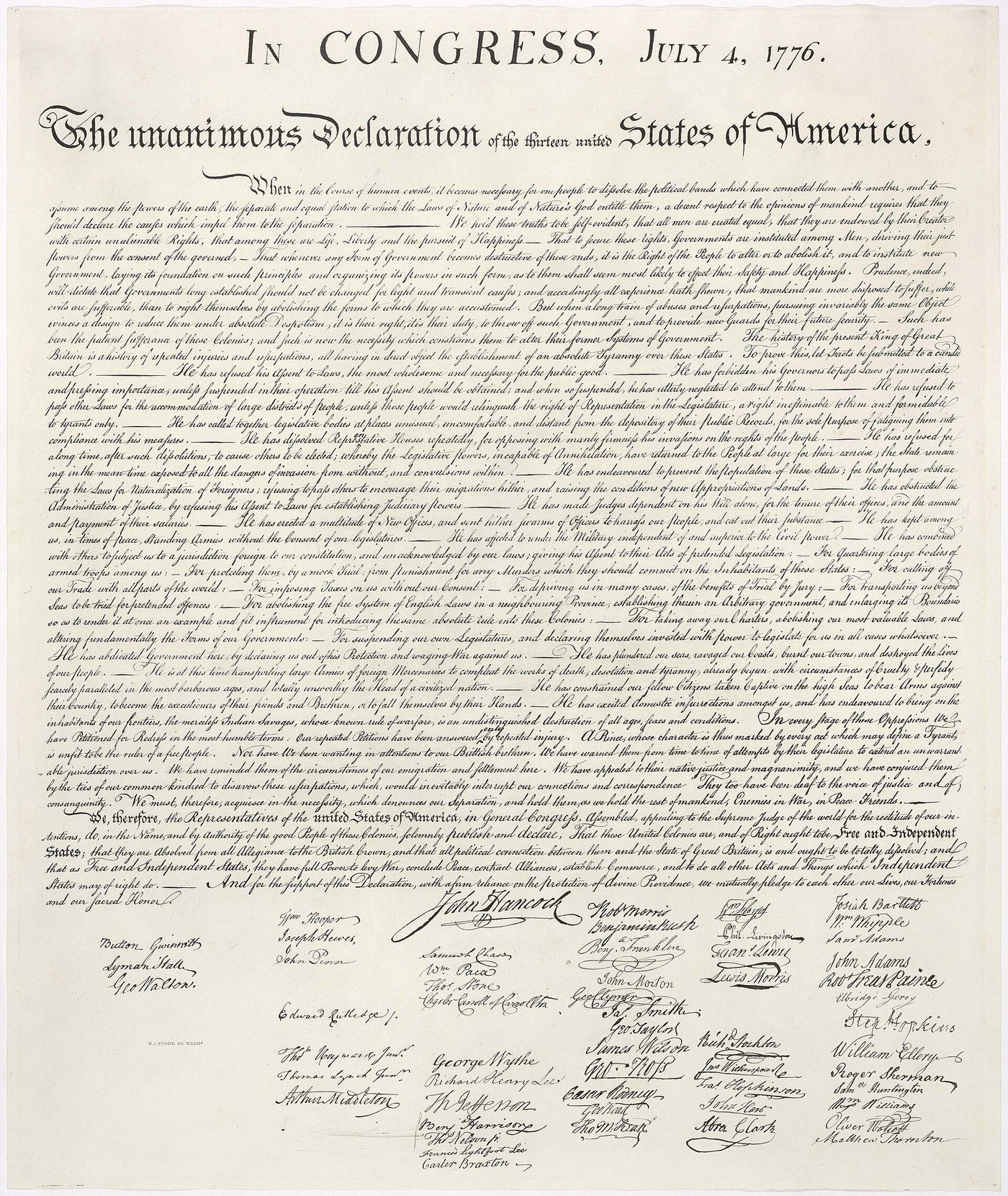
On July 4, 1776, the Second Continental Congress adopted the Declaration of Independence, proclaiming thirteen British colonies in North America to be free and sovereign states. As the world approaches the document’s 250th anniversary in 2026, it is worth pausing to ask a question that goes beyond American national mythology: what did this declaration actually argue, philosophically and legally, and why does it continue to reverberate in constitutional systems — including India’s — nearly two and a half centuries later? For CLAT aspirants, this is not a question of admiring a foreign document; it is an exercise in tracing the intellectual genealogy of the ideas that animate the very Preamble and Fundamental Rights of the Indian Constitution.
The Declaration’s most quoted passage declares that “all men are created equal” and are “endowed by their Creator with certain unalienable Rights” — among them “Life, Liberty and the pursuit of Happiness.” These eleven words carry the full weight of Enlightenment political philosophy, distilled by Thomas Jefferson into a political manifesto. Jefferson drew consciously from John Locke, Jean-Jacques Rousseau, and the broader tradition of natural-rights theory — a tradition that would, two centuries later, find expression in India’s own founding document. Understanding this lineage is essential for any student of constitutional thought.
The Enlightenment Roots: Locke, Rousseau, and Hobbes
The intellectual tradition behind the Declaration begins in seventeenth-century England with Thomas Hobbes. In his 1651 masterwork Leviathan, Hobbes described human life in a pre-political “state of nature” as “solitary, poor, nasty, brutish, and short.” To escape this condition, individuals surrender their natural freedom to an absolute sovereign in exchange for security. Hobbes’s social contract is, in essence, a one-way street: surrender rights, receive protection. His theory justifies strong central authority but offers no mechanism for popular revolt or constitutional limits on government.
John Locke took the same starting point — the state of nature — but drew radically different conclusions. Writing in his Two Treatises of Government (1689), Locke argued that even in a state of nature, individuals possess natural rights: life, liberty, and property. Government is not formed out of fear but as a rational compact among free individuals for the better protection of rights that already exist. Crucially, Locke insisted on government by consent: if a government violates the natural rights of its citizens, the people retain the right to withdraw their consent and, if necessary, to revolt. This idea — so threatening to monarchs — was lifted almost verbatim by Thomas Jefferson. Jefferson only substituted “property” with “the pursuit of Happiness,” a modification that scholars debate to this day, but which broadened the aspirational scope of the rights being claimed.
Jean-Jacques Rousseau, writing in The Social Contract (1762), added a democratic dimension. His formulation — “Man is born free, and everywhere he is in chains” — captured the alienation of ordinary people from power. Rousseau’s concept of the general will held that legitimate political authority derives from the collective will of the people, not from any hereditary or divine sanction. While Rousseau’s specific arguments were more radical than Locke’s and less directly absorbed into the American founding, they deeply influenced the French Revolution (1789) and, through it, the broader global discourse about popular sovereignty that echoes in the Indian Constitution’s “We, the People of India.”
The Declaration vs. a Constitution: A Crucial Distinction
CLAT aspirants must master a distinction that even educated citizens sometimes blur: the difference between a declaration and a constitution. The Declaration of Independence (1776) is a political manifesto. It states the philosophical grounds on which the colonies justified their separation from Britain. It announces values — equality, unalienable rights, consent of the governed — but it does not establish governmental institutions, distribute powers, or enumerate specific rights with legal enforceability.
A constitution does all of that. The United States Constitution, drafted in Philadelphia in 1787 and ratified by 1788, created the three branches of the federal government (legislative, executive, judicial), established the supremacy of federal law, and designed the separation of powers with checks and balances. Crucially, it said almost nothing about individual rights in its original text — a silence that triggered enormous controversy. The solution was the Bill of Rights — the first ten amendments to the US Constitution, ratified in 1791 — which enumerated specific protections including freedom of speech, religion, assembly, the right to a fair trial, and protection against unreasonable searches. The concept of due process of law (Fifth and Fourteenth Amendments) became perhaps the single most exported idea from the American constitutional experience.
Natural Rights Theory in Indian Constitutional Thought
The Indian Constitution, adopted on November 26, 1949 and brought into force on January 26, 1950, was not drafted in a vacuum. Dr. B.R. Ambedkar and the other architects of India’s founding document were steeped in comparative constitutional law. The American Bill of Rights, the Irish Constitution, the Canadian British North America Act, the Government of India Act 1935 — all contributed threads to the Indian constitutional tapestry.
The most direct parallel is the Preamble to the Indian Constitution. Its opening words — “We, the People of India” — consciously echo the American Constitution’s preamble. The Preamble’s declaration of India as a “Sovereign Democratic Republic” secures “to all its citizens — Justice, Liberty, Equality, and Fraternity” — a formulation that maps almost perfectly onto the Lockean and Jeffersonian vocabulary. “Liberty” corresponds to Locke’s natural right; “Equality” echoes “all men are created equal”; and “Fraternity” — added by Ambedkar from French Revolutionary thought — signals the communitarian dimension that purely individualistic natural-rights theory sometimes lacks.
Part III of the Indian Constitution — the Fundamental Rights (Articles 12–35) — is the operational expression of natural-rights theory in Indian law. Article 21, which protects the right to life and personal liberty, is the closest Indian analogue to the American “due process” clauses. The Supreme Court of India has progressively expanded Article 21 far beyond its original text to include rights to privacy, dignity, livelihood, education, health, and a clean environment — demonstrating how a constitutional provision rooted in natural-rights philosophy can grow organically through judicial interpretation.
Universalism vs. Historical Contradiction
The Declaration of Independence’s claim to universalism — “all men are created equal” — sat in profound tension with the historical reality that slavery was legal and widespread in the colonies that signed it. Jefferson himself enslaved over six hundred people during his lifetime. Commentators including P.B. Mehta and C. Raja Mohan, writing in Indian publications, have reflected on this tension: the Declaration articulates a universalism that its authors did not fully live. Yet this is also part of what makes it philosophically significant. The argument for natural rights, once articulated publicly, could not be indefinitely contained to the group its drafters had in mind. Abolitionists used the Declaration’s own logic against slavery; suffragists used it against the exclusion of women; civil rights leaders used it against racial segregation. Ideas, once released, escape their authors’ intentions.
This dynamic is not unique to America. The Indian Constitution’s guarantee of equality (Articles 14–16) has similarly been weaponised — in the best sense — by generations of citizens seeking to hold the state to its own promises. Constitutional law is, in part, the story of how foundational documents are made to mean more than their drafters bargained for.
Static GK Anchors for CLAT
Several dates and facts in this area are reliably tested in CLAT’s static General Knowledge section:
- 1776 — Declaration of Independence adopted, July 4, by the Second Continental Congress.
- Thomas Jefferson — principal drafter of the Declaration; third President of the United States.
- 1787 — US Constitution drafted at the Philadelphia Convention (Constitutional Convention).
- 1791 — Bill of Rights (first ten amendments) ratified.
- John Locke — natural rights: life, liberty, property; Two Treatises of Government (1689); government by consent.
- Rousseau — general will; The Social Contract (1762); “Man is born free.”
- Hobbes — state of nature; Leviathan (1651); absolute sovereign.
Why This Matters for CLAT
- Preamble comparison: CLAT Legal Reasoning questions frequently require identifying parallels between the Indian Preamble (“Liberty, Equality, Fraternity”) and its philosophical antecedents in Lockean and Enlightenment thought.
- Locke vs. Hobbes vs. Rousseau: The distinctions — especially on state of nature, social contract, and the right to revolt — are a reliable source of inference-based questions in the GK and legal sections.
- Declaration vs. Constitution: Questions testing the difference between a political manifesto and a legal instrument appear in Legal Reasoning; the 1776/1787/1791 sequence is a key static fact.
- Article 21 and due process: The American “due process” clause’s influence on India’s Article 21 is a tested connection in Legal Reasoning, especially in passage-based questions about rights jurisprudence.
- Universalism and constitutional guarantees: The gap between the ideals stated in founding documents and their practical realisation — and the role of courts in closing that gap — is a theme that appears in reading comprehension and legal reasoning passages.
Conclusion
The United States Declaration of Independence, approaching its 250th anniversary, is more than an American document. It is a landmark in the global history of political thought — the moment when the abstract philosophy of Locke, Rousseau, and the Enlightenment was translated into a public political act. Its claim that governments derive “their just powers from the consent of the governed” and that whenever any government becomes destructive of natural rights “it is the Right of the People to alter or to abolish it” echoes through every democratic constitution that followed — including India’s. For CLAT aspirants, the real lesson is not that America got everything right in 1776; it manifestly did not. The lesson is that ideas about rights, once articulated with clarity and moral force, develop a power of their own — shaping constitutions, driving judicial interpretation, and holding states accountable to the promises written in their founding documents. That is as true of the Indian Constitution’s Article 21 today as it was of Jefferson’s declaration two and a half centuries ago.
Test Yourself — Daily Quiz
Practice Quiz — 10 CLAT-Style Questions
Click an option to reveal the answer and explanation.