CURRENT AFFAIRS | 10 JUNE 2026
10 June 2026 — Wednesday’s newsroom for CLAT 2027 aspirants. Below is one of ten passage-led current-affairs explainers built on India’s constitutional, statutory and policy framework.
Constitutional & Statutory Framework
- Strait of Hormuz — the world’s most critical oil chokepoint; ~20% of global oil and much LNG transits here.
- UNCLOS, 1982 — the UN Convention on the Law of the Sea; codifies the right of transit passage through international straits.
- Transit passage — vessels and aircraft enjoy continuous and expeditious passage through straits used for international navigation.
- India’s “Link West” / “Look West” policy — deepening ties with the Gulf and West Asia.
- Strategic autonomy / non-alignment — India’s posture of independent, interest-led diplomacy.
- Gulf Cooperation Council (GCC) — Saudi Arabia, UAE, Kuwait, Qatar, Bahrain, Oman.
- Article 51 (DPSP) — promotion of international peace and security and respect for international law.
More than 100 days into the West Asia conflict, US President Trump claimed that Iran had shot down a US Apache helicopter patrolling the Strait of Hormuz and warned that Washington “must react” — even as PM Narendra Modi telephoned the Amir of Kuwait, Sheikh Meshal Al-Ahmad Al-Jaber Al Sabah, on Tuesday to reiterate India’s now-familiar plea for de-escalation, dialogue and diplomacy. For India, the crisis is not an abstract great-power quarrel: a near-closure of the Strait of Hormuz strikes directly at its energy security, its trade arteries and the safety of a nine-million-strong diaspora in the Gulf.
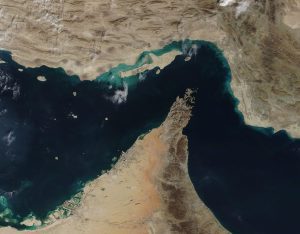
The Strait of Hormuz is the single most important oil chokepoint on the planet. A narrow waterway connecting the Persian Gulf to the Gulf of Oman and onward to the Arabian Sea, it carries roughly a fifth of the world’s seaborne oil and a large share of global LNG. When passage through it is throttled — as it has been by the near-closure and a naval blockade of Iranian vessels — the shock radiates outward as higher oil and fertiliser prices and as congestion at India’s western-seaboard ports such as JNPT, Kandla and Mundra.
India’s exposure is acute. It imports the bulk of its crude, much of it through Hormuz, and the Gulf hosts both its largest expatriate community and major energy and remittance interests. Earlier in the conflict at least seven Indians were among the casualties, and India had condemned an attack on Kuwait airport that left more than sixty injured. The Modi-Amir call is part of a sustained “Look West” diplomacy in which India positions itself as a friend to all parties and a votary of restraint.
The legal frame is the UN Convention on the Law of the Sea (UNCLOS), 1982. The Strait of Hormuz is a strait used for international navigation, and under UNCLOS Article 38 vessels and aircraft of all nations enjoy the right of transit passage — continuous and expeditious transit that a coastal State may not suspend. A blockade or closure of the strait therefore raises serious questions under the law of the sea, even though Iran (a signatory but not a ratifying party in the conventional sense) has historically disputed the automatic application of transit-passage rules to its waters.
For CLAT purposes the story braids together three threads: the geography of chokepoints, the UNCLOS regime of transit passage versus innocent passage, and India’s doctrine of strategic autonomy. India’s response — neither aligning with Washington nor endorsing Tehran, but pressing for an “earliest restoration of peace and stability” — is a live illustration of how a rising power calibrates principle (Article 51’s mandate to promote international peace) against hard interest (energy and diaspora security) in a multipolar world.
Key Facts at a Glance
| Field | Detail |
|---|---|
| Chokepoint | Strait of Hormuz — Persian Gulf to Gulf of Oman / Arabian Sea |
| Global significance | ~20% of world oil + much LNG transits; most critical oil chokepoint |
| India impact | Higher oil & fertiliser prices; port congestion at JNPT, Kandla, Mundra |
| Diaspora & interests | ~9 million Indians in the Gulf; energy + remittance stakes |
| Diplomacy | PM Modi spoke to Amir of Kuwait Sheikh Meshal Al-Ahmad Al-Jaber Al Sabah |
| Legal regime | UNCLOS 1982 — right of transit passage through international straits (Art. 38) |
| India’s posture | Strategic autonomy; “Look/Link West”; de-escalation & dialogue |
CLAT 2027 Angle
Strait of Hormuz as the world’s most critical oil chokepoint; UNCLOS 1982 and the right of transit passage (vs innocent passage); India’s energy security and Gulf diaspora; ‘Look/Link West’ policy and strategic autonomy; Article 51 (DPSP). Expect GK MCQs on Hormuz geography and the ~20% figure, and IR questions on UNCLOS transit passage and India’s de-escalation diplomacy.
Mnemonic — Memory Aid
“20% through Hormuz” — fix the headline number: roughly one-fifth of the world’s oil passes the Strait of Hormuz, linking the Persian Gulf → Gulf of Oman → Arabian Sea (chant “P-G-A”). For the law: “UNCLOS = Transit, not just Innocent” — international straits get transit passage (cannot be suspended), broader than the innocent passage of the territorial sea. For India: “Oil + Diaspora + Autonomy” — the three reasons Hormuz is a CLAT-favourite India-IR hook.
Test Yourself — 10-Question Quiz
Take the interactive quiz below to reinforce these concepts:
Practice Quiz — 10 CLAT-Style Questions
Click an option to reveal the answer and explanation.