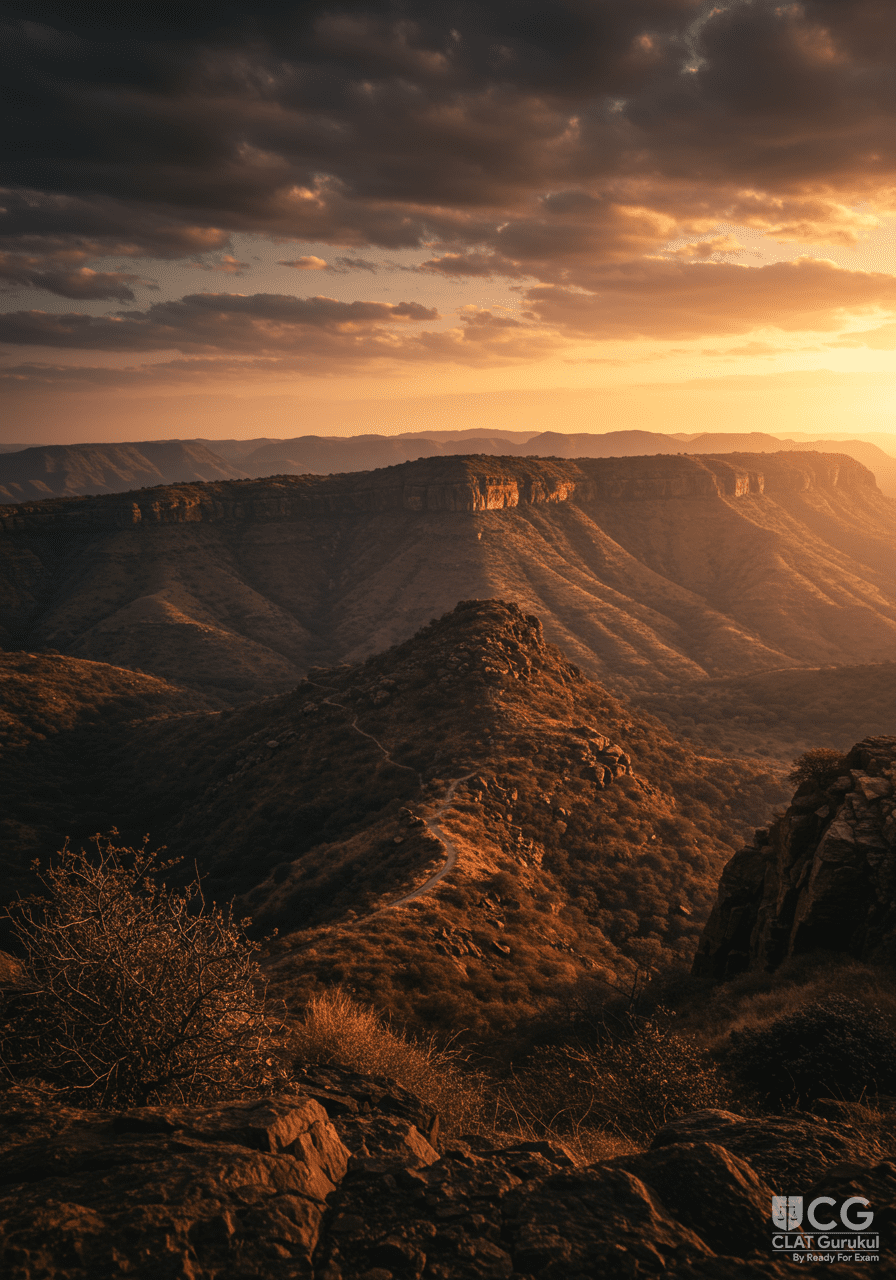
The Bhondsi cluster in the Aravalli stretch of Gurugram — surfaced four months ago when wildlife photographers chasing a leopard call stumbled upon cupules, geometric grids and a foot-shaped engraving — now stretches the Indian rock-art chronology from the Lower Palaeolithic through the Mesolithic in a single landscape, triggering the statutory protective machinery of the AMASR Act 1958, Art. 49, and the 1992 Aravalli Notification under the Environment Protection Act 1986.
The ASI Chandigarh Circle and Haryana Archaeology Department have submitted a documentation report; Superintending Archaeologist Kamei Athoilu Kabui has flagged ‘land mafia’ threats. The site combines petroglyphs (rock-engraved images/designs), what may be ancient stone game-boards, cup-shaped depressions (cupules), and stone tools — handaxes and cleavers from the Lower Palaeolithic, tools from the Middle Palaeolithic (300,000-50,000 years ago), and cupules/rock-art consistent with Mesolithic ritual phases. Akash Gupta (Delhi University’s Satyawati College) calls this ‘chronological continuity’ rare in Indian prehistoric archaeology — linking tool-making traditions with later ritual + symbolic life across the same landscape. The discovery began with photographs by Yatin Verma + Ramkumar Verma in February 2026, examined by PhD researcher Shalaish Baisla (Dr B R Ambedkar University Delhi).
📜 Constitutional / Statutory Anchor
AMASR Act 1958 — the Ancient Monuments and Archaeological Sites and Remains Act vests ASI with protective jurisdiction over centrally protected monuments; §4 declares national importance, §20A creates a 100m prohibited area + 200m regulated area around protected monuments (post 2010 Amendment). Art. 49 — places a State obligation to protect monuments + places + objects of artistic / historic interest declared by Parliament to be of national importance. Art. 51A(f) — Fundamental Duty of every citizen to value + preserve the rich heritage of our composite culture. Aravalli Notification 1992 — issued under the EPA 1986, prohibits non-forest activities (mining, construction) across Aravalli stretches of Haryana + Rajasthan. Heritage Conservation Bill 2024 (draft) — proposes to overhaul AMASR by introducing a new framework for living monuments + community-managed sites.
The institutional significance is the chronic enforcement gap. TN Godavarman Thirumulpad v. UoI (1996) 9 SCC 712‘s continuing-mandamus on forest conservation, the 2002 + 2018 SC Aravalli orders striking down state regularisation of illegal mining (MC Mehta v. UoI), and the 1992 Aravalli Notification have not stopped land-mafia encroachment. The Bhondsi cluster sits in this exact regulatory paradox — declared a forest under Godavarman, notified under the 1992 EPA Aravalli order, and now also potentially eligible for AMASR §4 declaration as a site of national importance. If the ASI declares it a centrally protected site, §20A’s 100m prohibited + 200m regulated zones kick in, layered on top of forest protection. Whether the Haryana government converts that statutory machinery into actual enforcement is the open question.
🎯 Key Facts at a Glance
- Petroglyphs + cupules + game-boards + handaxes at one Bhondsi site — Lower Palaeolithic to Mesolithic.
- Middle Palaeolithic tools indicate human activity 300,000-50,000 years ago.
- Discovered February 2026 by wildlife photographers Yatin + Ramkumar Verma; ASI Chandigarh + Haryana Archaeology documenting.
- AMASR Act 1958 §20A — 100m prohibited + 200m regulated area around centrally protected monuments.
- Aravalli Notification 1992 under EPA 1986 — prohibits non-forest activity across Aravalli stretches.
- Art. 49 + Art. 51A(f) — state duty + fundamental duty to protect heritage.
Comparable rock-art sites elsewhere are illuminating. Bhimbetka (MP) was declared a UNESCO World Heritage Site in 2003 — a parallel pathway via the 1972 World Heritage Convention + India’s 1977 ratification. Edakkal Caves (Kerala), Sundargarh rock art (Odisha), Lakhajuar (Chhattisgarh), and the Soan Valley assemblage (Punjab, partly in Pakistan) form India’s rock-art atlas. The Bhondsi find’s significance is its proximity to the National Capital Region — a heavily urbanised landscape where land values and infrastructure pressure routinely defeat protective notifications. The 1992 Aravalli Notification’s enforcement, the Forest (Conservation) Act 1980’s afforestation requirement, and the Wildlife (Protection) Act 1972 (Schedule I leopards in the same area) form a layered protective grid.
⚖️ CLAT Angle
Expect a Legal Reasoning passage on the AMASR Act 1958 §20A prohibited / regulated zones, with principle-application questions on whether a construction permit issued before AMASR declaration survives — recall the 2010 Amendment’s grandfathering provisions. TN Godavarman v. UoI (1996) 9 SCC 712 on the working definition of ‘forest’ and MC Mehta v. UoI Aravalli orders are likely anchors. A Current Affairs set may test the 1992 Aravalli Notification’s parent statute (EPA 1986), Art. 49 + Art. 51A(f), and the difference between centrally protected and state-protected sites.
What to watch next: whether the ASI moves a formal §4 AMASR declaration; the Haryana government’s response on the land-mafia threat flagged by Kabui; and whether the Heritage Conservation Bill 2024 advances in the monsoon session of Parliament. A PIL invoking Art. 49 + Art. 51A(f) + the 1992 Aravalli Notification may emerge if encroachment continues.
💡 Why This Matters for CLAT 2027 Aspirants
Heritage + Aravalli + AMASR is a high-probability 2027 CLAT theme. Memorise AMASR §4 + §20A (100m + 200m zones), Art. 49 vs Art. 51A(f), Aravalli Notification 1992 under EPA 1986, TN Godavarman ratio, and the World Heritage Convention 1972 (Bhimbetka 2003).
📝 Test Yourself — 10-Question Quiz
Take the interactive quiz below to reinforce these concepts:
Practice Quiz — 10 CLAT-Style Questions
Click an option to reveal the answer and explanation.