CURRENT AFFAIRS | 9 JUNE 2026
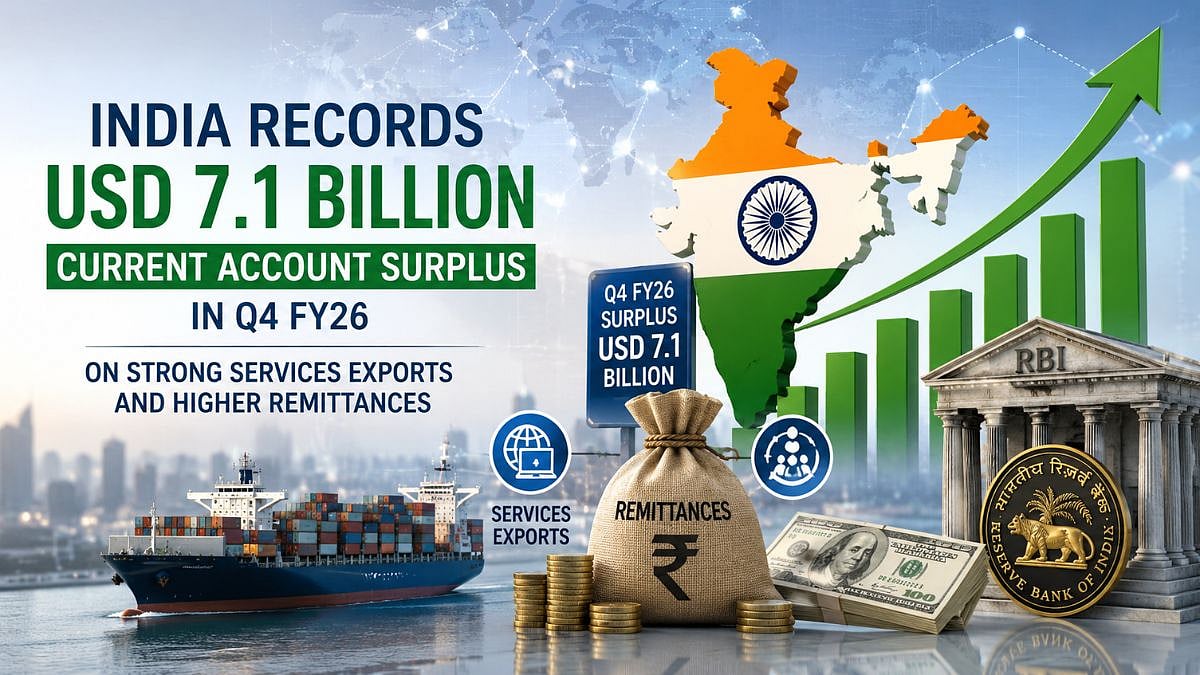
India’s external balance painted a mixed picture this week. The Reserve Bank of India on Monday 8 June 2026 reported that the country’s current account surplus narrowed sharply to $7.1 billion, or just 0.7 per cent of GDP, in the fourth quarter ended March 2026 — a steep fall from the $13.7 billion surplus recorded in the corresponding quarter a year earlier. A surging gold-import bill and sustained foreign-investor outflows together dragged the external account down.
For the full financial year 2025-26, India’s current account deficit widened modestly to $25.2 billion (0.6 per cent of GDP), against $5.9 billion in FY25. The Q4 RBI release came just two working days after the government, on Friday 6 June 2026, slashed long-term and short-term capital gains tax — and the withholding tax — on foreign institutional investor holdings of government bonds, in an explicit push to win Bloomberg Global Aggregate Bond Index inclusion.
Constitutional & Legal Framework
- Article 292 — Union Government’s power to borrow upon the security of the Consolidated Fund of India
- Reserve Bank of India Act 1934 — central-bank powers including BoP compilation
- Foreign Exchange Management Act (FEMA) 1999 — capital + current account transactions
- SEBI (Foreign Portfolio Investors) Regulations 2019 — gateway for FII bond investments
- Income Tax Act — special capital-gains regime for FIIs (just cut on 6 June 2026)
The structural story behind the headline numbers is the gold import bill: it ballooned to $71.97 billion in FY26 from $58 billion the previous year, while the Q4 alone saw $22.57 billion in gold inflows. With households continuing to view gold as an inflation hedge and central banks worldwide stockpiling bullion, India’s import basket has become more rigid even as oil prices softened.
The fall in FII inflows compounded the pressure. Through much of 2025-26, foreign portfolio investors were net sellers of Indian equities as a stronger dollar and elevated US Treasury yields pulled capital back to developed markets. The government’s tax-cut package on 6 June is therefore both a fiscal signal and a market-access manoeuvre: by improving the post-tax yield on Indian sovereign bonds, the Centre hopes to make Indian G-Secs competitive with peer emerging-market sovereigns already in the Bloomberg index.
Why does Bloomberg matter so much? India was added to the JP Morgan Emerging Markets Government Bond Index in mid-2024, drawing roughly $20 billion of passive inflows. The Bloomberg Global Aggregate Bond Index is far larger — analyst estimates put potential inflows from inclusion at $30-50 billion, which would meaningfully cushion the rupee and fund the fiscal deficit at lower cost.
The legal architecture supporting all this is dense. The RBI compiles BoP data under the RBI Act 1934. FII investment is permitted under FEMA 1999 read with the SEBI (FPI) Regulations 2019. Capital-gains treatment flows from the Income-Tax Act, and Union borrowing operates under Article 292 of the Constitution.
For CLAT 2027 aspirants, this story sits at the intersection of constitutional finance (Articles 292-293, the Finance Commission, the FRBM Act 2003) and the regulatory architecture for cross-border capital. Expect questions on the distinction between current and capital accounts, the role of the RBI vs SEBI, and the policy logic behind sovereign-bond index inclusion.
CLAT Angle
Articles 292-293 (Union and State borrowing), the RBI Act 1934, FEMA 1999, and the SEBI (FPI) Regulations 2019 together form the legal scaffolding of India’s external account. Expect CLAT 2027 questions on the Balance of Payments classification (current vs capital), the regulator-by-regulator mapping (RBI for BoP and forex, SEBI for FPI gateways), and the policy economics of sovereign-bond index inclusion, including the FY26 cut in FII withholding tax.
Key Facts
| Q4 FY26 Current Account | +$7.1 bn (0.7% of GDP) |
| Q4 FY25 Current Account | +$13.7 bn (1.4% of GDP) |
| Full-year FY26 CAD | $25.2 bn (0.6% of GDP) |
| FY26 Gold Import Bill | $71.97 bn (vs $58 bn in FY25) |
| FII Tax Cuts | Announced 6 June 2026 |
| Bloomberg Index Potential Inflows | $30-50 bn |
| Constitutional Provision | Article 292 (Union borrowing) |
Mnemonic
BLOOMBERG = Borrowings Liberalised, On Offer Major Bond-index, Economic Re-rating, G-Secs. Sequence to remember CAD drivers: ‘GOLD-FII-OIL’ — Gold imports up, FII outflows, Oil bill (cushioned this year).
Test Your Knowledge
Practice Quiz — 10 CLAT-Style Questions
Click an option to reveal the answer and explanation.