CURRENT AFFAIRS | 24 SEPTEMBER 2026
On 23 September 2026, in a compliance affidavit before the Supreme Court, the Food Safety and Standards Authority of India (FSSAI) proposed abandoning its earlier two-phase plan and moving to a single-phase rollout of front-of-pack nutrition labelling (FoPL). As reported by Business Standard, the regulator has proposed four months to finalise the draft regulations, a mandatory 60-day consultation with domestic stakeholders and through the World Trade Organization platform, and then a 365-day voluntary compliance window before the requirement bites — the long transition being intended to avoid commercial losses on packaging already printed.
The shift is small to state and large in effect. Under the earlier plan a warning would have appeared only where a product was high in two or more nutrients of concern; under the new proposal, a product high in any one of added sugar, added fat or salt carries it. The affidavit answers the Supreme Court’s order of 10 September 2026 in 3S and Our Health Society v. Union of India, reported as 2026 INSC 988 — a Miscellaneous Application in a writ petition filed under Article 32. This is a live proceeding, listed for further hearing; nothing here is settled law.
What the label is meant to look like
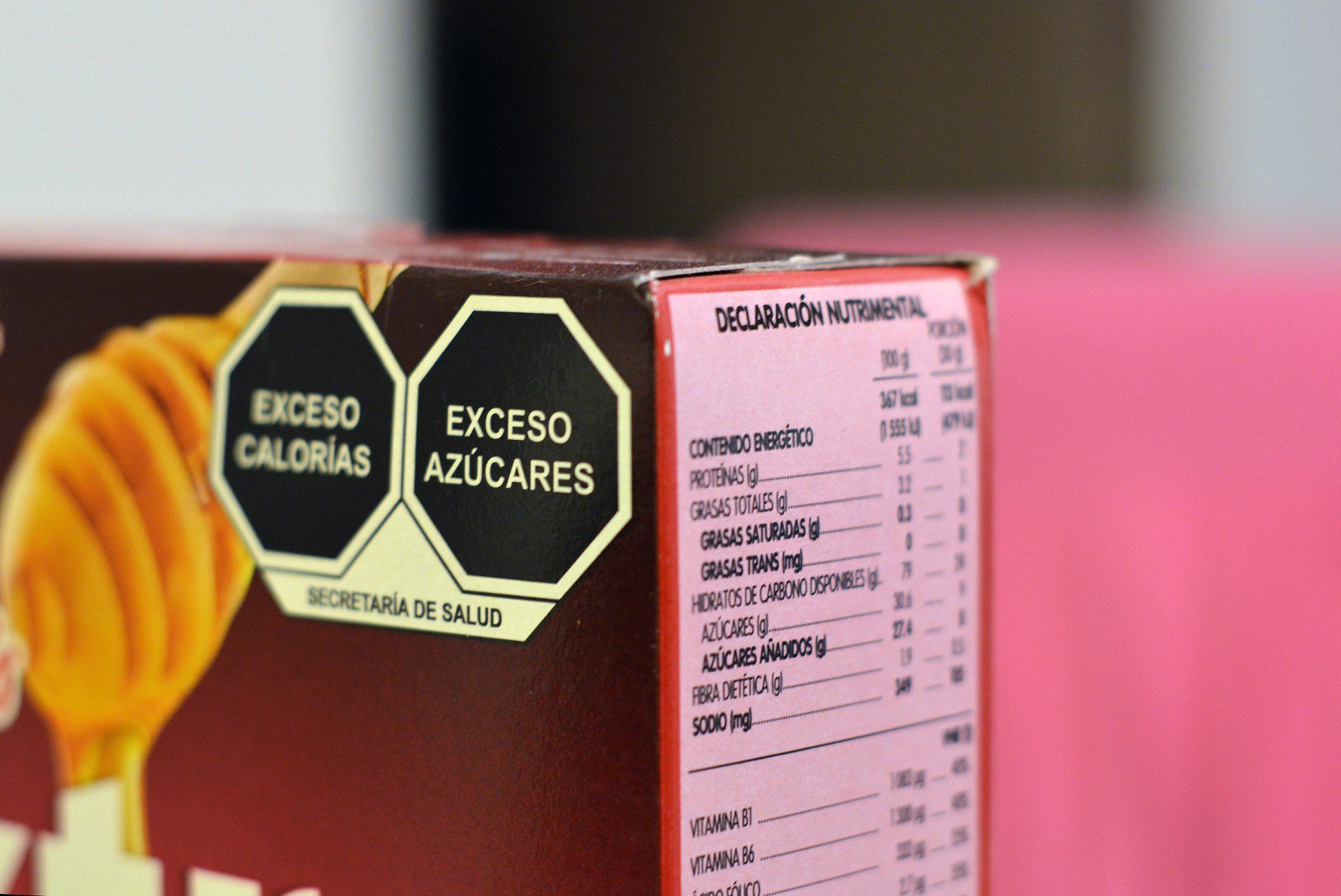
The design comes from FSSAI’s earlier affidavit of 28 August 2026, reproduced in full in the Court’s order. A red hexagonal warning label is to appear on the front of the pack, carrying declarations such as “HIGH FAT”, “HIGH SUGAR”, “HIGH SALT” and/or “HIGHLY SWEETENED BEVERAGE”, printed in a font one point larger than the nutrition information table on the back. Two categories were proposed for exemption: single-ingredient food products, and foods inherently rich in fat, sugar or salt such as ghee, edible oil, salt, sugar, jaggery and honey. Business Standard reports that the latest affidavit places the hexagon on a white square background at the top left of the front panel, adds a “contains non-calorific sweetener” declaration to the front, and draws broadly on the Canadian front-of-pack model.
Thresholds are not being invented for the occasion. FSSAI proposes to take them from the Dietary Guidelines for Indians, 2024, issued by the ICMR-National Institute of Nutrition. Table 15.1 sets, per 100 g of solid food, limits of 250 kcal, 625 mg salt, 3 g added sugar and 4.2 g added fat; per 100 ml of liquid, 70 kcal, 175 mg salt, 2 g added sugar and 1.5 g added fat. Table 15.2 sorts foods by degree of processing into Groups A, B and C and, within each, by calorie band into categories 1, 2 and 3 — categories 2 and 3 being HFSS.
Constitutional / Legal Framework
FSSAI is a statutory body under the Food Safety and Standards Act, 2006. Its standard-setting power flows from Section 16, which charges the Food Authority with regulating and laying down standards for articles of food. Section 23 governs packaging and labelling: no person may sell packaged food not marked and labelled as specified by regulations, and no label may carry any statement, claim, design or device that is false or misleading; sub-section (2) obliges every food business operator to ensure that labelling and presentation do not mislead. Section 92 supplies the rule-making route — the Food Authority may make regulations “with the previous approval of the Central Government and after previous publication, by notification”. “Previous publication” is why a draft must go out for comment before it can be gazetted. The existing regime is the Food Safety and Standards (Labelling and Display) Regulations, 2020; the unfinished reform is the Draft Labelling & Display (Amendment) Regulations, 2022, which proposed an Indian Nutrition Rating (INR) system with compliance voluntary for 48 months after notification. Constitutionally, the Court anchored the case in its order of 13 August 2026 on two provisions: Article 21, whose guarantee of life and personal liberty has been read to include the right to health, casting on the State a duty not merely to refrain from impairing health but to take affirmative steps to protect it; and Article 47, which makes raising the level of nutrition and improving public health among the State’s primary duties.
Why the Court sent the proposal back
On 10 September a Bench of Justice J. B. Pardiwala and Justice K. Vinod Chandran acknowledged FSSAI’s progress but found several “specificities anchoring the practical implementation” still ambiguous, and put thirteen questions to the Union and FSSAI, directing a fresh affidavit within ten days.
The heaviest objection was scientific. The petitioner argued that the “two or more” trigger was in substance a redefinition of HFSS, because excess sugar, excess salt and excess saturated fat are independently harmful and act through different pathways — sugar linked to diabetes and metabolic disease, salt to hypertension, saturated fat to cardiovascular disease. The Court also flagged a textual disparity: the 2024 Guidelines describe HFSS foods using “and/or”, the 2022 Draft Regulations used “or”. The 23 September affidavit’s move to a single phase covering any one nutrient responds directly to that criticism.
A second objection was about signalling. The Court observed that Indian consumers “have been habituated into associating the green colour with veg products and the red colour with non-veg products”, and asked FSSAI to reconsider the choice of red. A third concerned comprehension: why a single composite hexagon rather than separate hexagons per nutrient, and how a word-heavy label without pictorial icons would serve a population of widely differing literacy. A fourth was about time — with no fixed interval between the phases, the Court feared Phase II “might take a backseat or be indefinitely postponed”. It also asked how FSSAI would regulate a likely substitution effect: manufacturers replacing targeted nutrients with artificial preservatives and emulsifiers. Finally, it asked whether compliance would be mandatory from the outset, and directed the Union to explain how nutritional literacy would enter school curricula.
The CLAT Angle
This is a rich legal-reasoning source because it shows a regulator acting under judicial supervision without the Court itself writing the regulation. A passage can state the principle — a court exercising Article 32 jurisdiction may require the executive to explain and justify a policy choice affecting health, but the making of subordinate legislation remains with the delegate — and test where that line falls. Variants: the Court fixes the threshold itself (impermissible substitution of the regulator’s judgment); asks for reasons and a timeline (permissible); directs an unnotified draft to take effect at once (bypasses previous publication and previous approval). A second line tests delegated legislation: what happens to a regulation notified without previous publication, or beyond the parent Act’s scope. A third tests Article 21 read with Article 47 — a Directive Principle is non-justiciable alone, yet routinely used to give content to a fundamental right. Keep the vocabulary precise: interpretive label, nutrient of concern, HFSS, previous publication, technical regulation.
Why the WTO has to be told
The 60-day consultation is not a courtesy. A mandatory labelling rule is a technical regulation under the WTO’s Agreement on Technical Barriers to Trade (TBT Agreement). Article 2.9 requires a member to notify other members through the WTO Secretariat where no relevant international standard exists or the measure may significantly affect trade; Article 2.10 and associated practice set the comment period at roughly 60 days before formal adoption. India is therefore running two consultations at once, domestic and international, before the rule can be gazetted — the trade-law reason a health measure takes years to arrive.
India would not be first. The Pan American Health Organization records that the nutrition-warning approach was first adopted in Chile, and then in Peru, Israel, Uruguay and Mexico. The petitioner cited the Israeli model — higher thresholds first, lower ones within a defined period — as a template for a defensible phased approach, a suggestion the Court said it saw “some logic” in.
Key Facts
- Event: FSSAI compliance affidavit, 23 September 2026, proposing a single-phase FoPL rollout.
- Timeline: 4 months to draft; 60-day stakeholder and WTO consultation; 365-day voluntary window.
- Case: 3S and Our Health Society v. Union of India, MA No. 1177 of 2025 in WP (C) No. 437 of 2024; citation 2026 INSC 988.
- Order under reply: 10 September 2026; Justices Pardiwala and K. Vinod Chandran; thirteen questions.
- Earlier steps: Court order 13 August 2026; FSSAI affidavit 28 August 2026; petitioner’s reply 3 September 2026.
- Label: red hexagon reading HIGH FAT / HIGH SUGAR / HIGH SALT / HIGHLY SWEETENED BEVERAGE.
- Exemptions proposed: single-ingredient foods; ghee, edible oil, salt, sugar, jaggery, honey.
- Thresholds: Dietary Guidelines for Indians, 2024 (ICMR-NIN), Table 15.1 — per 100 g solid: 250 kcal, 625 mg salt, 3 g added sugar, 4.2 g added fat.
- Statute: FSS Act, 2006, ss. 16, 23, 92; Labelling and Display Regulations, 2020; Draft Amendment Regulations, 2022.
- Constitutional base: Article 21 (right to health), Article 47; petition under Article 32.
- Trade law: WTO TBT Agreement, Articles 2.9 and 2.10 — notify drafts, about 60 days for comments.
- Evidence cited: UNICEF Child Nutrition Report 2025 — overweight among 5–19s rose from 2% to 10%, 2000–2022.
Both sides of the argument
The public-health case is the one the Court has been pressing. Its earlier order recorded that while roughly 80% of food available within schools is freshly cooked, nearly 80% of what is sold near schools is packaged snacks, and that childhood exposure shapes lifelong dietary preference. A warning label is cheap, works at the moment of choice, and pushes manufacturers to reformulate.
Industry’s case was put by the All India Food Processors Association as an intervenor: a Nutrient Reference Value-based, per-serving disclosure is more scientific and more empowering than a blunt warning. The Court’s answer is worth memorising. It accepted that such data “would caution and provide necessary information”, but held that it “cannot raise a red signal insofar as the harmful contents is concerned” and “may turn out to be a red herring, likely to be ignored, rather than be noticed”. Accuracy and salience are different virtues, and a label aimed at behaviour must buy salience. The costs on the other side are real — reprinted packaging, reformulated recipes, and the risk the Court itself flagged, that squeezing out fat, sugar and salt invites more additives in their place. That tension, between the consumer’s right to know and the burden a technical regulation places on trade, is the essay question hiding inside this news item.
Memory Hook / Mnemonic
Remember the timeline as “4 – 60 – 365”: four months to draft, sixty days to consult at home and at the WTO, three hundred and sixty-five days of voluntary compliance. Remember the statute as “16 sets the standard, 23 puts it on the pack, 92 needs previous publication.” Remember the Constitution as “21 protects health, 47 promises nutrition.” And remember the Court’s test in its own words: information is not the same as a red signal.
Practice Quiz — 10 CLAT-Style Questions
Click an option to reveal the answer and explanation.