
CURRENT AFFAIRS | 24 SEPTEMBER 2026
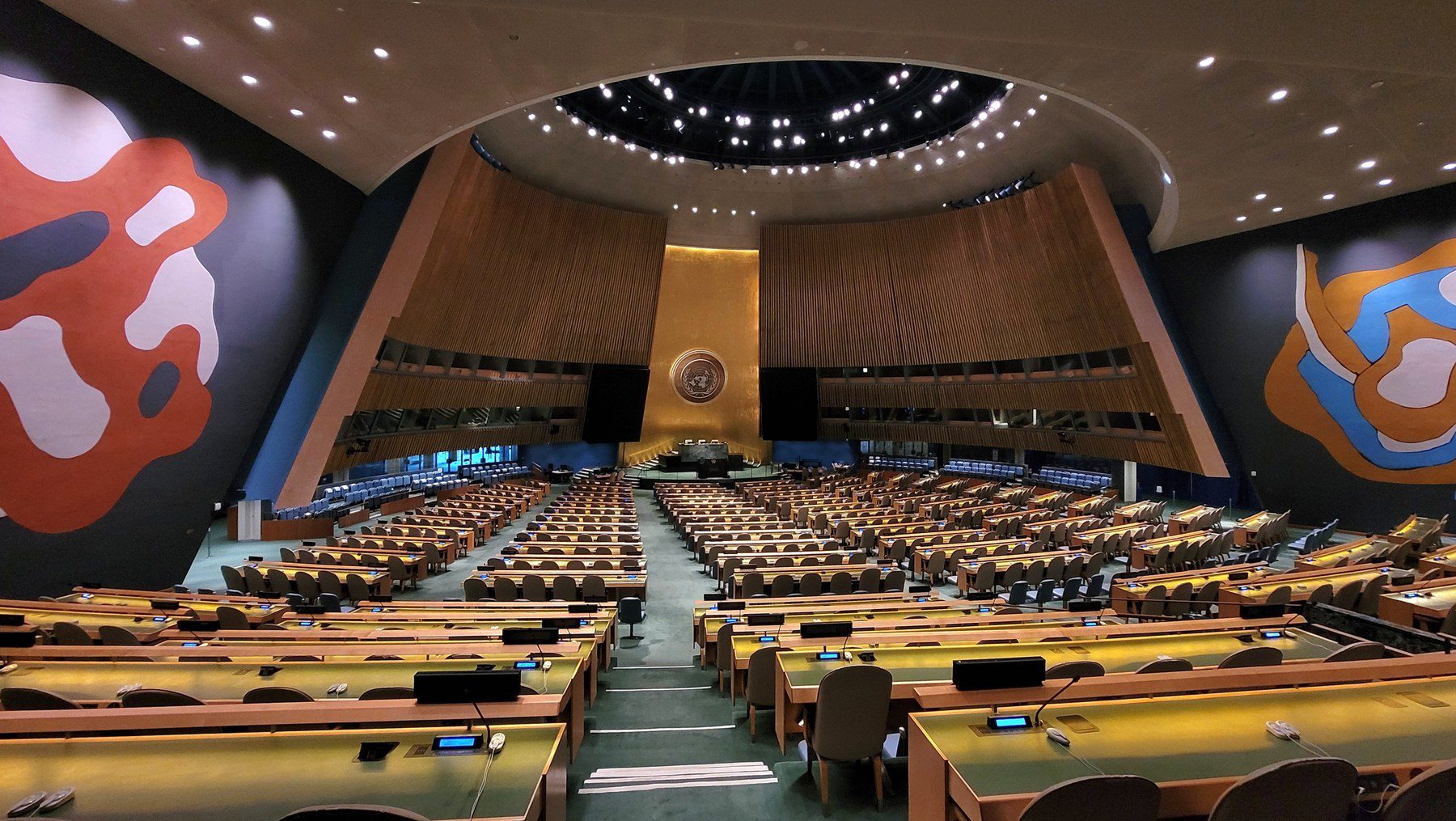
On Tuesday, 22 September 2026, the Foreign Ministers of the G4 — India, Brazil, Germany and Japan — met in New York on the margins of the 81st session of the United Nations General Assembly and issued a joint ministerial press statement on the reform of the UN Security Council. The four were External Affairs Minister S Jaishankar (India), Mauro Vieira (Brazil), Johann David Wadephul (Germany) and Motegi Toshimitsu (Japan). The meeting and statement were reported by the news agency ANI on 23 September 2026, which carried extracts from the text.
The Ministers said an increasingly difficult geopolitical environment had made Security Council reform “more necessary than ever before”, that the Council “is currently unable to effectively discharge its core responsibility of maintaining international peace and security”, and that its “representativeness, legitimacy, credibility and efficacy” are in question — a failure they traced to its “anachronistic eight-decades-old architecture”. For an aspirant, the examinable substance is not the adjective but the procedural argument underneath it: how reform is supposed to happen, and why it has not.
Who the G4 are, and what makes them a bloc
The G4 is not a treaty organisation or a secretariat. It is a coordination group of four aspirant states — Brazil, Germany, India and Japan — that back each other’s claims to permanent seats on an expanded Council. That mutual endorsement is the group’s whole architecture: each argues that its population, economic weight or record of contribution to UN peace and security justifies permanent membership, and none competes with the other three. Active since 2004–05, when it co-sponsored a framework resolution in the Assembly, the group now meets at ministerial level each September, during the high-level week.
This year the Ministers agreed to coordinate closely through the 81st session, tasked officials with follow-up, and agreed to take stock at the next Director General-level meeting in New Delhi.
Constitutional / Legal Framework
The Security Council is created by Chapter V of the UN Charter. Article 23 fixes its composition: the Council “shall consist of fifteen Members” — five named permanent members and ten elected by the General Assembly for two-year terms, with “due regard being specially paid, in the first instance to the contribution of Members… to the maintenance of international peace and security” and “also to equitable geographical distribution”. A retiring non-permanent member cannot be immediately re-elected. Notably, the Charter text still names “the Republic of China” and “the Union of Soviet Socialist Republics” — the seats are today occupied by the People’s Republic of China and the Russian Federation by succession, not by amendment. Article 24 confers “primary responsibility for the maintenance of international peace and security”, and Article 25 binds members to carry out Council decisions. Article 27 supplies the veto: procedural decisions need nine affirmative votes; all other matters need nine affirmative votes “including the concurring votes of the permanent members”. Amendment is governed by Chapter XVIII, Article 108: a Charter amendment enters into force only when adopted by a two-thirds vote of the General Assembly and ratified, by their own constitutional processes, by two-thirds of the Members, including all the permanent members of the Security Council.
What the statement actually asked for
Four concrete demands ran through the text: expansion in both the permanent and non-permanent categories, not merely more elected seats; greater representation of under-represented and unrepresented regions, naming Africa, the Asia-Pacific, and Latin America and the Caribbean; increased participation by states that contribute significantly to international peace and security; and — procedurally the most important — the commencement of text-based negotiations, which the Ministers called the key to “real and impactful UNSC reform”.
The G4 also welcomed the presentation of the African Group’s reform model during the Intergovernmental Negotiations in the 80th session, and reiterated support for Africa’s case for enhanced representation including in the permanent category. They expressed concern at the limited progress of the IGN, which they described as having run 18 years without concrete outcomes.
The CLAT Angle
Expect this in two forms. In the GK section, the safe questions are factual: the G4’s membership, the number of UNSC seats, the Article that governs Charter amendment, the group that opposes new permanent seats, the African common position by name. In a Current Affairs passage, the setter is likelier to exploit the procedural argument: state the rule — a Charter amendment needs a two-thirds Assembly vote plus ratification by two-thirds of members including all five permanent members — then test inference. Can a reform supported by 160 states take effect if one permanent member refuses to ratify? (No.) Is the veto exercised at the amendment stage or the ratification stage? (At ratification, under Article 108.) Watch too for the distinction between consensus and the Charter’s actual voting thresholds: “consensus is not the benchmark” is a claim about what the rules require, not about what is politically wise.
The machinery: the IGN, five clusters, and a “bridging proposal”
Reform does not happen in the Security Council. It happens in the General Assembly, through a process called the Intergovernmental Negotiations (IGN). By decision 62/557 of 15 September 2008, the Assembly decided to commence intergovernmental negotiations in informal plenary during its 63rd session, and not later than 28 February 2009, on “the question of equitable representation on and increase in the membership of the Security Council”, seeking “a solution that can garner the widest possible political acceptance”. The IGN works across five clusters: categories of membership; the veto; regional representation; size and working methods; and the Council–Assembly relationship. It replaced, in practice, the Open-ended Working Group set up in 1993. Since 2008 the Assembly has renewed the IGN by a fresh decision at almost every session — 63/565 B, 64/568 and onward — a chain of roll-overs that is itself the clearest evidence of deadlock.
Two of the G4’s objections turn on this machinery. The first is the demand for text-based negotiations. The IGN still has no single agreed negotiating text; it works from co-chairs’ papers, elements papers and models submitted by groups. Without a text there is nothing to amend, bracket or vote on — which is precisely why states content with the status quo are content for the process to remain conversational.
The second is the objection to a “bridging proposal” tabled before text-based negotiations began, which the G4 said did not reflect the views of a clear majority favouring expansion in both categories. Their procedural point, stated flatly, is that consensus is not the benchmark for decision-making on Security Council reform under the UN Charter and the IGN mandate. If unanimity were the test, a single objector could stop reform at the Assembly stage — well before Article 108’s ratification requirement came into play. The G4 said they would work with other reform-oriented groups to develop a consolidated model.
The competing camps
Reform is stalled not because one side wants it and the other does not, but because at least three reform camps want different things. The Uniting for Consensus group — historically nicknamed the Coffee Club, with Italy and Pakistan among its leading voices — opposes creating new permanent seats and would enlarge only the elected category, arguing that more permanent members means more entrenched privilege, not less. The African Union’s common position, the Ezulwini Consensus of March 2005 (reaffirmed that year in the Sirte Declaration and pressed since by the AU’s Committee of Ten), demands not less than two permanent and five non-permanent seats for Africa, and holds that while Africa opposes the veto in principle, so long as it exists it should extend to all permanent members. The L.69 group, a cross-regional grouping of developing countries named after a draft resolution’s symbol, also presses for expansion in both categories. The G4’s welcome for the African Group’s model is best read as an attempt to close the gap with Ezulwini.
Key Facts
- Event: G4 Foreign Ministers’ meeting and joint press statement on UNSC reform, New York, 22 September 2026, on the margins of UNGA-81.
- The Ministers: S Jaishankar (India), Mauro Vieira (Brazil), Johann David Wadephul (Germany), Motegi Toshimitsu (Japan).
- G4 = Brazil, Germany, India, Japan — aspirants who support one another’s candidatures.
- Core claim: the UNSC cannot discharge its core responsibility; its representativeness, legitimacy, credibility and efficacy are in question.
- UNSC composition: 15 members — 5 permanent (China, France, Russia, UK, USA) and 10 elected for two-year terms (Charter Article 23).
- Veto: Article 27 — non-procedural decisions need nine votes including the concurring votes of the permanent members.
- Amendment: Article 108 — two-thirds of the General Assembly plus ratification by two-thirds of members including all five permanent members.
- IGN: mandated by General Assembly decision 62/557 of 15 September 2008; talks to begin by 28 February 2009; renewed nearly every session since.
- G4 demands: start text-based negotiations; expand both categories; objection to a “bridging proposal” tabled before text-based talks; consensus is not the benchmark.
- Africa: the Ezulwini Consensus (March 2005) seeks not less than two permanent and five non-permanent seats; the G4 welcomed the African Group’s IGN model.
Why the wall is Article 108, not the rhetoric
Separate three obstacles, because examiners like to conflate them. The first is political: the reform camps disagree among themselves, and the G4, the UfC and the African Group have never converged on one model. The second is procedural: the IGN has no negotiating text, and its mandate is renewed rather than concluded. The third is legal, and it is the hardest. Even an overwhelming General Assembly majority produces nothing unless two-thirds of the membership ratify — and among that two-thirds must be every one of the five permanent members. A state that would lose relative influence has no obligation to ratify its own dilution. That is why the G4’s emphasis on the first two obstacles matters: they are the only ones a majority can move on its own.
One caveat of sourcing, honestly stated: the Joint Press Statement of 22 September 2026 was not available in its own published form at the time of writing, so the quotations above are as reported by ANI. The Charter provisions, decision 62/557 and the record of the IGN are taken from the United Nations’ own documents. Treat the statement’s wording as reported wording, and the Charter articles as verbatim law.
Memory Hook / Mnemonic
For the G4, remember “B-G-I-J” — Brazil, Germany, India, Japan (alphabetical, and the only four that endorse each other). For the Charter numbers, use “23 seats, 27 vetoes, 108 locks”: Article 23 sets the composition, Article 27 supplies the veto in voting, Article 108 locks the door on amendment. For the camps: “G4 wants in, UfC wants none, Africa wants two”. And the debate in one line: “A majority can write the reform; only the P5 can let it live.”
Practice Quiz — 10 CLAT-Style Questions
Click an option to reveal the answer and explanation.