CURRENT AFFAIRS | 21 SEPTEMBER 2026
On 21 September 2026 India and Canada confirmed that they will fast-track negotiations for the proposed Comprehensive Economic Partnership Agreement (CEPA), with the fifth round of talks to begin on 5 October 2026. Commerce and Industry Minister Piyush Goyal, speaking after the fourth round concluded in Mumbai with Canada’s Minister of International Trade Maninder Sidhu, said that “both sides have resolved to fast-track negotiations, in view of which our team is now slated to go for the fifth round on October 5”, and described the next 90 days as “a very defining period in the Canada-India relationship”. A Global Affairs Canada release issued from Mumbai the same day recorded that four rounds are now complete and that officials will keep narrowing gaps with the objective of concluding negotiations by the end of 2026.
For an aspirant, a trade negotiation is not a business story. It is an examinable set of institutions — negotiating rounds, tariff lines, rules of origin, most-favoured-nation treatment and the WTO’s tolerance of preferential deals. Learn the machinery once and every future trade headline becomes readable.
The timeline, from a primary source
The Press Information Bureau release of 2 March 2026 from the Ministry of Commerce and Industry is the cleanest record of how this round of talks began. The Terms of Reference for the India-Canada CEPA were signed by Shri Piyush Goyal and Mr Maninder Sidhu on 2 March 2026 and exchanged in the presence of Prime Minister Narendra Modi and Prime Minister Mark Carney at Hyderabad House, New Delhi. The PIB release notes that this followed the leaders’ statement at their bilateral meeting on the margins of the G7 meeting in Kananaskis, Canada. A Terms of Reference document is not the agreement; it settles the format, frequency and approach of the negotiations, and the release states that the talks would cover trade in goods, services and other mutually agreed policy areas.
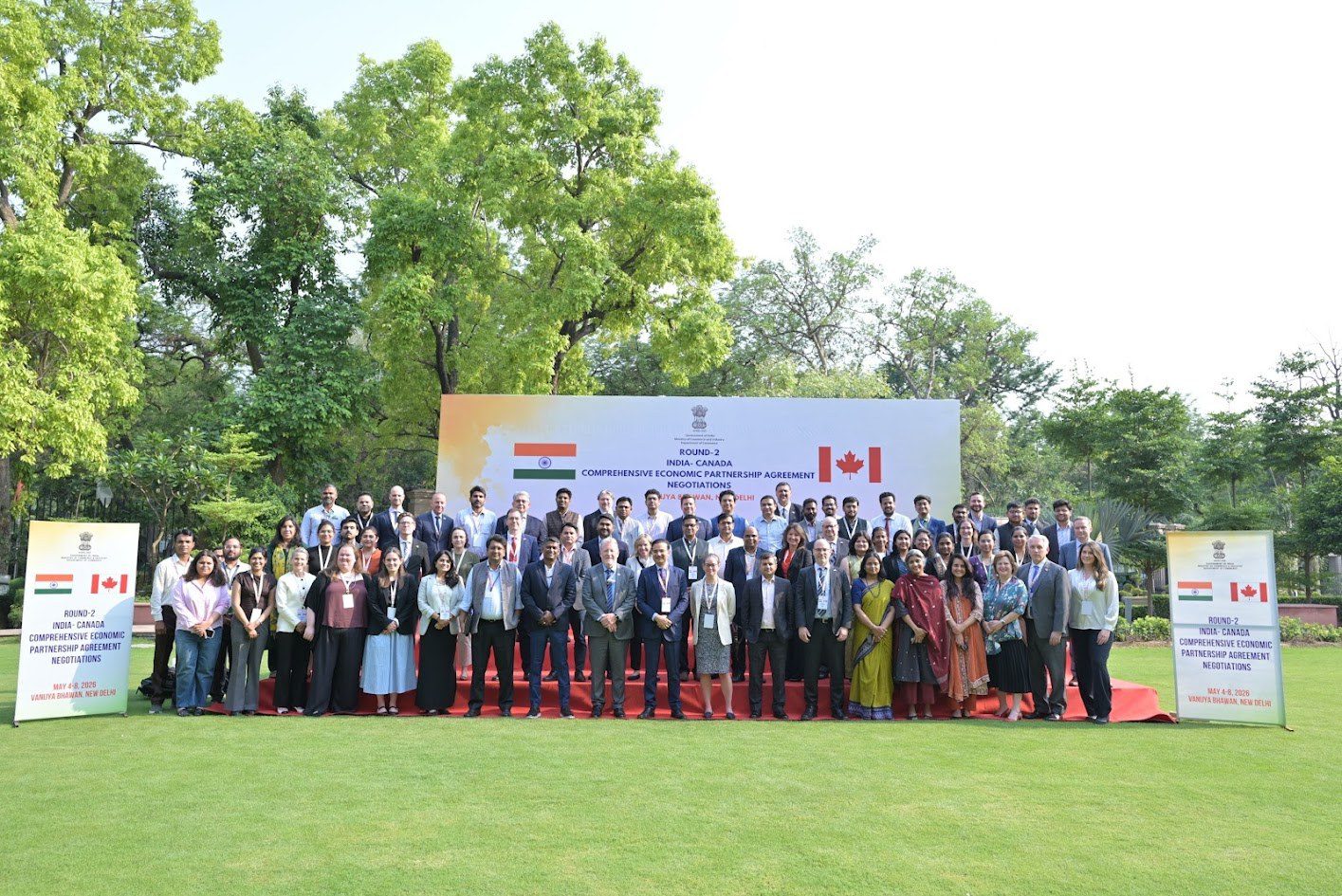
A further PIB release, the India-Canada Joint Statement of 8 May 2026, records that the second round was held from 4 to 8 May 2026 at Vanijya Bhawan, New Delhi, and that discussions covered chapters including Trade in Goods, Trade in Services, Intellectual Property, Rules of Origin, Sanitary and Phytosanitary Measures and Technical Barriers to Trade. The third round was scheduled for July 2026 in Ottawa. That chapter list is worth memorising: it is what “comprehensive” means in practice.
Background & Framework
FTA, CECA, CEPA are labels, not legal categories. A plain Free Trade Agreement typically concentrates on eliminating or reducing tariffs on goods. A Comprehensive Economic Cooperation Agreement (CECA) or Comprehensive Economic Partnership Agreement (CEPA) is broader, adding services, investment, intellectual property, standards, government procurement, dispute settlement and often the movement of professionals. What matters in an exam is coverage, not the acronym.
The vocabulary of the negotiation itself: a tariff line is a single product code in a country’s customs schedule, so “offering 90 per cent of tariff lines” describes breadth of product coverage, not value of trade. Rules of origin decide which goods actually qualify for the preferential tariff — typically by requiring a change in tariff heading, or a minimum percentage of local value addition, or both — and they exist to stop trade deflection, where goods from a third country are routed through a partner merely to capture the lower duty. A negotiating round is a scheduled block of sessions, chapter by chapter, with intersessional work in between. A negative list means everything is liberalised except what is listed; a positive list means only what is listed is liberalised.
The WTO frame
A preferential trade agreement is, on its face, an exception to the founding rule of the multilateral system. The most-favoured-nation obligation requires a member to extend to all other members any advantage it grants to one — restated for services in Article II of the GATS. A bilateral tariff preference is precisely the opposite. The reconciling provision for goods is Article XXIV of the GATT, which permits customs unions and free-trade areas subject to conditions the WTO states plainly: duties and other restrictive regulations of commerce must be eliminated on “substantially all the trade” between the parties; duties applied to outside members must not become higher or more restrictive than before; and an interim agreement must contain a plan and schedule for completion within a reasonable length of time — which the 1994 Understanding on Article XXIV says should not exceed ten years except in exceptional cases. The GATS separately allows economic integration agreements covering services, again on conditions.
Note the second key distinction the WTO itself draws: national treatment — not discriminating between imported and domestically produced goods once they have entered the market — is a general obligation in trade in goods, whereas under the GATS it arises only where a member has made a specific commitment in a sector. That asymmetry is exactly why services chapters are negotiated sector by sector and take longer than goods chapters.
The CLAT Angle
This topic feeds all three of CLAT’s relevant sections. Current affairs and GK: direct questions on the CEPA partner, the round number and date, the two ministers, and the name of the agreement. Reading comprehension: a passage on rules of origin is a favourite, because it rewards careful reading — a question may give you a product assembled in Canada from parts made elsewhere and ask whether it qualifies for the preferential tariff under a stated value-addition threshold. Legal reasoning: the MFN rule and its Article XXIV exception are a clean rule-and-exception structure. A passage can state the MFN principle, then the “substantially all the trade” condition, and ask whether an agreement that liberalises only three sectors qualifies. The correct approach is always to apply the stated rule, not your outside knowledge of any real agreement. Terms to own: MFN, national treatment, tariff line, rules of origin, trade deflection, Terms of Reference, intersessional, ratification.
The numbers, handled carefully
Two different sets of figures circulate, and confusing them is the commonest error in this story. The PIB release of 2 March 2026, citing DGCI&S, puts India-Canada bilateral trade at USD 8.66 billion in FY 2024-25, made up of exports of USD 4.22 billion and imports of USD 4.44 billion. The Global Affairs Canada release of 21 September 2026 gives Canada’s own calendar-year 2025 figures: two-way merchandise trade of $13.6 billion, and $30.4 billion when services are included. These are not contradictory — they use different periods, different currencies and, in the larger figure, a different basket that includes services.
The targets differ too. At the Terms of Reference ceremony, PIB records Prime Minister Modi highlighting a goal of US$50 billion in bilateral trade by 2030. Minister Sidhu’s statement of 21 September speaks of an agreement “that will double our two-way trade to $70 billion by 2030”. Again, different baskets and different currencies. In an answer, the safe discipline is to name the source with the number: “PIB puts trade at USD 8.66 billion in FY 2024-25; Global Affairs Canada reports goods-and-services trade of $30.4 billion in 2025.” Never merge two sources into one sentence.
Key Facts
- Fifth round of India-Canada CEPA negotiations begins 5 October 2026; announced 21 September 2026.
- Fourth round concluded in Mumbai; both sides agreed to fast-track the talks.
- Ministers: Piyush Goyal (Commerce and Industry, India) and Maninder Sidhu (International Trade, Canada).
- Stated objective: conclude negotiations by the end of 2026; Goyal called the next 90 days “defining”.
- Terms of Reference signed 2 March 2026, exchanged before PM Narendra Modi and PM Mark Carney at Hyderabad House.
- Second round: 4-8 May 2026, Vanijya Bhawan, New Delhi. Third round: July 2026, Ottawa.
- Bilateral trade: USD 8.66 billion in FY 2024-25 (exports USD 4.22 bn, imports USD 4.44 bn) — PIB, citing DGCI&S.
- Canada’s 2025 figures: $13.6 billion merchandise, $30.4 billion goods and services — Global Affairs Canada.
- Targets: US$50 billion by 2030 (PM Modi, per PIB); $70 billion by 2030 (Minister Sidhu).
- India’s key exports to Canada: pharmaceuticals, iron and steel, seafood, cotton garments, electronic goods, chemicals.
- India’s key imports from Canada: pulses, pearls and semi-precious stones, coal, fertiliser, paper, petroleum crude.
- Canada hosts over 425,000 Indian students; PIB describes its 2025 population as 41.65 million.
Where this sits in India’s trade strategy
A PIB release of 6 March 2026 sets out the wider picture: India has reached nine free trade agreements spanning 38 countries. The sequence it lists is the one to memorise — India-Mauritius in 2021; the India-UAE CEPA following in May 2022; the India-Australia trade agreement (ECTA) implemented in December 2022; the EFTA TEPA signed on 10 March 2024 and entering into force on 1 October 2025; the India-UK CETA signed in July 2025; the India-Oman CEPA in December 2025; the India-New Zealand FTA announced on 22 December 2025; the India-EU FTA on 27 January 2026; and a framework for an interim agreement with the United States on 7 February 2026.
Read against that list, Canada is one more partner in a deliberate sequence rather than a departure. Negotiations between the two countries had been relaunched earlier in the decade without concluding; the Terms of Reference of March 2026 restarted them on a fresh footing after the leaders met on the margins of the G7. What the fifth round will test is whether the hardest chapters — market access schedules, rules of origin thresholds and services commitments — can be closed inside the ninety days the Commerce Minister has flagged. Even after that, the text must be legally scrubbed, signed and ratified before a single tariff changes. Concluding negotiations and entry into force are different events, sometimes years apart — as the EFTA agreement, signed in March 2024 and in force from October 2025, shows.
Memory Hook / Mnemonic
For the ladder of depth, remember “FTA → CECA → CEPA”: goods, then goods plus cooperation, then the comprehensive partnership. For the WTO logic, “MFN is the rule, XXIV is the door” — and the door only opens for substantially all the trade. For this story, count the calendar: ToR in March, Round 2 in May, Round 3 in July, Round 4 in September, Round 5 on 5 October — roughly one round every two months. And for the two targets, note “50 in Delhi, 70 in Mumbai”, a reminder to always attribute a number to its source.
Practice Quiz — 10 CLAT-Style Questions
Click an option to reveal the answer and explanation.