
Poliovirus in Ghaziabad Sewage: How India’s Silent Watch System Caught an Early Warning
A sewage sample collected in Vijay Nagar, Ghaziabad, on June 5 has tested positive for poliovirus — specifically a vaccine-derived poliovirus (VDPV) strain. The detection triggered an immediate public-health response: tracing of the sewage network, identification of roughly a dozen high-risk neighbourhoods, and intensified door-to-door vaccination. For CLAT aspirants, this event is a compact case study in public-health law and administration — how India monitors for a disease it has officially eliminated, who is responsible for responding, and why the distinction between “wild” and “vaccine-derived” matters enormously in law and policy terms.
What Was Found, and Where
The positive sample came from a routine sewage collection point in Vijay Nagar, Ghaziabad, tested as part of ongoing environmental surveillance — a system in which sewage is periodically tested for traces of poliovirus even in the absence of any reported human case. The strain identified was a vaccine-derived poliovirus (VDPV), not the wild virus. Following detection, health authorities traced the local sewage network to map the catchment area, and identified approximately 12 neighbourhoods, home to around 150,000 residents, as being at elevated risk of exposure. This scale of response — mapping an entire sewage catchment and launching immunisation drives across a defined population — illustrates how seriously even a single environmental-surveillance signal is treated.
Wild Poliovirus Versus Vaccine-Derived Poliovirus
Understanding this story requires understanding the distinction between two very different sources of poliovirus detection.
Wild poliovirus (WPV) is the naturally occurring, disease-causing virus that has historically caused paralytic polio. India ran a decades-long mass immunisation campaign against WPV and was formally certified polio-free in 2014, following three consecutive years without a single case of wild poliovirus. This certification was a landmark public-health achievement, achieved primarily through the oral polio vaccine (OPV) delivered at a scale unmatched almost anywhere else in the world.
Vaccine-derived poliovirus (VDPV) is a different phenomenon altogether. The oral polio vaccine uses a live, weakened form of the virus, which is excreted by vaccinated children for a period. In populations with high immunisation coverage, this weakened virus poses no danger — it simply confers immunity and eventually dies out. However, in pockets where immunisation coverage is low or inconsistent, this weakened vaccine-strain virus can circulate from person to person over an extended period. During that prolonged circulation, it can undergo genetic changes that allow it to regain the ability to cause paralysis, becoming a “vaccine-derived” strain capable of harm. Crucially, a VDPV detection is not evidence that wild polio has returned — it is evidence that a specific pocket has a coverage gap serious enough to let even a weakened vaccine strain persist and evolve.
Why Environmental (Sewage) Surveillance Exists
Even after WPV elimination, India — like other countries in the polio-free category — continues environmental surveillance, a system of routinely testing sewage samples at designated sites across cities for any trace of poliovirus, whether wild or vaccine-derived. The logic is straightforward: an infected person, whether or not they show symptoms, sheds the virus in their stool, which enters the sewage system. Testing sewage at strategic points functions as an early-warning radar, catching viral circulation in a community well before any child develops visible paralysis. This is precisely how the Ghaziabad detection came to light — not through a hospital-reported case, but through this quiet, continuous background monitoring.
The Institutional Response
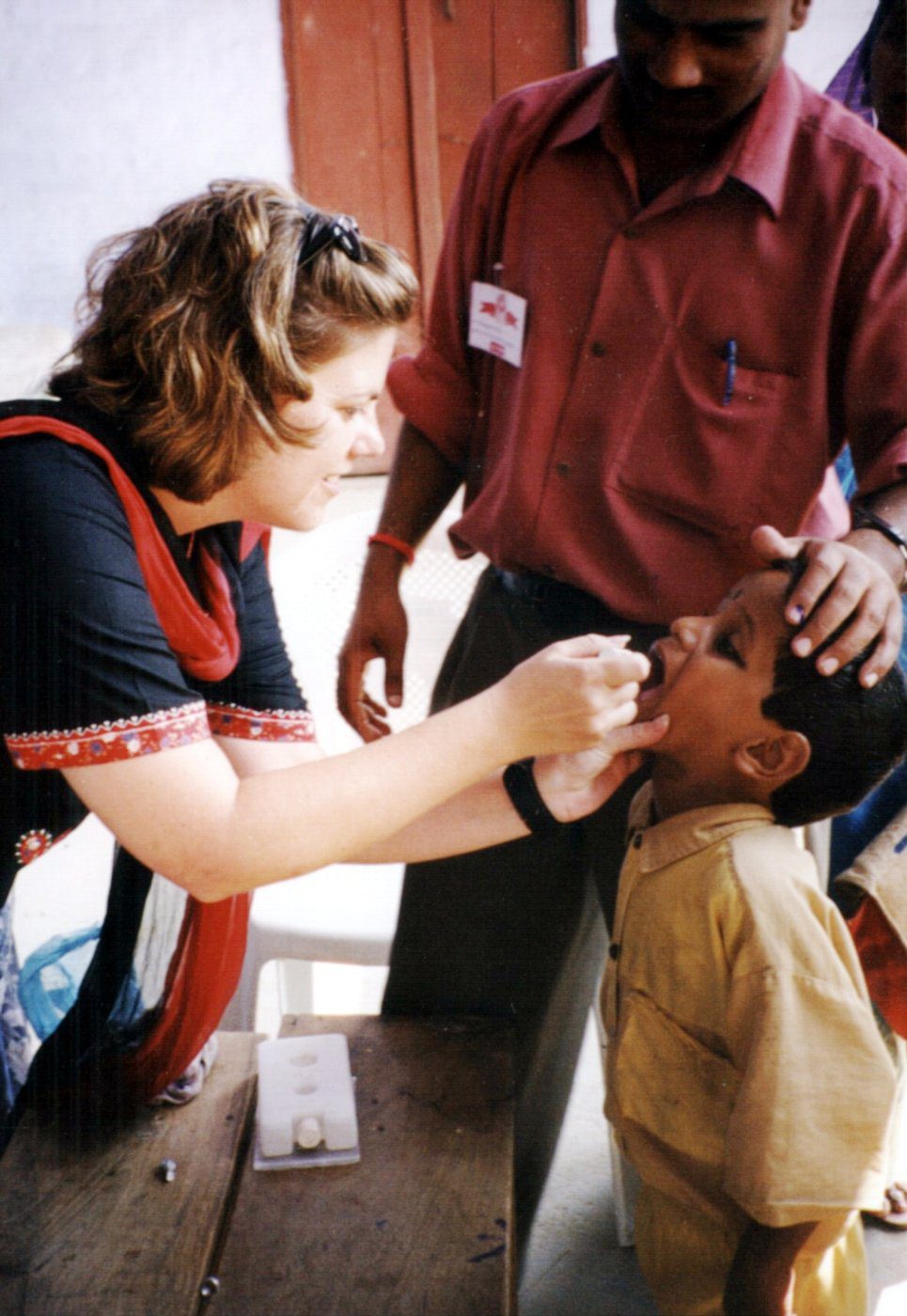
Following the detection, the response was coordinated under the National Centre for Disease Control (NCDC), working with the World Health Organization (WHO). The NCDC functions as India’s apex institution for disease surveillance and outbreak response, while the WHO continues to provide technical support to countries in the polio-free category as part of global eradication monitoring. On the ground, ASHA (Accredited Social Health Activist) workers — India’s grassroots community health workforce — conducted house-to-house oral polio vaccine (OPV) drives targeting children under five years of age across the identified high-risk neighbourhoods, operating under the explicit mandate that “no child is missed.”
The Global Polio Eradication Initiative and Pulse Polio
India’s polio programme has always operated within a larger global architecture: the Global Polio Eradication Initiative (GPEI), launched in 1988 as a partnership among national governments, the WHO, UNICEF, Rotary International, and other partners, with the singular goal of eradicating polio worldwide. India’s own flagship immunisation programme under this umbrella is Pulse Polio, launched in 1995, under which National Immunization Days see millions of children under five administered OPV doses in a short, intensive window, alongside routine immunisation. The Ghaziabad response — targeted OPV drives following a surveillance signal — is best understood as a localized, rapid-response echo of the same Pulse Polio machinery, deployed reactively rather than on the usual calendar schedule.
The CLAT Angle
This story offers dense material for both Current Affairs/GK and Legal Reasoning, since it sits at the intersection of public-health administration, statutory public-health powers, and constitutional health rights.
Right to Health Under Article 21
The Supreme Court has consistently read the right to health into Article 21‘s guarantee of the right to life, holding that life without access to basic health protection is not truly “life” in the constitutional sense. Sustained immunisation surveillance and rapid-response vaccination drives are direct instruments through which the State discharges this Article 21 obligation — a useful anchor whenever a Legal Reasoning passage tests whether a public-health measure is constitutionally grounded.
State’s Public Health Powers and the Union List/State List Interplay
Public health and sanitation are primarily State List subjects under the Seventh Schedule, but disease control that has interstate or international ramifications — such as polio eradication under a global framework — draws in Union coordination through bodies like the NCDC and cooperation with international bodies like the WHO. This dual structure is a recurring GK theme: health administration is federal in form but often nationally (and internationally) coordinated in substance for communicable diseases.
Precautionary, Preventive Administrative Action
The scale of the Ghaziabad response — tracing an entire sewage catchment and vaccinating a population of roughly 150,000 in response to a single sample — illustrates the administrative-law principle that public-health authorities are expected to act on the precautionary side when facing any signal of possible disease transmission, rather than waiting for confirmed clinical cases. This mirrors, in the public-health domain, the same precautionary logic tested in environmental law: act on credible risk, not only on proven harm.
Certification Versus Eradication — A Conceptual Distinction
A subtle but testable point: India’s 2014 declaration certified freedom from wild poliovirus specifically — it did not mean the country could stop all vigilance. The VDPV detection in Ghaziabad demonstrates precisely why continued environmental surveillance remains a legal and administrative necessity even after formal certification; eradication of a disease category is not the same as elimination of every mechanism by which a related pathogen can reappear. This distinction is a favourite trap in objective GK questions that conflate “polio-free” with “no polio-related risk whatsoever.”
ASHA Workers as Statutory-Recognised Community Health Functionaries
ASHA workers operate under the National Rural Health Mission (NRHM) framework as trained community-level health activists, forming the last-mile delivery mechanism for India’s public-health programmes, including immunisation. Their role in the Ghaziabad response is a reminder that much of India’s health law and policy is implemented not through courts or legislation alone, but through a dedicated grassroots workforce whose functioning is itself a matter of health policy and labour-rights discussion in current affairs.
Reading the Story Neutrally
The right way to process this story is as a demonstration of a system working as designed, not as an alarm about polio’s return. A VDPV detection through environmental surveillance is the surveillance system doing exactly its job — catching a local immunity gap before it produces a single paralysed child. The appropriate response is neither panic nor complacency, but appreciation of the layered structure — environmental surveillance, NCDC-WHO coordination, ASHA-led OPV drives — that converts a sewage sample into a targeted, population-scale public-health intervention within weeks.
Key Takeaways for Revision
- Detection: VDPV found in sewage sample, Vijay Nagar, Ghaziabad, June 5.
- Response scale: ~12 neighbourhoods, ~150,000 residents identified as high-risk; house-to-house OPV drives for under-5 children.
- Wild vs vaccine-derived: WPV = natural disease-causing strain (India WPV-free since 2014); VDPV = weakened vaccine strain that can regain virulence where coverage is low.
- Surveillance mechanism: Environmental (sewage) surveillance — early-warning system continued even after 2014 certification.
- Key institutions: National Centre for Disease Control (NCDC) + World Health Organization (WHO); ground-level delivery via ASHA workers.
- Global/national programmes: Global Polio Eradication Initiative (GPEI, 1988) and India’s Pulse Polio (1995).
- Constitutional hook: Right to health read into Article 21.
The CLAT Angle: anchor the story on three pillars — the WPV/VDPV distinction, the continuing necessity of environmental surveillance post-2014 certification, and Article 21’s right-to-health foundation for State immunisation action — and this single news item becomes a ready answer key for GK and Legal Reasoning questions on public health law.
Test Yourself — Daily Quiz
Practice Quiz — 10 CLAT-Style Questions
Click an option to reveal the answer and explanation.