CURRENT AFFAIRS | 22 SEPTEMBER 2026
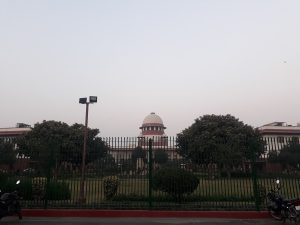
On 22 September 2026 the Supreme Court, hearing a challenge to the Special Intensive Revision (SIR) of Delhi’s electoral rolls, told the Election Commission of India that the notices being issued to voters “seem to be mechanically issued” and that the expression “logical discrepancy” used in those notices needed clarification. The matter is Anjali Bharadwaj & Anr. v. Election Commission of India, W.P.(C) No. 1188/2026, heard by a Bench of Chief Justice of India Surya Kant and Justices Joymalya Bagchi and V Mohana. According to LiveLaw’s report of the hearing, Justice Bagchi observed that “in all probability they are machine-generated notices”, while the Chief Justice told the Commission’s counsel that it needed to clarify what a “logical discrepancy” actually means.
The figures placed before the Court and reported by LiveLaw give the scale of the exercise: roughly 33.13 lakh voters in Delhi have been issued notices, the work is being handled by about 14,000 Booth Level Officers and around 1,200 Electoral Registration Officers, and the verification process is presently scheduled to close by 29 October, a deadline the Commission indicated it was open to extending. The Court directed the Commission to follow the interim directions it had already issued in the Bihar and West Bengal SIR matters — which require the publication of the names of excluded persons together with the reasons for exclusion — and to file a status report on the steps taken. No date for the next hearing was announced.
For a CLAT aspirant the value of this story lies in its constitutional architecture: where does the Election Commission get the power to revise an electoral roll, what limits does the law place on that power, and how far may a court supervise it?
What a Special Intensive Revision is
An electoral roll is not a permanent document. Section 21 of the Representation of the People Act, 1950 deals with its preparation and revision. Sub-section (1) says the roll for each constituency is prepared by reference to the qualifying date and comes into force on final publication. Sub-section (2) requires revision before every general election and bye-election, unless the Commission directs otherwise for reasons recorded in writing. The provision that matters here is Section 21(3): the Election Commission “may at any time, for reasons to be recorded, direct a special revision of the electoral roll for any constituency or part of a constituency” in such manner as it thinks fit, and the existing roll continues in force until that revision is complete.
Revisions come in two shapes. A summary revision works on the existing roll: claims and objections are invited, additions, deletions and corrections are made, and the roll is republished. An intensive revision goes further — enumerators visit households afresh and the roll is effectively rebuilt from house-to-house verification. A Special Intensive Revision is an intensive revision ordered under Section 21(3) outside the routine cycle. Because it places the onus of establishing eligibility back on the elector, it carries a far higher risk of wrongful exclusion, which is why its safeguards are contested.
Constitutional / Legal Framework
Article 324(1) vests the superintendence, direction and control of the preparation of electoral rolls for, and the conduct of, all elections to Parliament, to State Legislatures and to the offices of President and Vice-President in the Election Commission. Article 325 bars a separate electoral roll on grounds of religion, race, caste or sex, and bars exclusion from a roll on any of those grounds. Article 326 provides that elections to the House of the People and to State Legislative Assemblies shall be on the basis of adult suffrage — every citizen not less than eighteen years of age and not otherwise disqualified being entitled to be registered. The statutory layer is the Representation of the People Act, 1950, which governs rolls: Section 15 (an electoral roll for every constituency, prepared under the superintendence of the Commission), Section 16 (disqualifications — not a citizen of India, unsound mind so declared by a competent court, or disqualified for corrupt practices), Section 17 (no registration in more than one constituency), Section 18 (no registration more than once in one constituency), Section 19 (conditions of registration — not less than eighteen years on the qualifying date and ordinarily resident in the constituency), Section 20 (meaning of “ordinarily resident”), Section 21 (preparation and revision), Section 22 (correction of entries), Section 23 (inclusion of names) and Section 24 (appeals). Section 30 bars the jurisdiction of civil courts over questions about the preparation of rolls — one reason such disputes travel to the constitutional courts under Article 32 or Article 226.
Who actually does the work
Part IIA of the 1950 Act creates the officers, and the hierarchy is worth memorising because it appears in questions far more often than students expect. Section 13A provides for a Chief Electoral Officer for each State or Union Territory; Section 13AA for District Election Officers; Section 13B for Electoral Registration Officers, who are the officers actually responsible for the roll of a constituency; and Section 13C for Assistant Electoral Registration Officers. Section 13CC deems all of them to be on deputation to the Election Commission for the period they are so employed, which is how the Commission acquires disciplinary control over officers who remain, on paper, State government servants.
Below the ERO sits the Booth Level Officer, an administrative creation rather than a statutory one, attached to a polling station area and responsible for the field verification that an intensive revision depends on. The arithmetic argued in Court is therefore straightforward and, for an aspirant, instructive: roughly 33 lakh notices distributed across about 14,000 BLOs works out to well over two hundred verifications per officer. That ratio is precisely what prompted Justice Bagchi’s question about how many officers were deployed, and it is the empirical foundation for the observation that the notices look machine-generated.
The CLAT Angle
Three examinable shapes come out of this. Legal reasoning: a passage states that a statutory authority may act “for reasons to be recorded”, then asks whether a notice that recites a formula without disclosing the specific ground satisfies that requirement — the answer turns on whether recording reasons is a substantive safeguard or a formality. Current affairs plus polity: direct questions on the article that vests superintendence of elections in the ECI (324), the provision on adult suffrage (326), and the sub-section that authorises a special revision (Section 21(3) of the RP Act, 1950). Critical reasoning: the inference from a ratio — 33 lakh notices, 14,000 officers — to the conclusion that individual application of mind was impossible is an argument from scale, and a strengthener or weakener question can attack it by asking how many notices each officer actually issued personally. Learn the vocabulary as well: application of mind, natural justice, audi alteram partem, speaking order, and the difference between a summary and an intensive revision.
Judicial review of Election Commission action
Article 324 is unusually broad, and the leading authority on how broad is Mohinder Singh Gill v. Chief Election Commissioner, decided on 2 December 1977 by a Constitution Bench, with Justice V R Krishna Iyer writing. Two propositions from that judgment are permanently useful. First, Article 324 is a reservoir of power: the words “superintendence, direction and control” are of the widest amplitude and operate in areas left unoccupied by legislation — but the power is not arbitrary, and where Parliament has legislated, the Commission must act in conformity with the statute. Second, and directly relevant here, a public order publicly made cannot be supported by reasons supplied afterwards: its validity is judged on the grounds stated in the order itself, not on explanations offered later in an affidavit. A notice that does not tell the recipient which discrepancy is alleged is vulnerable precisely on that ground.
That is the doctrinal frame within which the Court’s observations sit. The Bench has not struck anything down; it has flagged a process concern, asked for clarification of a term, directed adherence to safeguards already ordered in the Bihar and West Bengal matters, and called for a status report. In administrative-law terms this is supervision of procedure rather than substitution of the Commission’s judgment — the classic boundary of judicial review, which examines the decision-making process for legality, fairness and reasonableness rather than re-deciding the merits.
Key Facts
- Hearing date: 22 September 2026, Supreme Court of India.
- Case: Anjali Bharadwaj & Anr. v. Election Commission of India, W.P.(C) No. 1188/2026.
- Bench: CJI Surya Kant, Justice Joymalya Bagchi, Justice V Mohana.
- Notices issued in the Delhi SIR: approximately 33.13 lakh (as reported by LiveLaw).
- Field machinery: about 14,000 Booth Level Officers and around 1,200 Electoral Registration Officers.
- Verification deadline presently set at 29 October; the ECI indicated openness to an extension.
- Court’s observation: notices “seem to be mechanically issued”; “logical discrepancy” needs clarification.
- Directions: follow the interim orders in the Bihar and West Bengal SIR matters (publish names of excluded persons with reasons) and file a status report.
- Statutory source of an SIR: Section 21(3), Representation of the People Act, 1950.
- Constitutional source of ECI authority: Article 324; adult suffrage under Article 326.
- Roll officers: CEO (s. 13A), DEO (s. 13AA), ERO (s. 13B), AERO (s. 13C).
- Leading case on the reach of Article 324: Mohinder Singh Gill (decided 2 December 1977).
Why this matters beyond one city
Every revision of an electoral roll runs into the same structural tension. A roll that is never cleaned accumulates the dead, the departed and the duplicated, and an inflated roll is itself a threat to electoral integrity. A roll cleaned too aggressively, or by an automated filter nobody checks, removes real voters — and a vote lost for an election cannot be restored after polling day. The law’s answer is to insist on process: reasons recorded, notices disclosing the specific ground, a hearing, a published list of exclusions, and a statutory appeal under Section 24.
These proceedings form part of a wider supervision exercise the Court has been conducting over revisions in other States, and its method has been consistent: it has not questioned the Commission’s power to order an intensive revision, which Section 21(3) plainly confers, but has pressed hard on the transparency of the output. That distinction — power upheld, process scrutinised — is the takeaway worth carrying into an answer.
Memory Hook / Mnemonic
For the officer chain, remember “C-D-E-B” — CEO, DEO, ERO, BLO, State down to booth, and note that the first three are statutory (ss. 13A, 13AA, 13B) while the BLO is administrative. For the numbers, “324 controls, 325 forbids, 326 enfranchises”, and for the statute, “21(3) is the SIR’s licence — but the licence says for reasons to be recorded.” One line for the whole case: “The power is plenary; the notice must still speak.”
Practice Quiz — 10 CLAT-Style Questions
Click an option to reveal the answer and explanation.