Vizhinjam Port: When a Stake Sale Becomes a Constitutional-Contract Question
India’s ports rarely make front-page news for legal drama. Vizhinjam, in Kerala, is proving to be an exception. Adani Ports & Special Economic Zone (APSEZ) is moving to sell a large slice of its holding in the country’s first deep-water transshipment port, and the Kerala government has objected sharply. What looks at first like a routine corporate transaction has opened up a genuinely interesting dispute about contract interpretation, change-of-control clauses, and the balance of power between a private operator and a State government. For a CLAT aspirant, this is a near-perfect case study in how public-private partnerships work — and how they can go wrong.
What Vizhinjam Port Is
Vizhinjam is India’s first deep-water container transshipment port. A transshipment port is one where cargo from very large ocean-going vessels is unloaded and transferred onto smaller ships for onward distribution, or consolidated the other way around. Because Vizhinjam sits close to major international shipping lanes and has naturally deep water, it can handle the giant mother vessels that most Indian ports cannot, potentially capturing transshipment business that India currently loses to foreign ports.
The port is a public-private partnership (PPP) between the Government of Kerala and Adani Vizhinjam Port Pvt Ltd (AVPPL). It was built under the DBFOT model — Design, Build, Finance, Operate, Transfer. Under DBFOT, a private concessionaire designs, builds, finances and then operates the asset for a fixed concession period, after which it is transferred back to the government. The concession agreement — the master contract governing the whole arrangement — was signed on 17 August 2015. Phase 1 was commissioned in December 2024, and the next phase is slated for December 2028.
The public stake in this project is substantial. The Kerala government invested roughly Rs 5,595 crore, while the Adani group put in about Rs 2,454 crore. In other words, the State has more capital in the ground than the private operator does — a fact that colours the political and legal temperature of the current dispute.
The Transaction That Triggered the Row
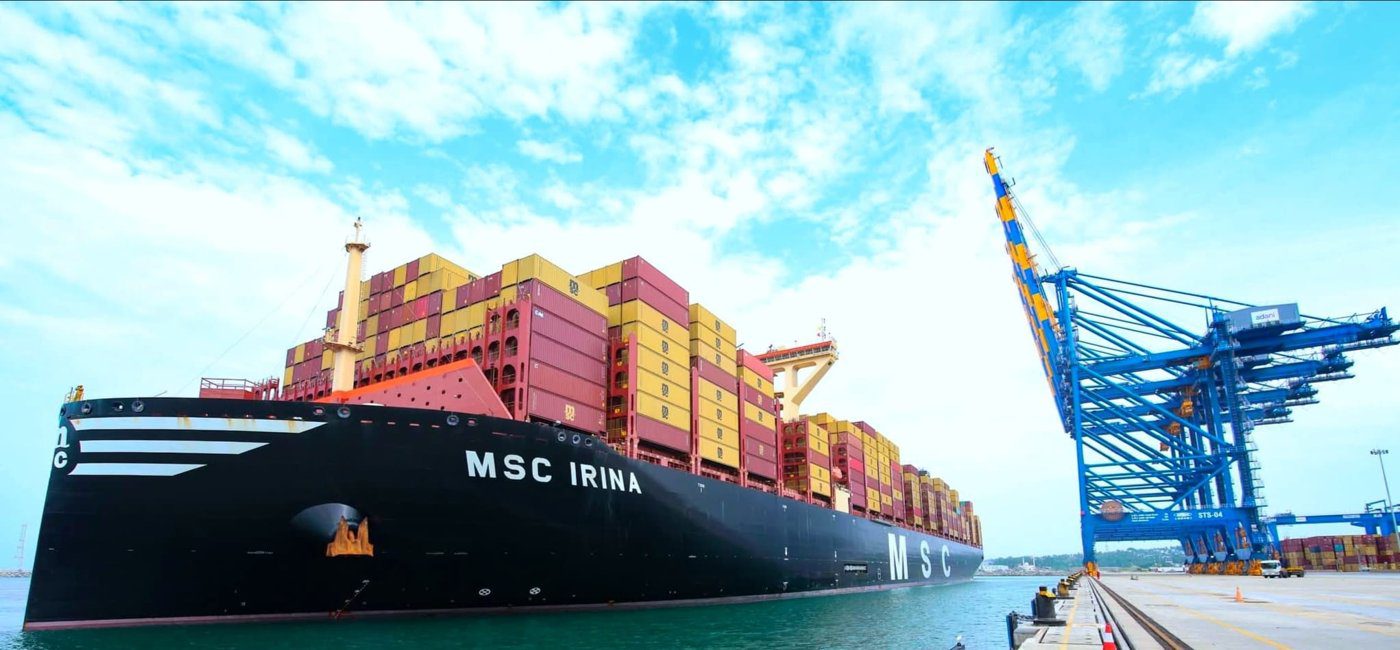
APSEZ has agreed to sell 49% of its stake in Vizhinjam to the Switzerland-based MSC Group, one of the world’s largest shipping lines, for approximately 1.4 billion US dollars — more than Rs 13,000 crore. The buyer is MSC’s terminal-investment arm, Terminal Investment Ltd (TiL), acting through its subsidiary Mundi Ltd. On paper, this is a strategic move: bringing in a global shipping giant could feed cargo volumes into the new port. But the manner and legality of the sale are what have set off the confrontation.
The Kerala Government’s Objection
Kerala’s core argument rests on the concession agreement itself. The State — which is the concessioning authority, the government body that granted the concession — contends that a decision to sell 49% amounts to a change in ownership or control of the concessionaire. The agreement, it says, provides that a transfer of equity aggregating 25% or more that constitutes a “change in ownership” requires the concessioning authority’s prior approval where the transfer affects national security or public interest. Since no such prior approval was sought, Kerala argues the sale is procedurally defective. In its view, when a foreign shipping conglomerate acquires a controlling interest in a strategic national port, the State that granted the concession — and put in the larger share of public money — cannot simply be informed after the fact.
Adani’s Defence
The Adani group takes a different view. It points out that it made a disclosure to SEBI on 30 June, the day after the share purchase and subscription agreement was executed, complying with its obligations under securities law. It further argues that because Vizhinjam is now in its second year of commercial operations, the terms of the arrangement permit it to dilute up to 74% of its stake. On this reading, a 49% sale falls comfortably within the permitted band and does not require prior State clearance.
Why the Buyer Matters
The identity of the buyer is central to the controversy. The MSC Group is not a passive investor; it is one of the largest container shipping lines on the planet, and its terminal-investment arm, Terminal Investment Ltd (TiL), holds stakes in ports across the world. Bringing such a partner into Vizhinjam could, on one view, be excellent for the port: a global carrier has every incentive to route its own vessels through a terminal it part-owns, filling the new deep-water berths with cargo. On another view, precisely because MSC is a foreign shipping giant, its acquisition of a controlling interest in a strategic transshipment gateway raises questions the concession agreement seems designed to catch — questions about who ultimately controls a piece of national infrastructure in which the public purse holds the larger share. This is why the phrase “change in ownership” is doing so much work in the dispute: it is not the money changing hands that alarms Kerala, but the identity and control that come with it.
Where the Ambiguity Lies
The dispute turns on how the contract is read, and two features make that reading contentious. First, the agreement does not clearly define “public interest.” That phrase is the gateway to the prior-approval requirement, yet without a definition it is open to competing interpretations — Kerala reads it broadly to cover a strategic port, while Adani reads the transaction as falling outside the trigger altogether. Second, there is a genuine tension between a clause requiring prior approval for a 25%-plus change of control and a separate permission to dilute up to 74% after operations begin. Reconciling these provisions is a classic exercise in contract interpretation: when two clauses appear to pull in different directions, courts and arbitrators must read the agreement as a whole and give effect to its evident purpose.
The CLAT Angle
This story is a gift for the CLAT aspirant because it sits precisely where contract law, administrative law, economy and federalism intersect — all favourite CLAT territories.
On contract law, the case illustrates how a written agreement governs commercial conduct, how change-of-control clauses protect one party against a shift in the identity of the other, and why the absence of a defined term like “public interest” invites dispute. Expect legal-reasoning passages that hand you a principle — for example, “a transfer of 25% or more requires prior approval where public interest is affected” — and then ask you to apply it to a factual scenario. The skill tested is application, not memory: match the fact (a 49% sale) to the rule (25%-plus triggers approval) and reason to a conclusion.
On administrative and public law, note the role of the concessioning authority and the idea that a government body granting a concession retains supervisory rights over strategic changes. On infrastructure and the economy, understand the PPP and DBFOT model, what a transshipment port is, and why India wants one. On federalism, appreciate the Centre–State dimension: ports and national security touch Union concerns, yet the State of Kerala is the concessioning partner with the larger financial stake, creating exactly the kind of overlapping jurisdiction CLAT loves to probe. Finally, the SEBI disclosure obligation — a listed company must disclose material events — is a clean fact worth remembering for both legal and current-affairs questions.
Keep the anchor facts ready: Vizhinjam is India’s first deep-water transshipment port; the concession was signed on 17 August 2015 under DBFOT; Phase 1 was commissioned in December 2024, with the next phase slated for December 2028; Kerala invested about Rs 5,595 crore against Adani’s roughly Rs 2,454 crore; and the disputed sale is 49% to MSC’s TiL and its subsidiary Mundi for about 1.4 billion dollars. With those figures in hand, you can handle whichever angle an examiner chooses, whether it is a legal-reasoning application question, a static-GK factual item, or a comprehension passage on federal cooperation.
Above all, this dispute is a reminder that infrastructure and law are not separate worlds. Behind every great project lies a contract, and behind every contract lies a set of choices about who bears risk, who reaps reward, and who decides when circumstances change. Vizhinjam is where those choices are now being tested in public — and for the student of law, there are few better classrooms.
Test Yourself — Daily Quiz
Practice Quiz — 10 CLAT-Style Questions
Click an option to reveal the answer and explanation.