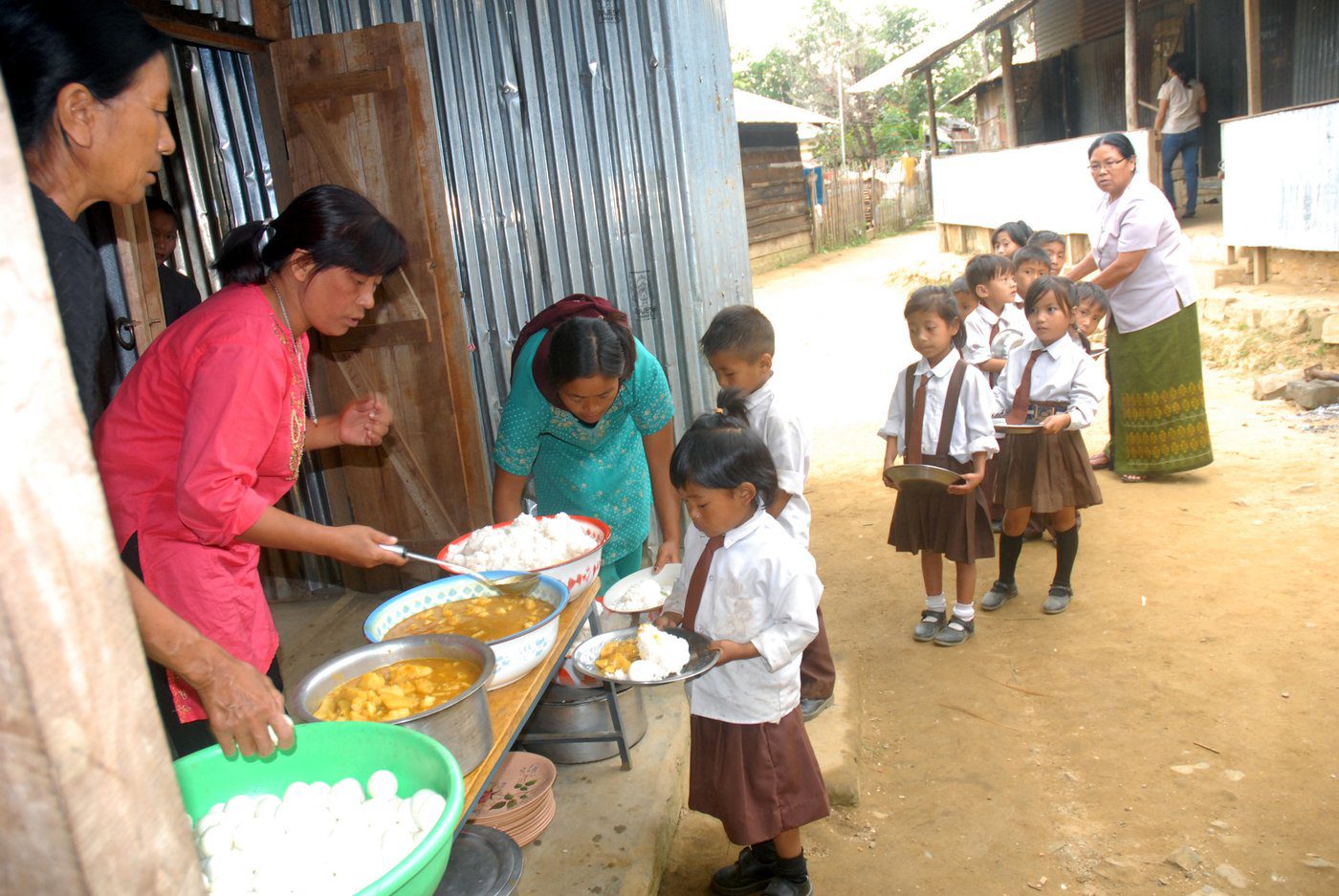
Eggs, Nutrition, and the Right to Food: The Midday Meal Debate Returns
A humble school lunch has become a constitutional talking point. After West Bengal announced that it will remove eggs from its midday meals, a familiar policy debate has flared up again: what belongs on a child’s government-provided plate, and who decides? Behind the immediate quarrel over eggs lies one of India’s most consequential welfare schemes — the midday meal, now branded PM POSHAN — and a rich body of constitutional law about the right to food. For CLAT aspirants, this is a rare topic where nutrition science, social history, and Article 21 converge on a single lunch tray.
What Happened
West Bengal’s decision to drop eggs from its school midday meals reignited a nationwide conversation about the scheme’s nutritional content. Eggs are, in nutritional terms, a nearly ideal food for growing children: they are a complete protein, containing all essential amino acids, and are highly digestible and affordable — which is precisely why so many states include them.
The debate also drew attention to the scheme’s remarkable history. The midday meal is not a recent idea. Its pioneer is Tamil Nadu — an experiment began in the Madras Presidency as far back as 1920, and in 1956 Chief Minister K. Kamaraj introduced a full school-meal programme that became a national model. Kerala followed as the second state in 1984. The scheme’s real turning point came in 2001, when the Supreme Court, hearing a public-interest petition, directed states to provide cooked midday meals to schoolchildren. In 2021 the programme was renamed PM POSHAN (Pradhan Mantri Poshan Shakti Nirman). Today it is one of the largest school-feeding programmes in the world.
The CLAT Angle
This story is a gift for the Legal Reasoning and GK sections because it links a live policy dispute to bedrock constitutional doctrine. The central hook is the Right to Food, which Indian courts have read into the fundamental right to life. The landmark authority is People’s Union for Civil Liberties (PUCL) v. Union of India (2001) — the very case in which the Supreme Court ordered cooked midday meals. That order transformed a welfare scheme into an enforceable entitlement rooted in the Constitution.
The reasoning matters. Article 21 guarantees the right to life, and the courts have held that life means more than mere animal existence — it includes the right to live with dignity, which in turn includes freedom from hunger. This is a classic example of judicial expansion of a fundamental right, a theme CLAT examiners return to repeatedly. Aspirants should be able to trace the chain: Article 21 → right to live with dignity → right to food → cooked midday meals as a state obligation.
Key Concepts Explained
Article 21 and the Right to Food
Article 21 states that no person shall be deprived of life or personal liberty except according to procedure established by law. Through decades of interpretation, the Supreme Court has read an expansive meaning into “life,” holding that it encompasses the right to live with human dignity. Freedom from starvation is a minimum condition of dignity, so the right to food flows directly from Article 21. In PUCL v. Union of India, this reasoning was made concrete through the midday-meal directive.
Directive Principles: Articles 47 and 39
The Directive Principles of State Policy (DPSP) are non-justiciable guidelines the State should follow. Article 47 directs the State to raise the level of nutrition and the standard of living and to improve public health — the constitutional charter for a nutrition programme. Although DPSPs are not directly enforceable, courts routinely use them to interpret and enrich fundamental rights. The midday-meal jurisprudence is a textbook case of reading a directive principle (Article 47) together with a fundamental right (Article 21) to create an enforceable obligation.
Article 21A and the Right to Education
Article 21A guarantees free and compulsory education to children aged 6 to 14. The midday meal has a strong instrumental link to this right: a nourished child attends school, concentrates, and stays enrolled. The scheme therefore advances both the right to food and the right to education — a nutritious lunch is also an attendance-and-retention tool. This dual character is exactly the kind of connection CLAT passages test.
The National Food Security Act, 2013
The National Food Security Act, 2013 (NFSA) converted much of the earlier judicial and welfare framework into statute. It creates a legal entitlement to subsidised foodgrains and expressly provides for midday meals and nutritional support for children and pregnant and lactating mothers. The NFSA is the point where the court-driven right to food became a codified statutory right — an important progression from soft judicial direction to hard legislative guarantee.
Federalism and the Egg Question
Why can West Bengal remove eggs while other states keep them? Because the scheme is jointly funded and implemented, states retain discretion over the menu within broad nutritional norms. This makes the debate a small lesson in cooperative federalism: the Centre sets a framework, but states tailor delivery to local dietary, cultural, and budgetary realities. The egg question is thus not merely about nutrition but about which level of government decides what a child eats.
Why It Matters for the Exam
Expect this topic in two forms. First, GK/static questions: which state pioneered the midday meal (Tamil Nadu / Madras Presidency, 1920; Kamaraj 1956), the second state (Kerala, 1984), the 2001 Supreme Court order, and the 2021 rename to PM POSHAN. Second, Legal Reasoning passages that give a principle — say, “the right to life includes the right to food” — and ask you to apply it to a hypothetical about a government cutting a nutrition scheme. Keep four anchors ready: PUCL v. Union of India (2001), Article 21 (right to food via dignity), Article 47 (DPSP on nutrition), and the NFSA 2013. Being able to argue how a DPSP strengthens a fundamental right will let you handle the trickiest reasoning questions.
Takeaway
The egg debate is a small window into a large constitutional story: how India turned a school lunch into a legally protected right to food. From Tamil Nadu’s 1920 experiment to the Supreme Court’s 2001 order and the NFSA of 2013, the midday meal traces the journey of a welfare idea into enforceable law. For a future lawyer, the lesson is that fundamental rights are living instruments — Article 21 can nourish a child’s plate. Learn the timeline, hold the PUCL case and Articles 21, 21A, and 47 in mind, and a plate of food becomes a reliable source of marks.
Test Yourself — Daily Quiz
Practice Quiz — 10 CLAT-Style Questions
Click an option to reveal the answer and explanation.