CURRENT AFFAIRS | 1 JUNE 2026
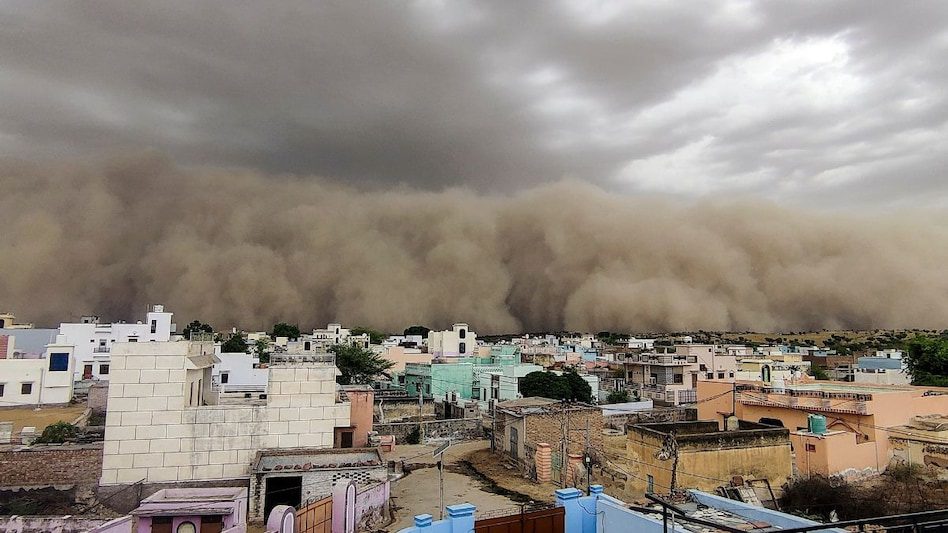
Saturday’s massive dust storm sweeping Churu, Hanumangarh, Sri Ganganagar, Bikaner, Nagaur, Didwana-Kuchaman, Alwar and Sikar in Rajasthan has once again pushed the Aravalli range into the spotlight. As Sophiya Mathew explained in The Indian Express on 31 May 2026, the Aravallis — the world’s oldest fold mountain system at roughly 2.5 billion years — run from Gujarat through Rajasthan and Haryana into Delhi, and act as a natural west-to-east barrier slowing dust travelling from the Thar Desert into the Indo-Gangetic plains.
The Forest Survey of India 2018 found that 31 of 128 Aravalli hills in Rajasthan have already disappeared due to red-silica and granite mining. The IMD’s Climate Hazards and Vulnerability Atlas (1981-2010) records an 88% annual probability of dust storms in Rajasthan. For CLAT 2027 aspirants, this story braids together Articles 48A and 51A(g), the Forest (Conservation) Act 1980, the Wildlife Protection Act 1972, the EIA Notification 2006, and landmark rulings in M.C. Mehta v Union of India and the Godavarman reference.
Constitutional & Statutory Framework
- Article 48A — DPSP: State shall endeavour to protect and improve the environment and safeguard forests and wildlife.
- Article 51A(g) — Fundamental Duty of every citizen to protect and improve the natural environment.
- Article 21 — Right to clean environment, judicially read in (Subhash Kumar v State of Bihar, 1991).
- Forest (Conservation) Act, 1980 — Prior Central Government approval needed for diversion of forest land.
- Wildlife (Protection) Act, 1972 — Protected-area regime and species schedules.
- Environmental Impact Assessment (EIA) Notification, 2006 — Statutory environmental clearance regime under EPA 1986.
CLAT Legal Reasoning Angle
CLAT typically tests environmental law through Legal Reasoning passages on sustainable development, the polluter pays and precautionary principles, and the public trust doctrine. Aravalli mining bans (M.C. Mehta) and the Godavarman forest in dictionary sense doctrine are CLAT favourites.
Expect a passage on whether a State can grant mining leases in eco-sensitive hill ranges. The answer should reference: (i) prior Forest Conservation Act 1980 approval, (ii) EIA Notification 2006 clearance, (iii) Article 48A as an interpretive aid to Article 21, and (iv) the SC’s continuing mandamus in the Godavarman case.
Key Facts at a Glance
| Aravalli age | ~2.5 billion years — world’s oldest fold mountain |
| Stretch | Gujarat → Rajasthan → Haryana → Delhi |
| Elevation | 200-600 m |
| Hills lost (FSI 2018) | 31 of 128 in Rajasthan |
| Dust storm probability | 88% annual (IMD Atlas 1981-2010) |
| WII 2009 study | 12 gaps in Aravalli range expanded due to forest degradation |
| Recent diversion | 9.4 sq km forest for Lloyds Metals (Gadchiroli) — 13 May 2026 |
Mnemonic & Landmark Cases
Mnemonic — “TIBBA-31/128-88%”: Tibba obstacle dunes + 31 of 128 hills lost + 88% dust-storm chance.
- M.C. Mehta v Union of India (Aravalli mining) — SC ban on mining within Aravalli; precautionary principle.
- T.N. Godavarman Thirumulpad v Union of India (1996 onwards) — “forest” given dictionary meaning; ongoing mandamus.
- Vellore Citizens Welfare Forum v UOI (1996) — sustainable development as part of Indian environmental law.
- Subhash Kumar v State of Bihar (1991) — right to clean environment under Article 21.
Practice Quiz — 10 CLAT-Style Questions
Click an option to reveal the answer and explanation.