The Great Nicobar Project and the Public Trust Doctrine: A CLAT Case Study in Environmental Law
Few infrastructure proposals in recent Indian history have generated as sustained a legal-environmental debate as the Great Nicobar Island mega-development — a plan to build a transhipment port, greenfield airport, township, and power plant on an island that hosts some of the world’s most biodiverse tropical rainforest and two of India’s most isolated indigenous communities. For CLAT aspirants, this project is not just a current-affairs item; it is a living examination question in environmental jurisprudence.
What Is the Great Nicobar Project
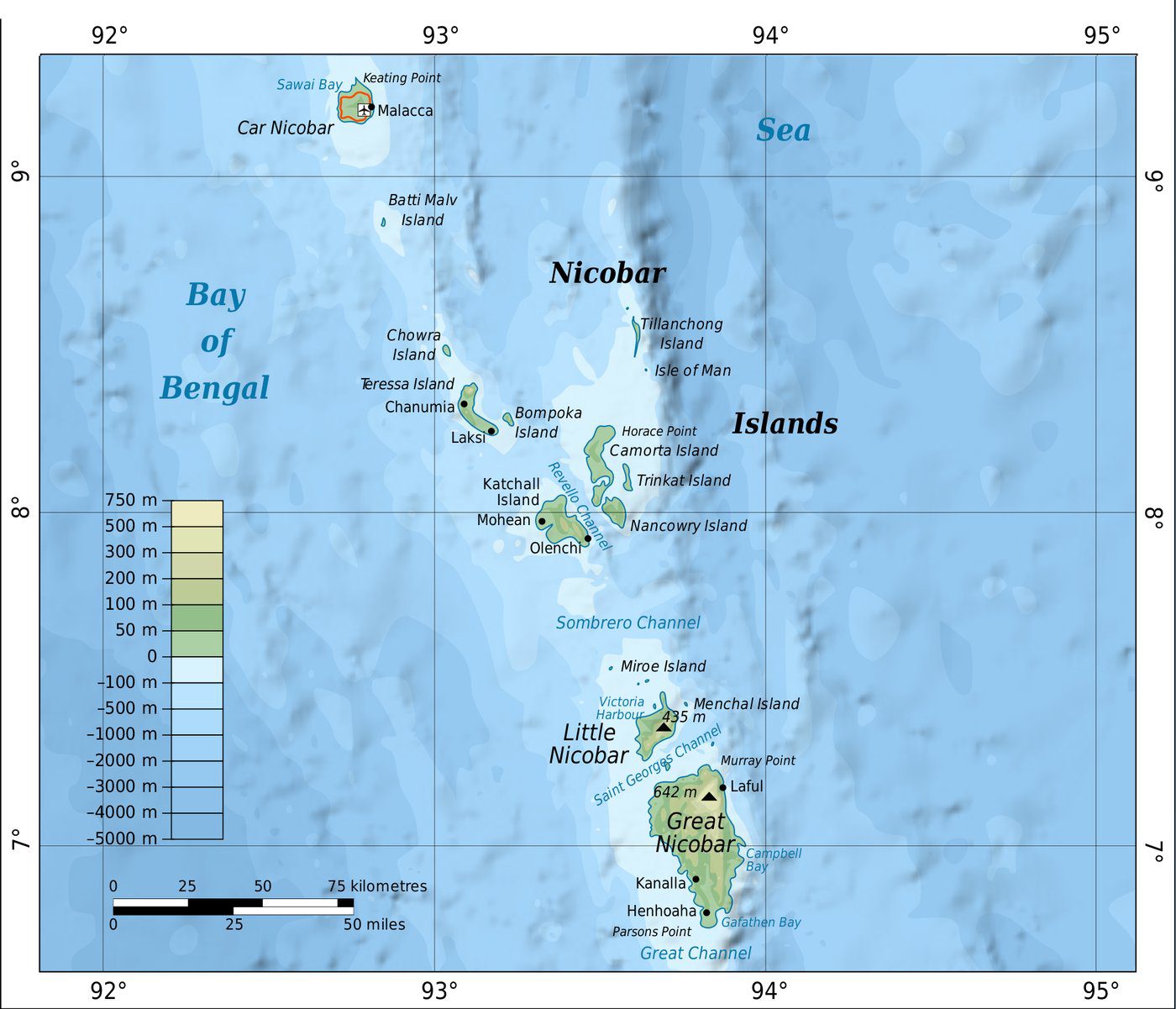
The Andaman and Nicobar Islands Integrated Development Corporation (ANIIDCO), under the Union government, has proposed a large-scale infrastructure development on Great Nicobar — the southernmost island of the Andaman and Nicobar archipelago. The project envisions a deep-water transhipment port capable of handling major global shipping routes (positioned near the Malacca Strait junction), an international greenfield airport, a township to house a projected future population, and a power generation facility.
The project has attracted significant environmental and legal scrutiny because of what it would require: the clearance of tens of thousands of trees across a substantial area — estimates have placed this at somewhere in the range of several thousand hectares — of tropical rainforest classified as the Galathea Bay Wildlife Sanctuary and surrounding tribal reserve. The island is also home to the Shompen, a particularly vulnerable tribal group (PVTG) with very limited contact with the outside world, and the Nicobarese, another indigenous community. Concern has been raised about the adequacy of prior environmental clearances and the process followed for tribal consent.
The CLAT Angle
This project touches four distinct bodies of law that CLAT regularly examines:
1. The Public Trust Doctrine (PTD) — established in Indian constitutional jurisprudence through M.C. Mehta v. Kamal Nath (1997), in which the Supreme Court held that the state holds certain natural resources — rivers, forests, seashores, air — as a trustee for the public, and cannot alienate or hand them over to private parties in a manner that destroys the public’s right to enjoy them. The Court drew on ancient common law principles and held that the doctrine is part of Article 21’s guarantee of the right to life, which the Supreme Court has long read to include the right to a clean and healthy environment (Subhash Kumar v. State of Bihar, 1991).
2. Free, Prior and Informed Consent (FPIC) and the Niyamgiri Precedent — in Orissa Mining Corporation v. Ministry of Environment and Forests (2013), the Supreme Court held that gram sabhas of the Dongria Kondh tribe had the right to decide whether bauxite mining in their traditional forest area should proceed. The Court grounded this in the Forest Rights Act, 2006 (FRA), the Panchayats (Extension to Scheduled Areas) Act, 1996 (PESA), and Article 21 read with the right to culture and livelihood. The Niyamgiri decision established that indigenous communities’ FPIC is a legally cognisable requirement, not merely a policy preference. Critics of the Great Nicobar project have raised questions about whether equivalent consent processes were followed for the Shompen, who have Particularly Vulnerable Tribal Group status.
3. The Forest Rights Act, 2006 — the FRA recognises the rights of Scheduled Tribes and other forest-dwelling communities over forest land they have traditionally inhabited and depended upon. Any diversion of such forest land for non-forest purposes requires the consent of gram sabhas under the FRA, a requirement that courts have enforced strictly since Niyamgiri.
4. Sustainable Development and the Precautionary Principle — these twin environmental law principles, absorbed into Indian law through the Vellore Citizens Welfare Forum v. Union of India (1996) judgment, require that development account for long-term ecological costs and that, where there is scientific uncertainty about serious or irreversible harm, the burden of proof lies on the developer to show safety rather than on the public to prove harm.
Key Concepts Explained
Public Trust Doctrine
The state is a trustee, not an owner, of natural commons. It can regulate use but cannot permanently transfer natural resources in ways that extinguish public rights. Under the PTD, if a forest or wildlife sanctuary is diverted, the state must demonstrate that the diversion is compatible with its trusteeship obligations — a higher standard than mere procedural clearance.
Article 21 and the Right to Environment
The Supreme Court has interpreted Article 21’s guarantee of “life and personal liberty” expansively. In M.C. Mehta v. Union of India (the Taj Trapezium case) and others, the Court held that the right to life includes the right to live in a clean environment. This means environmental degradation, if sufficiently severe, is a constitutional violation, not merely a statutory breach.
FPIC and Tribal Sovereignty
Free, Prior and Informed Consent means consent given voluntarily (free), before the project begins (prior), on the basis of adequate information (informed), and through the community’s own decision-making processes. The Niyamgiri case operationalised this through gram sabha votes. Whether the processes followed for the Shompen — who are particularly isolated — meet this standard is a question that legal scholars and rights groups have raised.
Precautionary Principle
Recognised in Principle 15 of the Rio Declaration (1992) and applied by Indian courts: where an action raises threats of serious or irreversible harm to the environment, lack of full scientific certainty should not be used as a reason to postpone protective measures. The developer bears the burden of demonstrating safety.
The Tension: Development vs. Conservation
Proponents of the project argue that Great Nicobar’s strategic location near one of the world’s busiest shipping lanes makes it an asset for India’s maritime trade ambitions and national security, and that development can be designed to minimise ecological damage. Critics argue that tropical rainforests and tribal communities cannot be adequately compensated by mitigation measures, that biodiversity loss in such ecosystems is functionally irreversible, and that the consent process for the Shompen has not met the Niyamgiri standard. Courts have generally required that both concerns be addressed through rigorous evidence-based review — not one at the expense of the other.
Why It Matters for the Exam
- Legal reasoning passages: Examiners may present a fact pattern about a forest diversion project and test your ability to apply the PTD, FRA consent requirement, or the precautionary principle.
- Landmark case identification: M.C. Mehta v. Kamal Nath (PTD), Niyamgiri/Orissa Mining Corporation (tribal FPIC), Vellore Citizens (precautionary principle) are all CLAT-frequency citations.
- Principle application: Distinguish sustainable development (balancing present and future needs) from the precautionary principle (reversing the burden of proof under scientific uncertainty) — examiners test this distinction.
- Constitutional hooks: Article 21 (right to life), Article 48A (state duty to protect environment), Article 51A(g) (fundamental duty to protect natural environment).
One-Line Takeaway
The Great Nicobar project brings together the Public Trust Doctrine, Article 21’s environmental right, FPIC under the Forest Rights Act 2006, and the precautionary principle — making it one of the most exam-relevant environmental law controversies of 2026.
Test Yourself — Quick Quiz
Practice Quiz — 10 CLAT-Style Questions
Click an option to reveal the answer and explanation.