CURRENT AFFAIRS | 14 JULY 2026
India’s Navy is quietly rewriting its self-reliance story: since December 2024 it has commissioned 18 warships in about 18 months, with 8 more expected by end-2026 and 48 vessels currently under construction almost entirely in Indian yards.
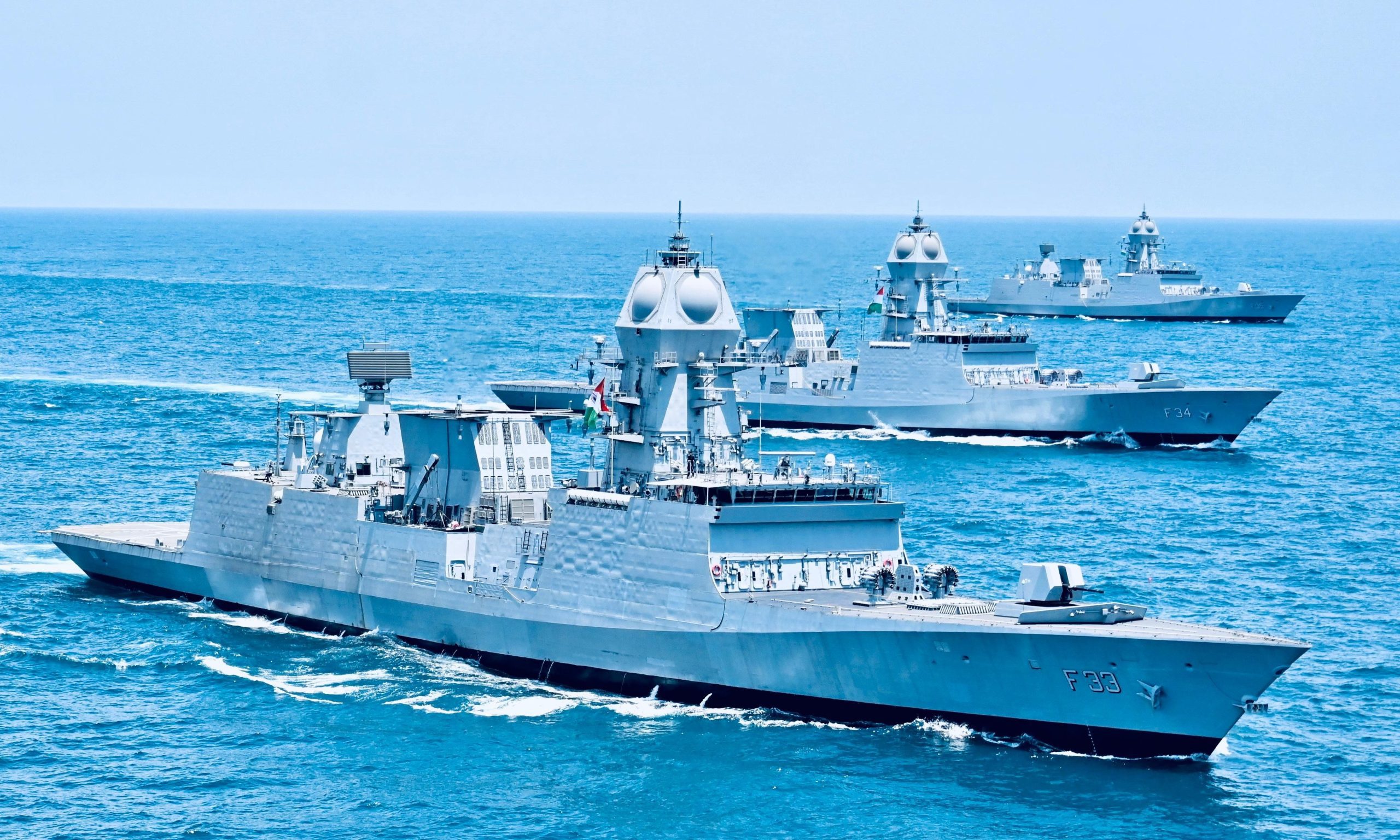
The showpiece of this surge is Project 17A, the Nilgiri-class stealth frigates. A follow-on to the Shivalik-class (Project 17), these ships are built jointly by Mazagon Dock Shipbuilders Limited (MDL, Mumbai) and Garden Reach Shipbuilders & Engineers (GRSE, Kolkata), and carry over 75% indigenous content — a figure that captures how far India’s warship ecosystem has matured from importing hulls to designing and integrating them at home.
The sixth and final P-17A frigate, INS Mahendragiri (about 6,670 tonnes), was recently commissioned. These multi-role platforms bristle with capability: BrahMos supersonic surface-to-surface missiles, a multi-function radar and medium-range surface-to-air missiles, giving the Navy potent reach across air, surface and sub-surface threats. Just as striking is the pace — by using advanced simulation, modular construction and public-private partnerships, delivery timelines were compressed from roughly 90 months to about 72 months per ship.
The programme is not a one-off. The Navy is already moving to Project 17B frigates and Project 15B (Visakhapatnam-class) destroyers, and is planning a class of next-generation destroyers. Together these projects anchor India’s ambition of a genuine blue-water Navy — one able to secure the Indian Ocean Region and its vital sea lines of communication as China’s naval footprint expands.
🏛️ Constitutional / Legal Framework
- Defence Acquisition Council (DAC): The apex procurement body, chaired by the Defence Minister, that clears major acquisitions and grants Acceptance of Necessity (AoN) at the start of the cycle.
- Atmanirbhar Bharat / Make in India: The policy vision driving self-reliance in defence manufacturing and design.
- MoD positive indigenisation lists: The Ministry of Defence’s negative-import lists progressively bar imports of specified items to force domestic sourcing.
- MDL & GRSE: Public-sector defence shipyards executing Project 17A, backed by public-private partnerships.
⚖️ Why This Matters for CLAT
Defence indigenisation is a recurring GK theme that fuses current affairs with static knowledge. CLAT questions can test the institutional chain — who grants AoN (the DAC), which ministry issues the indigenisation lists (MoD) — alongside factual recall of shipyards, classes and weapon systems. The Atmanirbhar Bharat framing also links defence to economic and strategic policy, ideal terrain for reasoning-based passages.
📌 Key Facts
| Project | Project 17A — Nilgiri-class stealth frigates |
| Predecessor | Shivalik-class (Project 17) |
| Shipyards | MDL (Mumbai) & GRSE (Kolkata) |
| Indigenous content | Over 75% |
| Sixth & last frigate | INS Mahendragiri (~6,670 tonnes) |
| Key armament | BrahMos missiles, multi-function radar, MR-SAM |
| Delivery time cut | ~90 months → ~72 months per ship |
| Framework | DAC / AoN under Atmanirbhar Bharat |
From MDL and GRSE slipways to BrahMos-armed frigates, Project 17A is the clearest sign yet that India’s blue-water Navy is being built at home.
🧠 Memory Aid
“MDL-GRSE Make Nilgiri Roar” — two shipyards (MDL, GRSE) build the Nilgiri-class Project 17A frigates that make India’s blue-water Navy roar.
Practice Quiz — 10 CLAT-Style Questions
Click an option to reveal the answer and explanation.