CURRENT AFFAIRS | JULY 13, 2026
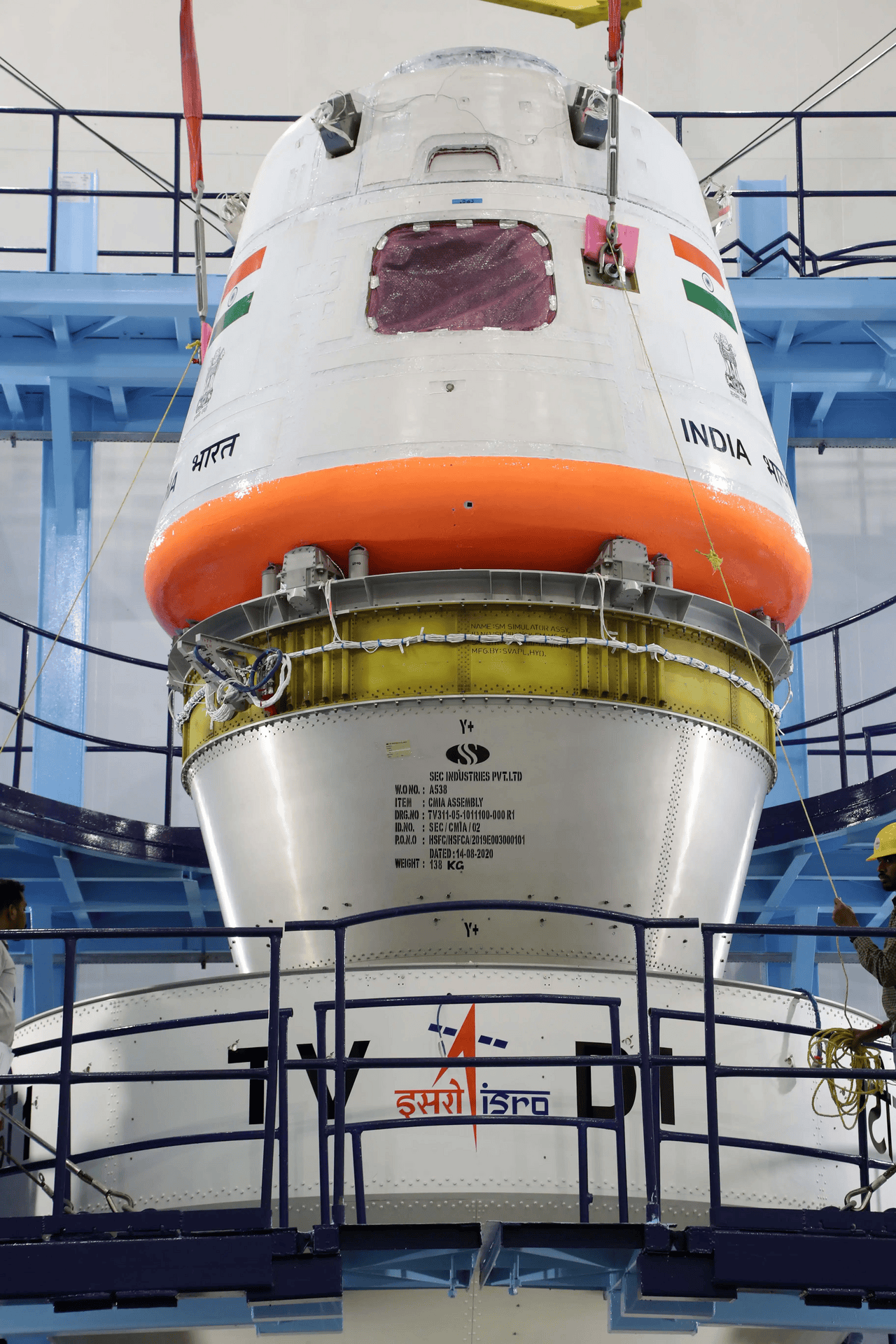
India’s dream of putting its own astronauts into space took another concrete step forward this week. The Indian Space Research Organisation (ISRO) announced that it had completed three key qualification tests for the Gaganyaan human-spaceflight programme — the milestones that quietly turn a plan on paper into flight-ready hardware.
Each of these tests targets a life-or-death moment of a crewed mission: staying upright after landing in the sea, cleanly separating from the launch vehicle, and surviving the fierce loads of re-entry. For CLAT aspirants, Gaganyaan is a recurring high-frequency science-and-technology topic, and the details this week are exactly the kind that get turned into precise, factual GK questions.
The three qualification tests
ISRO said it had cleared the following on the same day:
1. Float inflation test of the Crew Module Up-righting System (CMUS). After a mission, the capsule splashes down in the sea. If it lands upside down, the crew inside would be in serious danger. The CMUS uses inflatable bags that turn the module upright and keep it stable in the water — the float inflation test verifies that this righting system works as designed.
2. Umbilical separation test. “Umbilical” connections carry power, data and fluids between the spacecraft and the ground or the launch vehicle before lift-off. These must detach cleanly at the right instant — a failure here can jeopardise the launch.
3. Crew Module–Service Module Connect & Disconnect / structural qualification tests for the Apex Cover separation loads during re-entry. As the spacecraft plunges back through the atmosphere, protective covers must jettison under enormous aerodynamic and thermal stress; these tests confirm the structure can take those loads.
ISRO was established in 1969, is headquartered in Bengaluru, and functions under the Department of Space, which reports directly to the Prime Minister. Gaganyaan is India’s maiden crewed-spaceflight programme, aiming to send a 3-member crew to a Low Earth Orbit of about 400 km for up to three days. Core systems: the Crew Module Up-righting System (CMUS), the Crew Escape System, and the human-rated launch vehicle HLVM3 (the crew-rated version of LVM3). Launches lift off from Sriharikota (SDSC-SHAR). India’s first citizen in space was Rakesh Sharma (1984, aboard a Soviet Soyuz).
Building on recent milestones
These tests followed the Integrated Main Parachute Air Drop Test (IMAT), conducted on 7 July 2026 at ADRDE, Sheopur (Madhya Pradesh). Parachutes are the last line of defence for a safe splashdown, slowing the crew module from a rapid descent to a survivable landing speed — and the “integrated” test checks the whole parachute cluster working together.
Together, the CMUS, umbilical, structural and parachute tests trace the arc of a mission’s most dangerous phases: ascent, re-entry and recovery. Qualifying each independently before an actual flight is how human-rated spaceflight is done everywhere in the world.
Vyommitra flies first
The first mission, the uncrewed Gaganyaan-1 (G1), will not carry an astronaut. Instead, it will fly a half-humanoid robot named Vyommitra — from the Sanskrit vyoma (space) and mitra (friend). Vyommitra will simulate human functions, monitor systems and report back, allowing ISRO to test the crew environment without risking a life. ISRO is targeting the second half of 2026 for G1, though the schedule may slip to 2027, with the crewed flight to follow after the uncrewed missions succeed.
| Programme | Gaganyaan (ISRO human spaceflight) |
| Tests cleared | CMUS float inflation, umbilical separation, structural / Apex Cover |
| IMAT date & site | 7 July 2026, ADRDE Sheopur (MP) |
| First mission | Gaganyaan-1 (uncrewed), carrying Vyommitra |
| Target orbit | ~400 km Low Earth Orbit, up to 3 days |
| Crew size | 3 members |
| Launch vehicle | HLVM3 (human-rated LVM3) |
Why it is a national milestone
If Gaganyaan succeeds in flying Indian astronauts on an Indian rocket from Indian soil, India would become the fourth nation to achieve indigenous crewed spaceflight — after the erstwhile USSR/Russia, the United States and China. That places the programme in an elite club and marks a leap from India’s earlier achievements in satellites, lunar missions (Chandrayaan) and interplanetary probes (Mangalyaan) to the far harder challenge of keeping humans alive in space and bringing them home safely.
Why crewed spaceflight is so much harder
Sending a satellite to orbit is a formidable engineering feat; sending humans and returning them alive is an order of magnitude harder. A satellite can tolerate failures that would be fatal to a crew. Human-rating a launch vehicle — hence the name HLVM3 — means building in redundancy, stricter safety margins and, crucially, a Crew Escape System that can pull the capsule clear of the rocket within seconds if something goes wrong on the pad or during ascent. Life support must supply breathable air, manage temperature and remove carbon dioxide for the duration of the mission. Re-entry subjects the module to searing heat and violent deceleration, which is why the Apex Cover and structural qualification tests announced this week matter so much.
This is also why ISRO proceeds through a deliberate sequence: component tests, then integrated tests like the IMAT parachute drop, then uncrewed test flights carrying Vyommitra, and only then a human mission. Each stage retires a category of risk. The three qualification tests cleared this week are individual bricks in that wall of safety — unglamorous on their own, indispensable together.
Gaganyaan in India’s space strategy
Gaganyaan is not a standalone stunt; it is the foundation of a broader vision. ISRO has articulated longer-term goals including a Bharatiya Antariksha Station (Indian space station) and, eventually, an Indian crewed lunar landing. Mastering human spaceflight — life support, crew safety, re-entry and recovery — is the prerequisite for all of it. The programme also has strategic and economic dimensions: it spurs advanced manufacturing, trains a generation of engineers, and strengthens India’s standing in the growing global space economy, where private players and international partnerships are increasingly important.
For context, ISRO’s human-spaceflight push runs parallel to a wider opening of India’s space sector to private companies through reforms and the regulator IN-SPACe, and the public-sector enterprise NSIL (NewSpace India Limited). Gaganyaan thus symbolises both national capability and a maturing space ecosystem.
ISRO and Gaganyaan are perennial GK favourites. The examination tends to test crisp facts: ISRO’s founding year (1969), its parent Department of Space, the target orbit (~400 km LEO), the robot’s name (Vyommitra), the launch vehicle (HLVM3), and India’s ranking as the 4th nation for indigenous crewed flight. Knowing the function of systems like CMUS (up-righting after splashdown) helps you answer application-style questions, not just recall ones.
“Gaganyaan-CMUS-IMAT-Vyommitra-LEO400” — picture a capsule (Gaganyaan) bobbing upright in the sea thanks to airbags (CMUS), floating down under parachutes (IMAT), with a friendly robot (Vyommitra) waving from inside, all orbiting at 400 km (LEO). One scene locks the programme, the up-righting system, the parachute test, the humanoid and the target altitude.
From Rakesh Sharma to Gaganyaan
India has sent a citizen to space before, but not on its own rocket. In 1984, Rakesh Sharma flew aboard a Soviet Soyuz as part of a joint mission, famously describing India from orbit as “saare jahan se achha.” That was a guest seat on another nation’s spacecraft. Gaganyaan is fundamentally different: an indigenous human-spaceflight capability, where the launch vehicle, crew module, life-support and recovery systems are all built and operated by India. The distinction between flying on someone else’s rocket and building your own is exactly what separates a passenger from a spacefaring nation.
The four astronaut-designates for the programme — drawn from the Indian Air Force and trained in part in Russia — have already been named publicly, underscoring that the human dimension is no longer hypothetical. When the crewed flight finally lifts off, it will be the culmination of thousands of individual qualification tests like the three announced this week, each one closing off a possible way for the mission to fail.
Every one of these tests is a small, undramatic step — but string them together and they add up to something historic: the machinery of India’s first home-grown journey to carry humans beyond the atmosphere, and a template for the crewed lunar and space-station ambitions that lie beyond it.
Practice Quiz — 10 CLAT-Style Questions
Click an option to reveal the answer and explanation.