A worsening air leak aboard the ISS Russian segment forced NASA to order astronaut shelter aboard SpaceX Crew-12 — an alert reversed within hours, underlining how the Outer Space Treaty 1967 keeps cooperation alive even amid terrestrial tension.
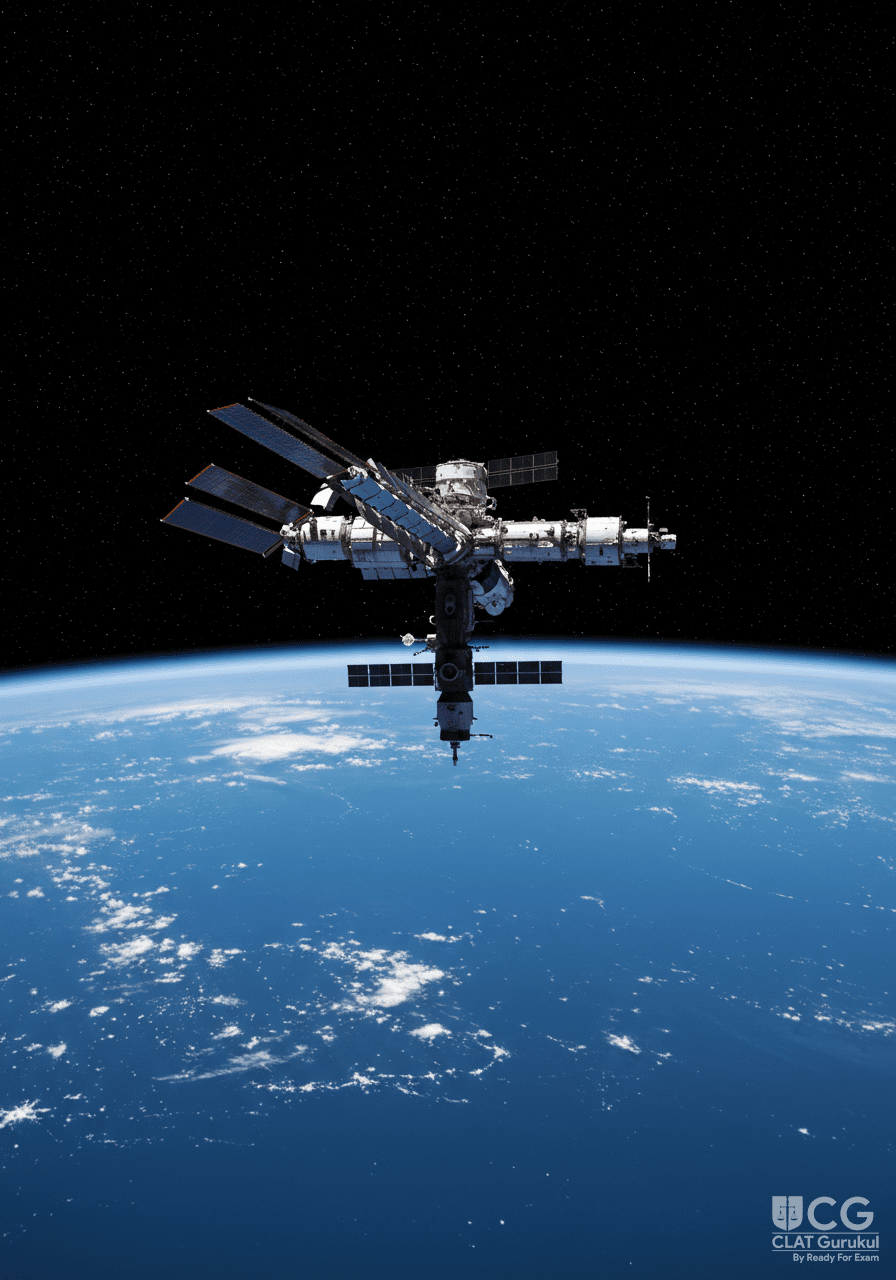
On June 5, 2026, NASA’s Mission Control detected an accelerating air-pressure drop in the Zvezda service module of the International Space Station’s Russian Orbital Segment. The seven-member Expedition 73 crew was directed to shelter inside the SpaceX Crew Dragon (Crew-12) docked at the Harmony module — a contingency that pre-positions astronauts for emergency return. Hours later, Roscosmos and NASA jointly confirmed the leak had been isolated to a known fissure and evacuation was no longer warranted. The incident revives debate over the ISS’s 2030 retirement and the legal architecture governing space cooperation.
📜 Constitutional / Statutory Anchor
Outer Space Treaty 1967: the foundational “Magna Carta of space” — prohibits national appropriation (Art II) and weapons of mass destruction in orbit (Art IV). Article IX OST: mandates international cooperation and avoidance of harmful contamination. ISS Intergovernmental Agreement 1998: binds the US, Russia, Japan, Canada and ESA. Liability Convention 1972: absolute liability for surface damage; fault-based in orbit. Registration Convention 1976: launching states must register space objects with the UN.
The incident showcases the legal pragmatism of the OST framework. Despite the Ukraine conflict-era US sanctions, Roscosmos and NASA continue daily joint operations under the 1998 IGA, which lacks any unilateral-termination clause for political dispute. India, though not an ISS partner, is a party to all four core space treaties (OST, Rescue Agreement 1968, Liability Convention 1972, Registration Convention 1976) and operationalises its obligations through the IN-SPACe authority and the Indian Space Policy 2023. The Crew-12 sheltering also vindicates the multi-vehicle redundancy doctrine that drove NASA’s commercial-crew programme.
🎯 Key Facts at a Glance
- Date: June 5, 2026; module affected: Zvezda (Russian segment)
- Outer Space Treaty: signed 1967, 114 state parties
- Article IX OST: international cooperation + no harmful contamination
- ISS IGA 1998: US, Russia, Japan, Canada, ESA partners
- Liability Convention 1972: absolute liability for surface damage
- India party to all 4 UN space treaties; not an ISS partner
Historically, the ISS itself emerged from the 1993 merger of NASA’s Space Station Freedom programme with Russia’s Mir-2 plans — a post-Cold War cooperation template. The Apollo-Soyuz Test Project (1975) was its conceptual precursor. China’s Tiangong station, by contrast, operates outside the IGA framework, while India’s Bharatiya Antariksh Station (BAS) targets 2035 launch under the Gaganyaan-derived architecture. Recurrent ISS leaks since 2019 have intensified debate over de-orbiting timing; SpaceX has been contracted to build the US Deorbit Vehicle (USDV).
⚖️ CLAT Angle
This is a classic Current Affairs + International Law passage. Expect questions on OST principles — non-appropriation, peaceful use, common heritage. Legal Reasoning may pose absolute vs fault-based liability under the 1972 Convention. Polity-IR overlap could test India’s space treaty ratifications and IN-SPACe / Indian Space Policy 2023. Watch for “first” and “year” MCQs: OST = 1967, ISS construction begun 1998.
Watch next: NASA’s Inspector General report on Russian-segment structural integrity is expected by July 2026 and may accelerate the 2030 de-orbit timeline. Axiom Station’s first commercial module is due to dock in 2027, beginning the privatised LEO transition. India’s Gaganyaan crewed mission, slated for 2027, will give New Delhi observer leverage at the UN COPUOS. Track also the proposed Artemis Accords expansion — 50+ signatories including India (signed 2023) — which reaffirm OST principles for lunar operations.
💡 Why This Matters for CLAT 2027 Aspirants
Memorise the 4 UN space treaties with years: OST 1967, Rescue 1968, Liability 1972, Registration 1976. CLAT loves “Magna Carta of space” framing. Pair with India’s Artemis Accords (2023) and Indian Space Policy 2023 — both high-yield current-affairs anchors.
📝 Test Yourself — 10-Question Quiz
Take the interactive quiz below to reinforce these concepts:
Practice Quiz — 10 CLAT-Style Questions
Click an option to reveal the answer and explanation.