CURRENT AFFAIRS | 29 JUNE 2026
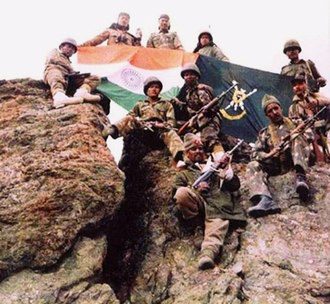
Twenty-seven years ago, on the night of 28–29 June 1999, the soldiers of 2 Rajputana Rifles began one of the most punishing assaults of the Kargil War — the capture of the “Black Rock” complex (which included the “Three Pimples”, Knoll and Lone Hill) in the Drass sector. These icy heights dominated National Highway 1A, the lifeline to Leh, and clearing them was vital to the larger campaign known as Operation Vijay. The anniversary of this battle is a fitting moment for CLAT 2027 aspirants to lock down one of the most reliably tested chapters in defence and modern-history GK.
This is a static-GK and defence story rather than a constitutional one, but it is exactly the kind of high-yield, low-risk material that pads your GK score. The dates, the operation name, the terrain and the commemorative day all recur in objective papers.
The Background
The Kargil War of 1999 was fought between India and Pakistan after Pakistani soldiers and irregulars infiltrated across the Line of Control (LoC) into Indian territory in the Kargil-Drass region of Jammu and Kashmir, occupying high-altitude ridges. India’s military response to evict them was codenamed Operation Vijay (“Victory”). The Indian Army, supported by the Indian Air Force’s Operation Safed Sagar, fought uphill against entrenched positions in brutal Himalayan conditions. The war is remembered for the recapture of peaks like Tiger Hill and Tololing, and for the gallantry of units such as 2 Rajputana Rifles in the Black Rock / Three Pimples assault.
The CLAT Angle
CLAT and other law entrances repeatedly test Kargil basics: the year (1999), the operation name (Vijay), the air-force operation (Safed Sagar), and the date of Kargil Vijay Diwas (26 July), which marks the day the conflict formally ended with India regaining its positions. Expect a GK passage describing the Drass-sector battles followed by direct questions, or a “match the operation to the war” item where Operation Vijay must be distinguished from Operation Meghdoot (Siachen, 1984) and Operation Parakram (2001-02 standoff). The Line of Control is also worth knowing as a concept: it is a military control line, not an internationally recognised legal border, a nuance examiners sometimes probe.
Key Facts
| War | Kargil War, 1999 (India vs Pakistan) |
| Army operation | Operation Vijay |
| Air Force operation | Operation Safed Sagar |
| Battle highlighted | Capture of Black Rock / Three Pimples, Drass, by 2 Rajputana Rifles (28-29 June 1999) |
| Famous peaks recaptured | Tiger Hill, Tololing |
| Commemoration | Kargil Vijay Diwas — 26 July |
A useful frame for the exam is the distinction between a “control line” and a “border”. The Line of Control emerged from the 1972 Shimla Agreement (renaming the earlier ceasefire line) and is the de facto military frontier in Jammu and Kashmir — but it is not an international boundary recognised in law. The Kargil intrusion was so serious precisely because it violated the sanctity of that line. Aspirants who can state this cleanly often pick up an extra mark when a GK question slips from “history” into “international relations”.
The human story matters too. Units like 2 Rajputana Rifles attacked near-vertical, well-defended heights at night and in thin air; several officers and men earned gallantry awards. CLAT occasionally tests the names of India’s highest military decorations — the Param Vir Chakra (highest wartime gallantry award), the Maha Vir Chakra and the Vir Chakra — so it is worth keeping that order of precedence ready.
Memory Hook
“VIJAY on land, SAFED SAGAR in the sky, ’99 is the year, 26 July they say goodbye.” Operation Vijay (Army) + Operation Safed Sagar (IAF), Kargil War 1999, and Kargil Vijay Diwas on 26 July. For the gallantry order: “PVC > MVC > VrC” (Param Vir > Maha Vir > Vir Chakra).
For CLAT 2027, the Kargil chapter is dependable, high-frequency GK. Memorise the year, the two operation names, the commemorative date and the LoC-versus-border distinction, and you will convert this anniversary into easy, guaranteed marks while honouring the soldiers who won those heights.
Practice Quiz — 10 CLAT-Style Questions
Click an option to reveal the answer and explanation.