CURRENT AFFAIRS | MAY 30, 2026
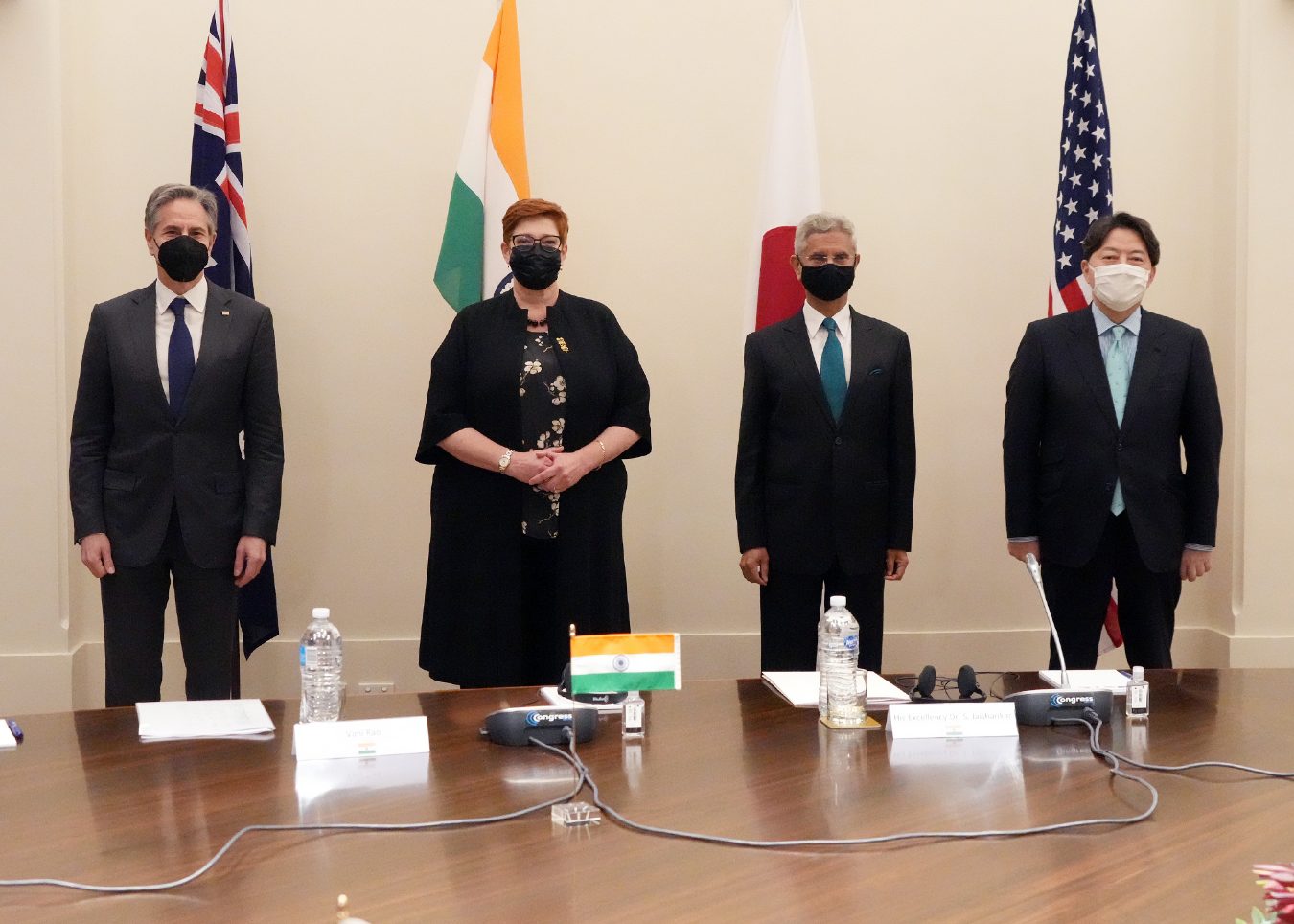
The Quadrilateral Security Dialogue (Quad) — comprising India, the United States, Japan and Australia — held a Foreign Ministers’ meeting in New Delhi around 26 May 2026 that “attempted to break fresh ground.” Yet, as a widely read Explained analysis notes, the grouping continues to struggle to find a single central question, with its four members pursuing disparate objectives. For CLAT 2027 aspirants, the Quad is a rich case study in minilateralism, the Indo-Pacific balance of power, and India’s doctrine of strategic autonomy.
Origins, Revival and the Momentum Problem
The Quad’s roots lie in the coordination among these four navies after the 2004 Indian Ocean tsunami. It was formalised in 2007, lapsed, and was revived in 2017. China has consistently opposed it; Foreign Minister Wang Yi once predicted it would “dissipate like sea foam.” Under President Donald Trump, the United States is perceived by some as leaning toward a bilateral accommodation with Beijing, complicating Quad cohesion. Crucially, the Quad has no NATO-style collective-defence mechanism and no binding treaty, which is exactly why the “Asian NATO” label is misleading. The New Delhi meeting nonetheless unveiled fresh initiatives: maritime domain-awareness coordination, an energy-security framework, cooperation on critical minerals to cut dependence on China, and a port-infrastructure project in Fiji.
Concepts & Framework
- Quad — India, US, Japan, Australia; formalised 2007, revived 2017
- Minilateralism — small, flexible, issue-based groupings versus formal alliances
- Indo-Pacific — the strategic theatre linking the Indian and Pacific Oceans
- UNCLOS & freedom of navigation — legal basis for open sea lanes
- Malabar Exercise — the principal naval exercise associated with Quad members
- IPMDA — Indo-Pacific Maritime Domain Awareness initiative
- Supply-chain resilience / critical minerals — reducing dependence on China
- Strategic autonomy — India’s policy of not joining a binding military alliance
Why This Matters for CLAT 2027
The Quad is a perennial GK-current favourite. Expect questions on the four member countries, the 2007 formalisation / 2017 revival timeline, and the link to the 2004 tsunami. The “Asian NATO” debate is examinable as an assertion-reason item: the assertion that the Quad is a military alliance is false because it lacks a collective-defence treaty. The fresh New Delhi initiatives — critical minerals, energy security, the Fiji port project — are high-yield current-affairs hooks. A passage may test strategic autonomy and the difference between minilateralism and a formal alliance, plus UNCLOS-based freedom of navigation.
Key Facts (Quick Revision)
| Element | Detail |
|---|---|
| Members | India, United States, Japan, Australia |
| Origins | Post-2004 Indian Ocean tsunami coordination |
| Formalised / revived | 2007 / 2017 |
| 2026 FM meeting | New Delhi, ~26 May 2026 |
| China’s stance | “Sea foam” (FM Wang Yi); opposes Quad |
| New initiatives | Critical minerals, energy security, Fiji port |
| Not a | Collective-defence (NATO-style) alliance |
CLAT Mnemonic — W-A-V-E-S
Wang Yi “sea foam” · Australia-Japan-US-India · Vital critical minerals · Energy + maritime pacts · Strategic autonomy retained.
The Quad rides the Indo-Pacific WAVES — without an alliance anchor.
Test Yourself: 10-Question Quiz
The quiz below tests Quad history, the Indo-Pacific, and minilateralism. Aim for 8/10.
Practice Quiz — 10 CLAT-Style Questions
Click an option to reveal the answer and explanation.
Further Reading for CLAT Aspirants
- Distinguish the Quad (minilateral) from NATO (treaty alliance).
- Note the 2004 tsunami origin and the 2007/2017 timeline.
- Track the critical-minerals and Fiji port initiatives from the 2026 meeting.