CURRENT AFFAIRS | JULY 13, 2026
A decade ago, a tribunal in The Hague told the world’s second-largest economy that its sweeping claim over one of the busiest seas on earth had no basis in law. On 12 July 2026 — the tenth anniversary of that ruling — the United States, the United Kingdom, a dozen other Western and Asian nations, and the 27-member European Union collectively reaffirmed the 2016 South China Sea arbitral award. Their message was blunt: the ruling is “final and legally binding.” China’s answer was equally blunt: “null and void.” The standoff is a living case study in the promise and the limits of international law.
What was decided in 2016
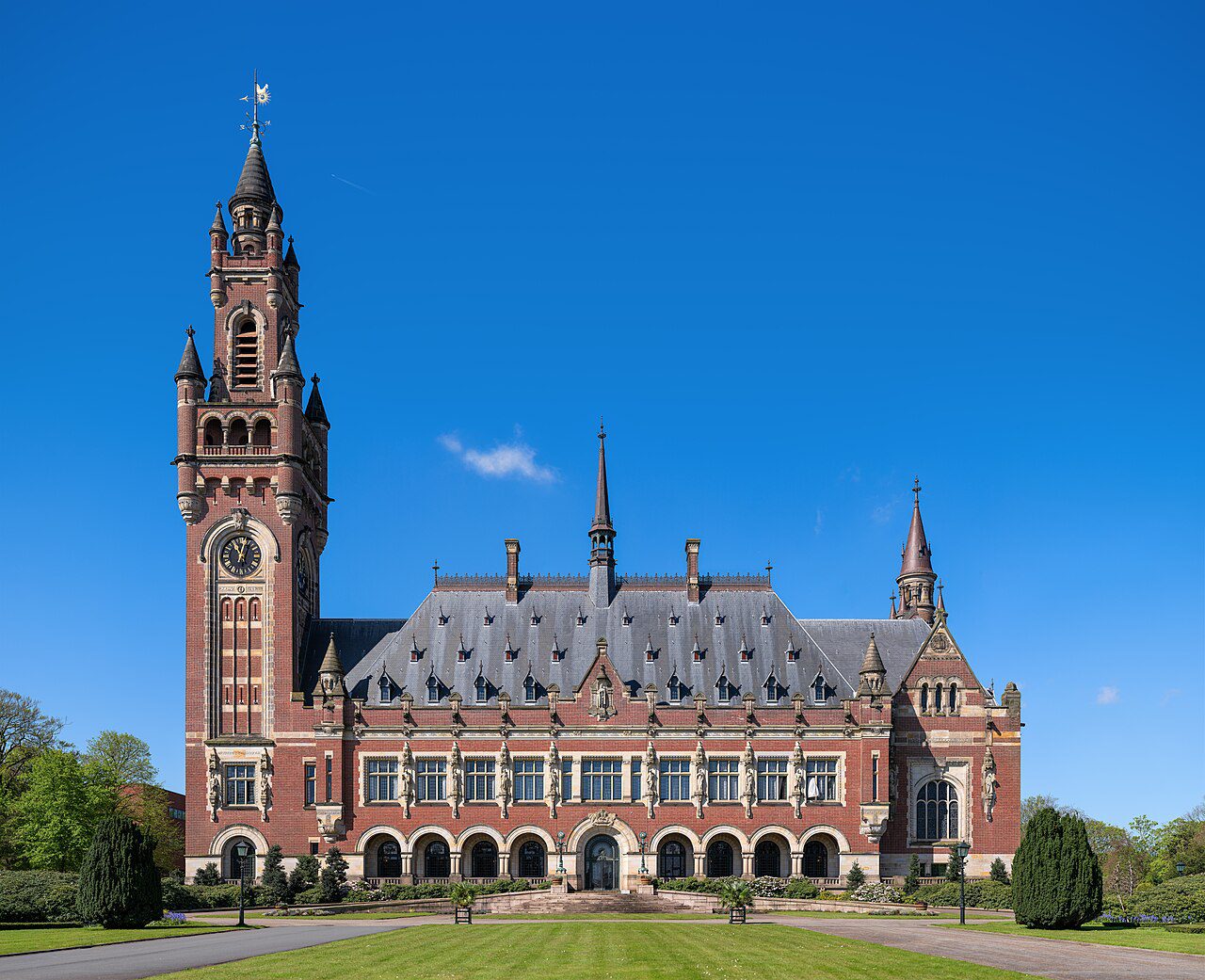
The dispute began when the Philippines initiated arbitration against China in 2013, challenging Beijing’s expansive maritime claims. The case was decided by an arbitral tribunal constituted under Annex VII of UNCLOS — the UN Convention on the Law of the Sea — and administered by the Permanent Court of Arbitration (PCA) in The Hague. In July 2016, the tribunal held that China’s “nine-dash line”, the U-shaped boundary Beijing drew across almost the entire South China Sea, had no legal basis, and that no historic-rights claim survived the moment China ratified UNCLOS.
In effect, the tribunal said that UNCLOS is a complete code for maritime entitlements: a state’s rights over the sea derive from its coastline and the zones the Convention allows, not from vague historical assertions. Beijing’s “historic rights” simply could not coexist with the treaty it had signed.
UNCLOS, 1982 is the “constitution for the oceans.” It defines maritime zones: the territorial sea (up to 12 nautical miles, full sovereignty), the Exclusive Economic Zone (EEZ) (up to 200 nm, sovereign rights over resources), and the continental shelf. Disputes can go to compulsory arbitration under Annex VII. The Permanent Court of Arbitration (PCA), established 1899, administered Philippines v. China — and must be distinguished from the ICJ (the UN’s principal judicial organ, settling inter-state disputes) and the ICC (which tries individuals for international crimes). PCA ≠ ICJ ≠ ICC.
The tenth-anniversary reaffirmation
On the 10th anniversary, a coalition led by the US and UK — and joined by the 27-member European Union and a dozen Western and Asian states — issued statements describing the award as “final and legally binding.” The reaffirmation was more than ceremonial. It was a coordinated diplomatic signal that a large bloc of states continues to treat the ruling as authoritative, regardless of Beijing’s rejection, and that they view the South China Sea through the lens of a rules-based order rather than raw power.
China’s position has not budged. Beijing rejects the ruling as “null and void… no binding force” and insists it “neither accepts nor recognises it.” This rejection exposes the central tension of public international law: an arbitral award can be legally binding yet practically unenforceable when a powerful state refuses to comply and no global police force exists to make it.
Why the South China Sea matters
The stakes are enormous. The South China Sea is one of Asia’s most active flashpoints and a critical artery of global trade, with a huge share of the world’s shipping passing through it. It is rich in fisheries and potential hydrocarbons, and it is ringed by claimants — China, the Philippines, Vietnam, Malaysia, Brunei and Taiwan — whose overlapping claims make every reef and shoal a potential trigger. Freedom of navigation through these waters is a direct interest of trading nations far beyond the region, including India.
For India, the dispute is a matter of principle rather than territory. New Delhi consistently emphasises a rules-based international order, freedom of navigation, and adherence to UNCLOS, while declining to take sides on the underlying sovereignty claims. This posture lets India champion international law — it accepted an UNCLOS tribunal’s ruling in its own maritime boundary case with Bangladesh in 2014 — without being drawn into great-power confrontation.
Public international law and the law of the sea are evergreen, high-yield CLAT topics. Nail the distinctions that setters love to test: UNCLOS 1982, Annex VII arbitration, the PCA (est. 1899, The Hague) versus the ICJ versus the ICC — three different bodies students routinely confuse. Remember the zones: territorial sea 12 nm, EEZ 200 nm. Know the parties — Philippines v. China, initiated 2013, decided 2016 — the “nine-dash line”, and India’s rules-based-order stance. The enforceability gap is a favourite critical-reasoning angle.
The nine-dash line and “historic rights”
At the centre of the dispute is China’s “nine-dash line” — a series of dashes on Chinese maps that loops around roughly 90% of the South China Sea, overlapping the exclusive economic zones of several neighbours. Beijing has justified the claim by invoking “historic rights” said to predate modern international law. The 2016 tribunal rejected this squarely: it held that whatever historic usage may have existed, those rights were extinguished to the extent they conflicted with UNCLOS once China became a party to the Convention. In other words, a state cannot sign a comprehensive treaty on maritime zones and then claim rights outside its framework on the basis of history.
This holding is doctrinally important well beyond Asia. It affirms that UNCLOS is a self-contained code: maritime entitlements are generated by land — coastlines, islands and their features — and measured in the Convention’s zones, not asserted through cartographic lines or ancient claims. The tribunal also clarified that certain features China had built up were legally “rocks” or low-tide elevations incapable of generating an EEZ, puncturing the idea that artificial island-building can manufacture maritime rights.
Distinguishing the Hague institutions
Because so many international bodies cluster in The Hague, students routinely confuse them — and CLAT exploits exactly this. The Permanent Court of Arbitration (PCA), which administered this case, is the oldest, founded in 1899; it is not a standing court but a framework that facilitates arbitration between states and other parties. The International Court of Justice (ICJ) is the principal judicial organ of the United Nations, settling disputes between states and giving advisory opinions. The International Criminal Court (ICC) is entirely different — it prosecutes individuals for genocide, war crimes and crimes against humanity. Keeping “PCA arbitrates states, ICJ judges states, ICC tries individuals” straight is often the difference between a right and wrong answer.
The bigger lesson: binding but not enforceable
The South China Sea saga illustrates the paradox at the heart of international law. A tribunal’s award is “final and binding” as a legal matter, yet international law lacks the centralised enforcement machinery that domestic legal systems take for granted. Compliance depends heavily on state consent, reputational pressure, and the collective will of other nations — which is exactly why the tenth-anniversary reaffirmation matters. Each time a coalition of states reasserts the ruling, it reinforces the norm even if it cannot compel obedience.
This is why the story endures as an exam favourite: it packages the law of the sea, dispute settlement, the difference between the Hague courts, and the philosophy of international law into one concrete controversy. Understanding it means understanding both what international law says and why saying it is not the same as securing it.
The tenth-anniversary moment also carries a lesson about how norms survive. Ten years on, the award has not moved a single ship or reef, yet a widening circle of states — now including the entire European Union — keeps citing it as authoritative. That persistence is itself a form of enforcement: international law works less like a police officer and more like a shared vocabulary that states use to legitimise their conduct and delegitimise a rival’s. For India, which stakes its diplomacy on a rules-based order, joining the chorus that treats the ruling as binding is a way of defending the very framework — UNCLOS — on which its own maritime interests rest.
| Ruling | 2016 South China Sea arbitral award (10th anniversary 12 July 2026) |
| Case | Philippines v. China — initiated 2013 |
| Legal basis | Annex VII tribunal under UNCLOS 1982; administered by PCA, The Hague |
| Holding | China’s “nine-dash line” has no legal basis; no historic rights |
| China’s stance | “Null and void”; neither accepts nor recognises it |
| Zones | Territorial sea 12 nm; EEZ 200 nm |
“UNCLOS-AnnexVII-PCA-NineDash-2016.” Read it as the case’s DNA: under UNCLOS, an Annex VII tribunal at the PCA struck down the nine-dash line in 2016. For the three Hague bodies, use “P-I-I”: PCA arbitrates between states, ICJ is the UN’s court for states, ICC tries individuals. And for the zones, “12-200” — 12 nm territorial sea, 200 nm EEZ.
Practice Quiz — 10 CLAT-Style Questions
Click an option to reveal the answer and explanation.