CURRENT AFFAIRS | 14 JULY 2026
US President Donald Trump on 13 July 2026 declared that the United States would keep the Strait of Hormuz open “for a fee” — charging every ship 20% of its cargo value for safe passage, and styling America as the self-appointed “guardian of the Hormuz Strait”. International law says he simply cannot.
The announcement came as US-Iran attacks resumed and the United States reinstated a blockade of Iranian shipping in the Persian Gulf. Markets reacted instantly: Brent crude jumped more than 4% in a single session, a reminder that Hormuz is the most sensitive chokepoint on the world energy map. Roughly a fifth of all global oil and gas traffic threads through this narrow channel every single day — over 15 million barrels worth about USD 1.2 billion — so even the rumour of disruption pushes pump prices up across continents.
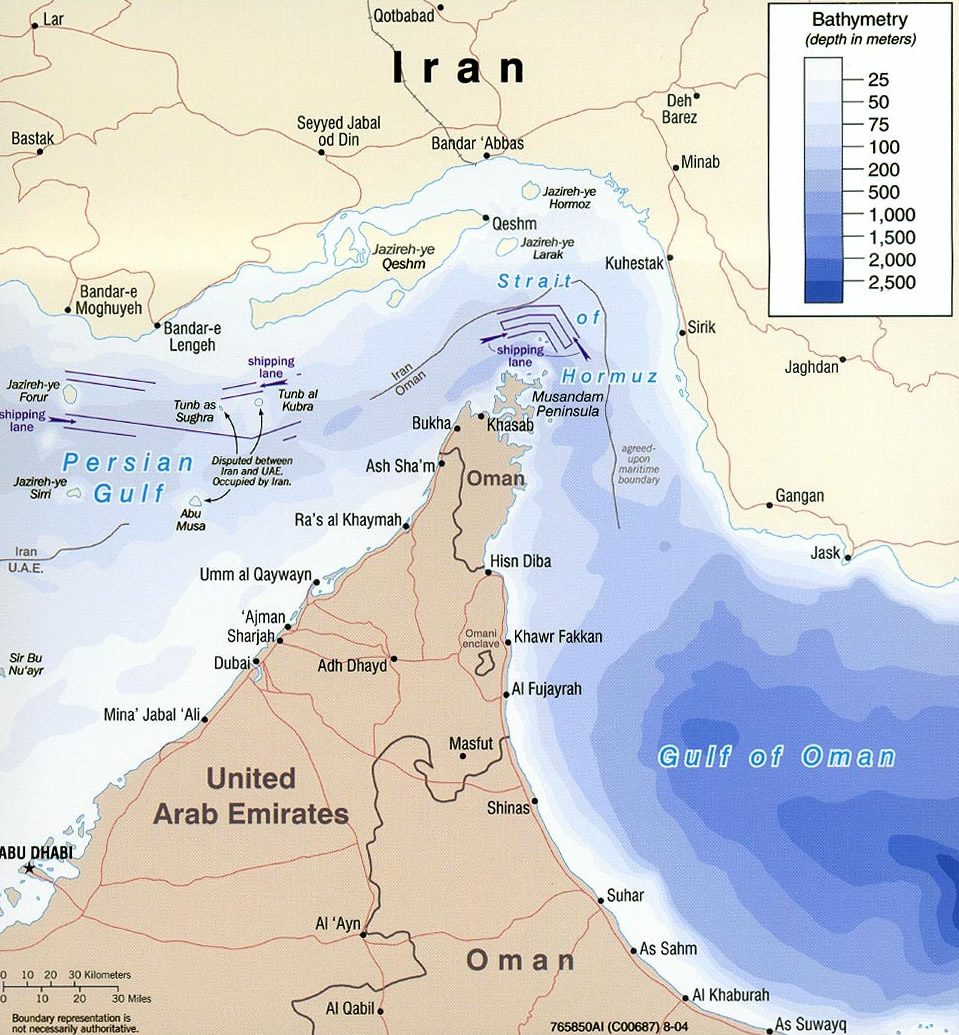
The move is doubly provocative because Iran had earlier threatened to close the strait entirely. Now the two rivals are brandishing opposite threats over the same waterway — one to shut it, the other to tax it. Neither position is lawful. The Strait of Hormuz connects the Persian Gulf to the Gulf of Oman, and its only bordering coastal states are Iran to the north and Oman to the south. The United States is not even a littoral state of the strait, and therefore has no sovereign claim to regulate passage through it.
The United Nations’ shipping agency, the International Maritime Organization (IMO), pushed back sharply within hours, stating that imposing fees on straits used for international navigation has no legal basis and that there is no legal basis for mandatory tolls on strait transits. That view rests on a settled body of treaty law — the UN Convention on the Law of the Sea — which guarantees an unimpeded right of transit passage that cannot be suspended or taxed at will.
🏛️ Constitutional / Legal Framework
- UNCLOS 1982, Articles 37-44: Govern “straits used for international navigation” such as Hormuz, and codify the special regime of transit passage.
- Article 38 (Transit Passage): Guarantees all ships and aircraft the right of transit passage, which “shall not be impeded” by any state.
- Article 44 (Duties of bordering states): States bordering straits shall not hamper transit passage and “there shall be no suspension of transit passage”.
- No arbitrary tolls: Because transit passage cannot be suspended or conditioned, a unilateral 20% cargo fee has no basis in law — the IMO confirms fees on such straits are unlawful.
- Non-littoral status: Only Iran and Oman border Hormuz; the US, as a non-bordering state, cannot lawfully levy any passage charge.
⚖️ Why This Matters for CLAT
This is a textbook fusion of GK and legal reasoning. CLAT loves testing whether a dramatic real-world claim (“we’ll charge 20%!”) survives the actual legal rule. The doctrine is crisp: UNCLOS transit passage cannot be suspended (Art 44) or subjected to arbitrary tolls, so neither the US nor Iran can lawfully tax or block Hormuz. Expect a passage that states the UNCLOS principle and then asks you to apply it to a fact pattern on fees, blockades, or which states may even regulate the strait.
📌 Key Facts
| Announcement | 13 July 2026 — Trump vows US will keep Hormuz open “for a fee” |
| Proposed fee | 20% of cargo value per ship |
| Connects | Persian Gulf ↔ Gulf of Oman |
| Bordering states | Iran (north) and Oman (south) |
| Daily traffic | ~1/5 of world oil & gas; 15M+ barrels/day (~USD 1.2 bn) |
| Market impact | Brent crude jumped over 4% |
| Governing law | UNCLOS 1982, Arts 37-44 (transit passage) |
| UN pushback | IMO: tolls on such straits have no legal basis |
For India — a major crude importer whose trade deficit has already widened on Hormuz-linked disruption — freedom of navigation through this strait is not abstract diplomacy but a first-order matter of energy security and price stability at home.
🧠 Memory Aid
“HORMUZ = Hardly Oman-iRan May Undo Zone.” Only Iran and Oman border it — and under UNCLOS Art 38/44 not even they can undo the free-passage zone, let alone a non-littoral US.
Practice Quiz — 10 CLAT-Style Questions
Click an option to reveal the answer and explanation.