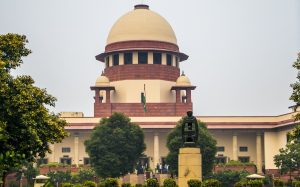


Born on the Soil, Citizen by Right: The US Supreme Court’s 14th Amendment Ruling and What It Teaches Indian Law Aspirants
A 6-3 ruling by the United States Supreme Court striking down an executive order on birthright citizenship has brought the Fourteenth Amendment’s Citizenship Clause back to the centre of constitutional discourse worldwide. For CLAT aspirants, this case is not merely foreign news — it is a masterclass in comparative constitutional law, separation of powers, and the contrast between two very different national approaches to the question of who is a citizen by birth.
What Happened
The United States Supreme Court, by a 6-3 majority, struck down an executive order that had sought to end birthright citizenship for children born on US soil to parents who were in the country unlawfully or on temporary visas. The Court held that the executive order was incompatible with the Fourteenth Amendment to the US Constitution, which explicitly provides that all persons born on US soil and subject to the jurisdiction of the United States are citizens of that country. The majority held that an executive order — a direction issued by the President without legislative backing — cannot unilaterally override a constitutional guarantee. The executive branch has the power to implement laws, but it cannot by executive action alone alter or nullify a constitutional text. The ruling reaffirmed that birthright citizenship in the United States is a constitutional entitlement, not a policy choice that any administration can reverse without a constitutional amendment.
The CLAT Angle
This case engages four distinct concepts that recur in CLAT legal reasoning and GK sections. First, the Fourteenth Amendment’s Citizenship Clause (jus soli — citizenship by place of birth). Second, the foundational precedent United States v. Wong Kim Ark (1898), in which the US Supreme Court first authoritatively interpreted this clause to extend citizenship to a child of Chinese immigrants born on US soil, establishing that birth on the territory is the operative fact. Third, the limits of executive orders in a constitutional democracy — a separation-of-powers issue equally relevant in the Indian context. And fourth, the comparative citizenship framework: India does not follow pure jus soli, which makes the contrast instructive for understanding how different constitutional traditions answer the same question.
Key Concepts Explained
Jus Soli (Law of the Soil)
Jus soli is the principle under which a person acquires citizenship by virtue of being born within the territory of a state, regardless of the nationality of their parents. The United States adopts a near-absolute form of jus soli through the Fourteenth Amendment. Several other countries, including Canada and Mexico, follow similar principles, though many nations have moved away from unconditional jus soli over the past few decades.
Jus Sanguinis (Law of Blood)
This is the contrasting principle, under which citizenship is transmitted by descent — through the nationality of one’s parents. Most European states and many Asian countries, including India in part, rely on jus sanguinis as a primary or co-equal basis for citizenship.
The Fourteenth Amendment — Citizenship Clause
Adopted in 1868 in the aftermath of the American Civil War and the abolition of slavery, the Fourteenth Amendment was designed to guarantee citizenship to formerly enslaved people who had been denied it. Its Citizenship Clause reads: “All persons born or naturalized in the United States, and subject to the jurisdiction thereof, are citizens of the United States.” The phrase “subject to the jurisdiction thereof” has been interpreted by US courts to exclude children of diplomats (who have diplomatic immunity) but to include virtually all other persons born on US soil.
United States v. Wong Kim Ark (1898)
This landmark US Supreme Court ruling is the foundational precedent for birthright citizenship. Wong Kim Ark was born in San Francisco to Chinese parents who were lawful residents but ineligible for US citizenship under the racial exclusion laws then in force. The Court held 6-2 that he was a US citizen by birth under the Fourteenth Amendment, regardless of his parents’ immigration status or racial background. This precedent established that birth on US soil confers citizenship, and the 2026 ruling rests on this foundation.
India’s Citizenship Framework — Articles 5 to 11 and the Citizenship Act, 1955
India’s approach to citizenship is notably different and significantly more complex. Articles 5 through 11 of the Constitution set out the original citizenship provisions for persons at the time of commencement. For citizenship after commencement, the Citizenship Act, 1955 governs the field. India does not follow pure jus soli. Under the Act as amended over the years, a person born in India is a citizen by birth only if at least one parent is an Indian citizen and neither parent is an illegal migrant. Children born to foreign diplomats in India are excluded. For persons born after 3 December 2004, both parents must be Indian citizens, or one must be an Indian citizen and the other must not be an illegal migrant. This graduated, jus sanguinis-inflected approach stands in sharp contrast to the US model.
Separation of Powers and Limits of Executive Orders
An executive order derives its authority from the executive branch’s power to manage the operations of the federal government. It cannot override a statute, and it certainly cannot override the Constitution. The US Supreme Court has a well-established doctrine — exemplified in Youngstown Sheet & Tube Co. v. Sawyer (1952) — that limits executive action where it conflicts with congressional authority or constitutional text. The 2026 ruling is a straightforward application of this principle: where the Constitution’s text is clear, executive orders cannot override it.
Why It Matters for the Exam
Comparative constitutional law has become an increasingly prominent feature of CLAT legal reasoning passages. Examiners use foreign cases to test whether aspirants can identify underlying principles — jus soli versus jus sanguinis, constitutional supremacy, separation of powers — without being misled by the unfamiliar jurisdiction. The Wong Kim Ark precedent and the Fourteenth Amendment are likely to appear in passage-based questions where you are asked to apply a legal rule to a new set of facts. The contrast with India’s Citizenship Act gives you a ready analytical framework: identify the principle, compare the rule, spot the distinction.
India’s own citizenship law has been contested and amended multiple times, and the interplay between the Constitution’s Articles 5-11, the Citizenship Act 1955, and more recent amendments makes this a rich area for both GK and legal reasoning questions.
Takeaway
The US Supreme Court’s 2026 ruling reaffirms that jus soli citizenship under the Fourteenth Amendment is a constitutional guarantee no executive order can erase — a sharp contrast to India’s mixed, jus-sanguinis-inflected Citizenship Act, 1955, and a reminder that constitutional text binds even the executive branch in a system of separated powers.
Test Yourself — Quick Quiz
Practice Quiz — 10 CLAT-Style Questions
Click an option to reveal the answer and explanation.