CURRENT AFFAIRS | 8 JULY 2026
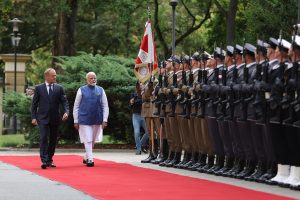
India’s flagship supersonic cruise missile has a new customer. With the deal sealed during PM Modi’s Jakarta visit, Indonesia has become the third foreign buyer of the BrahMos missile — following the Philippines in 2022 and Vietnam. The agreement is a milestone not just in defence diplomacy but in India’s larger story of self-reliance in arms production under Atmanirbhar Bharat and Make in India. For CLAT aspirants, it bundles together defence current affairs, export-control law, and the vocabulary of strategic autonomy that examiners increasingly favour.
The Indonesia contract in numbers
The core BrahMos deal is worth roughly USD 200 million for two batteries. Sitting inside a broader package of agreements valued at about USD 630 million (₹5,985 crore), it also includes the Astra air-to-air missile, routed through a Bharat Dynamics Limited (BDL)–Republikorp arrangement. Indonesia thus joins a small but growing club of nations that field an India-made missile system — a marker of how far New Delhi has travelled from being one of the world’s largest arms importers toward becoming a credible exporter.
The distinction between the two figures is worth understanding, because examiners sometimes test whether a candidate can separate a specific deal from the umbrella package it sits within. The BrahMos batteries account for the roughly USD 200 million line item; the wider USD 630 million figure captures the full basket of defence agreements concluded during the visit, of which the Astra missile is the other headline element. Reading the numbers carefully — and not conflating them — is precisely the kind of precision that distinguishes a well-prepared aspirant in a comprehension-heavy paper.
Missile exports are governed by an international regime, not domestic law alone. India joined the Missile Technology Control Regime (MTCR) in 2016. The MTCR is a voluntary, non-treaty export-control arrangement among member states that restricts the proliferation of missiles and unmanned delivery systems capable of carrying weapons of mass destruction. Crucially, MTCR membership enabled India and Russia to extend BrahMos’s range beyond the earlier 290 km cap toward roughly 500 km (about 400 km for the ship-launched variant), because the regime’s rules and India’s compliant status permitted the co-development and transfer. Defence exports also engage India’s foreign-trade and licensing framework, layered on top of these international commitments.
What exactly is BrahMos?
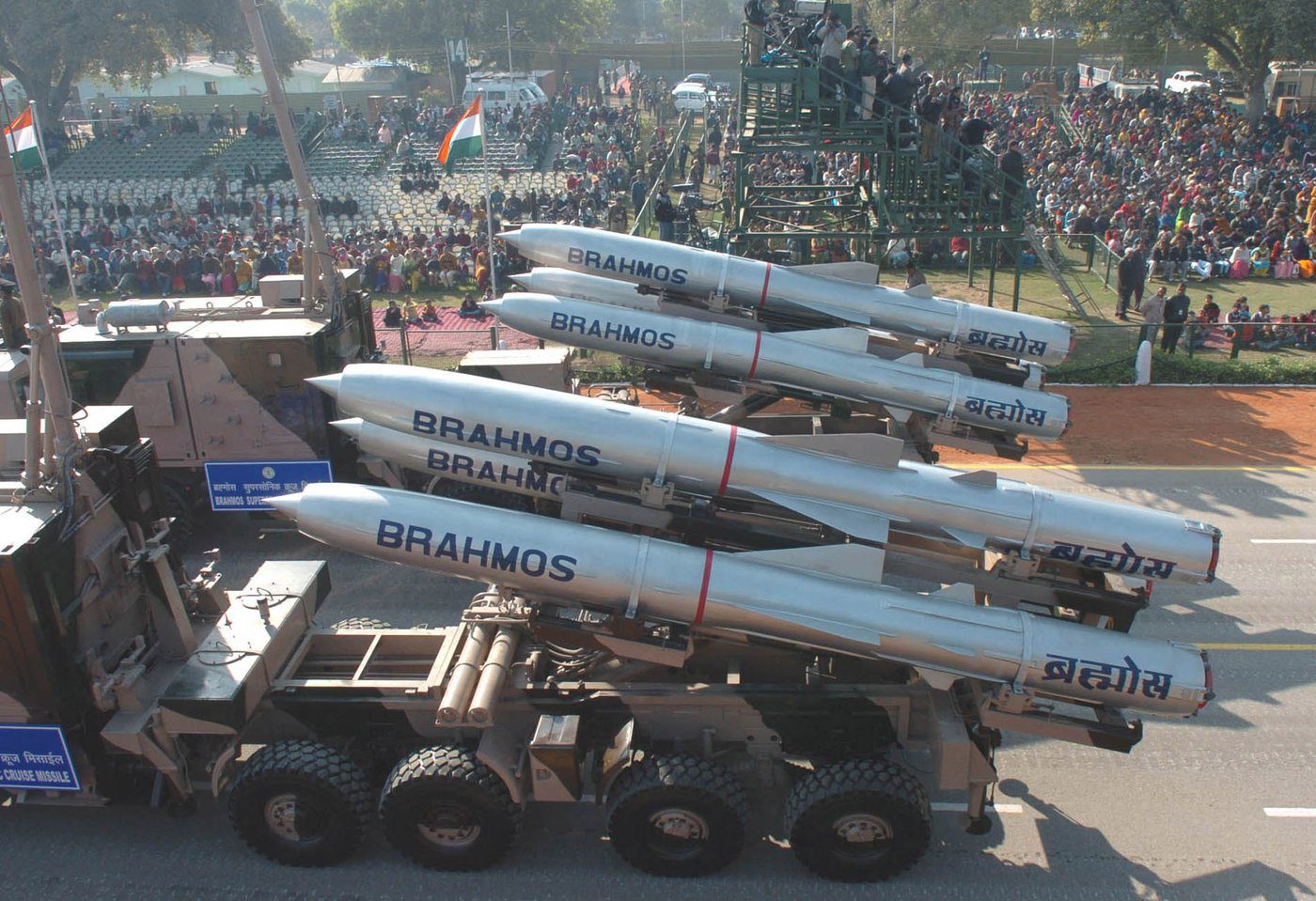
BrahMos is a supersonic cruise missile developed through an India–Russia joint venture — BrahMos Aerospace Private Limited, formed by India’s Defence Research and Development Organisation (DRDO) and Russia’s NPO Mashinostroyeniya (NPOM). The name itself is a fusion of two rivers: the Brahmaputra of India and the Moskva of Russia — a neat mnemonic and a favourite examiner detail.
The missile flies at supersonic speeds of around Mach 2.8 to 3, making it one of the fastest cruise missiles in operational service. It has been inducted across all three Indian armed services — the Army, Navy and Air Force — and reportedly played a key role in precision strikes deep inside Pakistan during Operation Sindoor, underscoring its combat credibility.
A cruise missile differs from a ballistic missile in an important way that is worth carrying into the exam hall. A ballistic missile follows a high, arcing trajectory largely governed by gravity after an initial powered phase, whereas a cruise missile flies low and level, powered throughout its flight and able to manoeuvre toward its target — traits that make it harder to detect and intercept. BrahMos’s combination of that low-flying profile with supersonic speed is what gives it its formidable reputation. Combat use adds a further layer of significance: a weapon that has been tested in an actual operation carries greater credibility with prospective foreign buyers than one known only from trials, which partly explains the growing export interest.
This story is a GK goldmine and a legal-reasoning hook rolled into one. For Current Affairs, memorise the “third buyer” sequence (Philippines 2022 → Vietnam → Indonesia 2026), the DRDO+NPOM parentage, and the Brahmaputra+Moskva etymology. For Legal Reasoning, expect passages built around export-control regimes: a stem may ask whether India, as an MTCR member, may transfer a missile of a given range — testing your ability to apply a stated rule to facts. For Logical Reasoning, the “importer-turned-exporter” narrative supports cause-effect and inference questions about the Atmanirbhar Bharat policy.
The export-diplomacy pipeline
The Indonesia sale is not a one-off. India is reportedly in talks with at least half-a-dozen more nations. A compact, next-generation variant — BrahMos-NG — is being actively pitched to over ten countries, including South Africa, the United Arab Emirates, Saudi Arabia and Egypt. This lighter version is designed to be carried on more platforms, widening the potential customer base.
Defence exports have become a deliberate instrument of Indian foreign policy, showcased at forums such as the Shangri-La Dialogue, Asia’s premier security summit. Selling a marquee weapon system does more than earn foreign exchange: it builds long-term strategic relationships, since the buyer depends on the seller for spares, training and upgrades over decades.
This dependency, often described as strategic lock-in, is a double-edged concept that appears frequently in international-relations passages. For the exporter, it converts a one-time sale into a durable partnership and a source of quiet influence. For the buyer, it is a calculated trade-off: greater capability today in exchange for a long relationship with the supplier’s industrial base. Understanding this dynamic helps explain why states treat major arms deals as strategic decisions rather than mere procurement, and why a sale like BrahMos to Indonesia is read as a signal of deepening alignment rather than a simple commercial transaction.
| Missile | BrahMos — supersonic cruise missile (~Mach 2.8–3) |
| Joint venture | BrahMos Aerospace: DRDO (India) + NPOM (Russia) |
| Name origin | Brahmaputra (India) + Moskva (Russia) rivers |
| Foreign buyers | Philippines (2022), Vietnam, Indonesia (2026 — 3rd) |
| Indonesia deal | ~USD 200 mn (2 batteries); package ~USD 630 mn / ₹5,985 cr |
| MTCR | India joined 2016; enabled range extension to ~500 km |
| Next-gen | BrahMos-NG pitched to 10+ nations (South Africa, UAE, Saudi Arabia, Egypt) |
Atmanirbhar Bharat and strategic autonomy
The BrahMos export drive is a flagship exhibit for two intertwined policy ideas. Atmanirbhar Bharat (self-reliant India) and Make in India aim to build a domestic defence-manufacturing base, reduce import dependence, and generate high-technology jobs. Strategic autonomy — India’s long-standing doctrine of keeping its foreign-policy choices independent of any single bloc — is reinforced when the country can supply, rather than merely purchase, cutting-edge military hardware.
A defence-public-sector undertaking like BDL, partnering with private and foreign entities, illustrates how India blends public capacity with joint ventures to compete in the global arms market. Each successful export deepens that ecosystem.
It is also useful to see the export drive in the context of India’s stated goal of expanding its annual defence-exports figure and broadening the range of countries it supplies. Every new buyer diversifies the customer base and reduces reliance on any single market, mirroring the same supply-chain logic that shapes India’s imports. In that sense, becoming a dependable exporter is not merely a matter of prestige; it is a structural shift that strengthens the domestic industrial base, sustains high-skill employment, and gives India additional leverage in its wider diplomatic relationships. The Indonesia deal, modest in dollar terms, is best understood as one more building block in that longer-term transformation.
“PVI = Philippines-Vietnam-Indonesia” — the three foreign BrahMos buyers in order. Add “River-Name: BRAHMa + MOSkva” for the etymology, and “MTCR-2016 = Range-Rise to 500” to lock the export-control link. One line to recall it all: “PVI bought the BRAHMa-MOS; MTCR-2016 unlocked 500 km.”
How to revise this for CLAT
Treat the BrahMos export as a mini case study in India’s defence trajectory. Fix the hard facts first: the three buyers and their order, the DRDO–NPOM joint venture, the river etymology, the Mach 2.8–3 speed, and the 2016 MTCR membership that enabled range extension. Then layer the policy vocabulary — Atmanirbhar Bharat, Make in India, strategic autonomy, defence-public-sector undertaking — that examiners weave into passages.
Finally, practise the legal-reasoning application: given a stated export-control rule and a set of facts about a missile’s range and a country’s membership status, can you correctly conclude whether a transfer is permitted? That skill — applying a rule to facts without importing outside knowledge — is exactly what CLAT’s legal-reasoning section rewards. The BrahMos–Indonesia story gives you a memorable, real-world scaffold on which to build it.
Test Yourself — Daily Quiz
Practice Quiz — 10 CLAT-Style Questions
Click an option to reveal the answer and explanation.