CURRENT AFFAIRS | 24 JUNE 2026
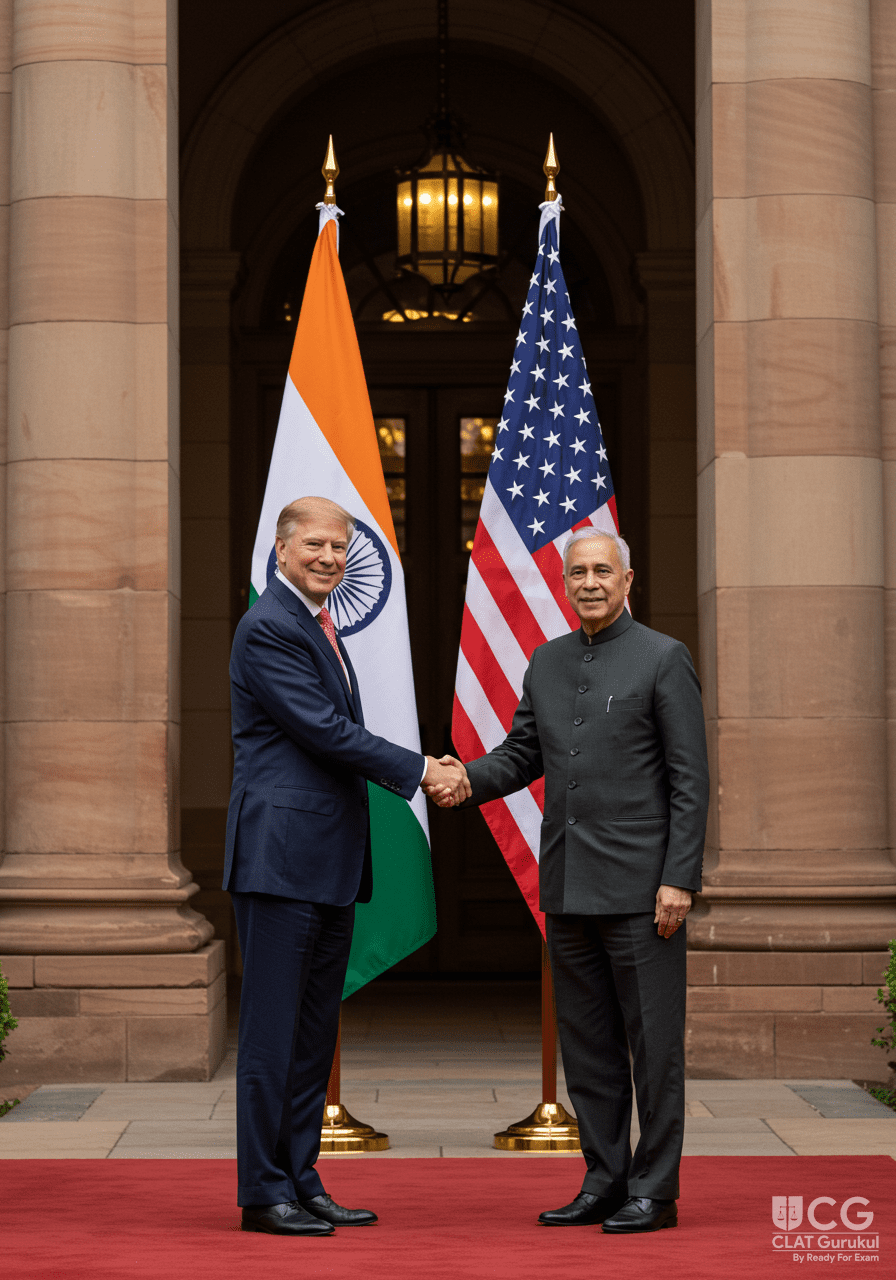
US Trade Representative Jamieson Greer led the first United States trade delegation to India in over a year, as both sides push to seal a long-awaited trade deal. After the US Supreme Court struck down the reciprocal tariffs imposed under the International Emergency Economic Powers Act (IEEPA), Washington has shifted to a steeper tariff architecture under Section 301 of the US Trade Act, 1974. India, meanwhile, is carefully shielding its agriculture and dairy sectors even as it negotiates wider market access. The episode is a textbook study in how domestic statutes, multilateral rules and raw trade economics collide in a single live negotiation.
From IEEPA to Section 301: a change of legal weapon
The earlier tariff round rested on the International Emergency Economic Powers Act, a statute that lets a US President regulate commerce during a declared national emergency. It is a sweeping power, and precisely because it is so broad, it was vulnerable to legal challenge. Once the US Supreme Court invalidated that route, Washington pivoted to Section 301 of the US Trade Act, 1974 — the classic instrument for retaliating against foreign trade practices deemed unfair, unreasonable or discriminatory.
Section 301 is more procedurally robust than an emergency declaration: it requires an investigation by the US Trade Representative, findings, and only then the imposition of duties. That structure makes it harder to strike down in court but slower to deploy. Findings under this Section 301 process are due on 24 July, which turns the current negotiations into a race against a hard legal deadline rather than an open-ended conversation.
The numbers behind the talks
India runs a goods-trade surplus with the United States of roughly $2.94 billion in May 2026, narrowing from $5.02 billion the previous period. Strikingly, the US is the only one of India’s top ten trading partners with which India exports more than it imports — India runs a deficit with nine of those ten partners, including major sources of crude oil and electronics. That single surplus is exactly what makes the relationship politically sensitive in Washington and gives the negotiations their edge.
For India, the surplus is both an asset and a vulnerability. It signals competitive strength in goods such as pharmaceuticals, textiles and engineering products, but it also paints a target for any administration looking to narrow its own trade deficit. Reading a trade balance is therefore not just an economics exercise; it is a way of predicting where political pressure will fall.
Why the WTO framework matters
Underlying all of this is the World Trade Organization’s Most Favoured Nation principle, enshrined in GATT Article I, which requires members to extend any trade advantage given to one member to all other members equally. Free trade agreements are the main permitted exception, carved out by GATT Article XXIV, which lets countries form customs unions and FTAs that lower barriers among themselves without violating MFN. A bilateral India-US deal would therefore have to fit within that FTA exception to remain WTO-consistent.
There is a further layer in the WTO Agreement on Agriculture, which disciplines how countries support and protect their farm sectors. India’s insistence on shielding agriculture and dairy is rooted partly in the livelihood concerns of millions of small farmers and partly in the policy space that this Agreement preserves. The negotiation is thus a balancing act between opening markets and defending the most politically sensitive sectors.
Reciprocal tariffs and the bigger picture
The phrase ‘reciprocal tariffs’ captures the core idea behind the earlier US approach: matching the duties that trading partners impose, on the theory that fairness means symmetry. Critics argue this logic ignores the complexity of modern supply chains, where a single product crosses borders many times before it is finished, so that a tariff on one country often raises costs for businesses and consumers at home as well.
For India, the lesson of this episode is the value of negotiating from the strength of its surplus while protecting its vulnerabilities. For the student of law and policy, it is a reminder that international trade is governed not by a single rule but by the interplay of domestic statutes, treaty obligations and hard economic realities — all of which can shift when a court strikes down one instrument and a government reaches for another.
Constitutional / Legal Framework
US Trade Act 1974, Section 301 (retaliation against unfair trade practices); the International Emergency Economic Powers Act (IEEPA); WTO Most Favoured Nation under GATT Article I; the FTA exception under GATT Article XXIV; and the WTO Agreement on Agriculture, which frames the agriculture and dairy sensitivities India is protecting.
CLAT Angle
It teaches the legal machinery of global trade — Section 301, IEEPA, WTO MFN and trade-balance economics — through a live negotiation.
Exam tip: MFN under GATT Article I requires treating all WTO members equally; FTAs are the main permitted exception under GATT Article XXIV.
Key Facts
| USTR Jamieson Greer led the first US trade delegation to India in over a year |
| Section 301 findings due 24 July |
| India’s goods-trade surplus with the US about $2.94 billion (May 2026), down from $5.02 billion |
| The US is the only top-10 partner with which India runs a surplus |
| India is protecting agriculture and dairy from market-access demands |
Memory Hook
301 = trade weapon; MFN = no favourites.
The India-US trade reset is more than a tariff dispute; it is a live lesson in the legal plumbing of global commerce. For CLAT aspirants, the takeaway is to hold three threads together — the domestic US statutes (Section 301 and IEEPA), the multilateral WTO rules (MFN and the FTA exception), and the underlying economics of trade balances. Master that triangle and trade questions become predictable.
Practice Quiz — 10 CLAT-Style Questions
Click an option to reveal the answer and explanation.