CURRENT AFFAIRS | 14 JULY 2026
Only about half of India’s tiger reserves have notified Eco-Sensitive Zones (ESZs), a fresh status report by the National Tiger Conservation Authority (NTCA) has found — leaving the edges of the country’s most protected wild spaces without a legal buffer against mining and infrastructure pressure.
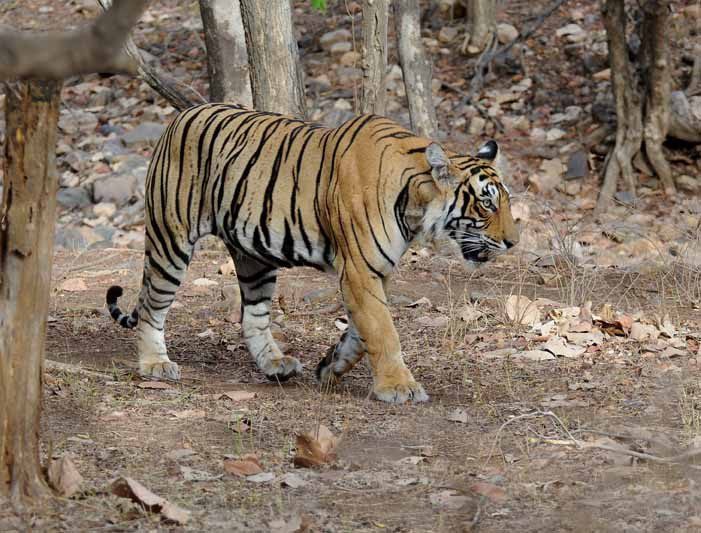
According to the report, 29 of India’s 58 notified tiger reserves have final ESZ notifications in place, while the other 29 are still waiting for them. This is a striking gap for a country that is the global heartland of tiger conservation: India’s 58 reserves are spread across 18 states, cover more than 82,000 sq km, and shelter nearly 75% of the world’s wild tigers. The finding lands at a sensitive moment, with the 6th All India Tiger Estimation — the national tiger census — having begun in January 2026 and its report due in 2027.
The two-tier legal architecture is central to understanding the issue. Tiger reserves themselves are constituted under the Wild Life (Protection) Act, 1972, whose Sections 38V and 38W empower the NTCA and set up the core-and-buffer ‘critical tiger habitat’ model. The NTCA is a statutory body under the Ministry of Environment, Forest and Climate Change (MoEFCC) that administers Project Tiger, the flagship conservation scheme launched in 1973. Eco-Sensitive Zones, however, come from a different statute altogether.
ESZs are notified around protected areas under Section 3 of the Environment (Protection) Act, 1986. They act as ‘shock absorbers’ or transition buffers, regulating — not banning — activities such as mining, large-scale construction and polluting industry within a notified radius. The Supreme Court, in the long-running In re: T.N. Godavarman Thirumulpad case, issued a 2022 order (later modified) pushing for a minimum one-kilometre ESZ around protected areas. Where reserves lack notified ESZs, their edges remain legally exposed to habitat fragmentation and development pressure, even though the protected core stays safeguarded.
🏛️ Constitutional / Legal Framework
- Wild Life (Protection) Act, 1972 (Ss 38V-38W): Constitutes tiger reserves, empowers the NTCA, and defines the core/buffer critical tiger habitat model.
- Environment (Protection) Act, 1986 (Section 3): Legal basis for notifying Eco-Sensitive Zones as regulatory buffers around protected areas.
- In re: T.N. Godavarman Thirumulpad: Continuing SC forest case; 2022 order (later modified) sought a minimum 1-km ESZ.
- Article 48A & 51A(g): Directive Principle and Fundamental Duty casting a constitutional obligation to protect forests and wildlife.
⚖️ Why This Matters for CLAT
This story is a classic GK-plus-legal-reasoning item. Aspirants must separate the two statutes — reserves under the WLPA 1972, ESZs under the EPA 1986 — a distinction examiners love to test through swapped-Act traps. It also links to the precautionary principle and the Godavarman case, letting the paper build application questions on whether development can proceed near an un-notified reserve edge.
📌 Key Facts
| Reserves with notified ESZ | 29 of 58 |
| Total tiger reserves | 58, across 18 states |
| Area covered | Over 82,000 sq km |
| Share of world’s wild tigers | Nearly 75% |
| Report author | NTCA (statutory body, MoEFCC) |
| ESZ legal basis | Section 3, EPA 1986 |
| 6th Tiger Estimation | Began Jan 2026; report due 2027 |
| Related anchor | India crossed 100 Ramsar sites (June 2026) |
The NTCA report is a reminder that safeguarding the tiger’s core habitat means little if the vulnerable periphery — where most human-wildlife conflict occurs — is left without a notified regulatory buffer.
🧠 Memory Aid
“Two acts guard the tiger — 72 makes the reserve, 86 makes the buffer.” Reserves under WLPA 1972; ESZ shock-absorbers under EPA 1986.
Practice Quiz — 10 CLAT-Style Questions
Click an option to reveal the answer and explanation.