CURRENT AFFAIRS | 25 MAY 2026
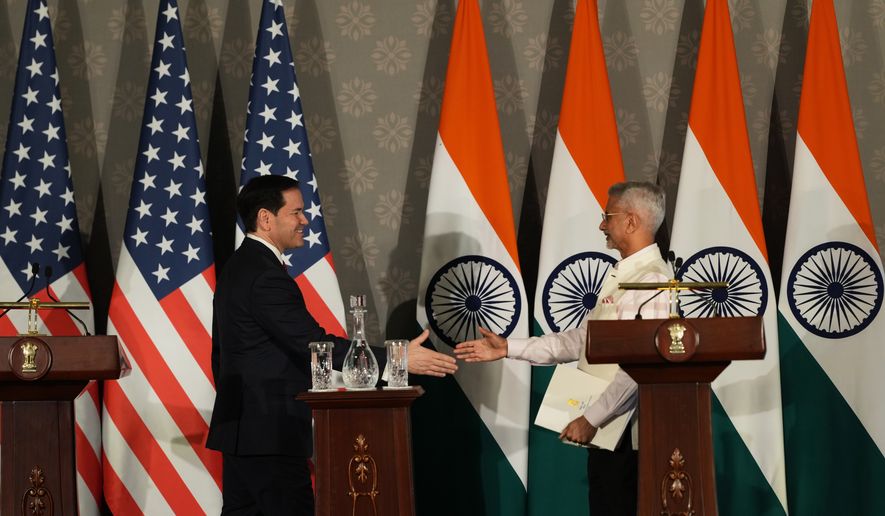
On 24 May 2026 in Delhi, US Secretary of State and concurrent National Security Adviser Marco Rubio met EAM S. Jaishankar, PM Narendra Modi and NSA Ajit Doval. The headline takeaway: Rubio publicly characterised the bilateral as a “strategic alliance” — describing India as one of the few countries with both “global influence and the ability to influence global events.” President Donald Trump joined the 250th US Independence Day reception by phone, declaring: “I love India…anything India wants, they get…100 per cent.”
The trade pact, characterised days earlier as at risk of “winding up”, will now be signed “in the next few weeks.” Indian companies are tracked as having committed roughly $20 billion in US investments. Visa “modernisation” bumps were clarified as not India-targeted. On Pakistan, Rubio drew a sharp distinction: that relationship is at the “tactical level…not the same as ours with India.” Talks ran across the Indo-Pacific, semiconductors, critical & emerging technologies, and the Quad.
Constitutional & Legal Framework
- Article 73 — Union executive power coextensive with Parliament’s legislative powers (includes treaty-making).
- Schedule VII, List I, Entry 14 — “Entering into treaties and agreements with foreign countries and implementing of treaties.”
- Article 246 + 253 — Parliament can legislate to implement treaties even on State subjects.
- Article 51 (DPSP) — Promote international peace, respect for international law and treaty obligations.
- Maganbhai Patel v. Union of India (1969) — Treaties affecting citizens’ rights require enabling legislation.
- VCLT, 1969 Article 26 — pacta sunt servanda; Article 27 — domestic law no defence to non-performance.
- US Constitution, Article II §2 — 2/3 Senate concurrence for treaties (why US prefers executive agreements with India).
- WTO MFN obligations — Constrain plurilateral trade preferences absent FTA notification.
CLAT 2027 Angle
Three vectors will be tested. One: the constitutional doctrine that international treaties don’t auto-incorporate — Maganbhai Patel (1969), Berubari Union (1960). Two: the milestone arc — NSSP 2004 → 123 Civil Nuclear Agreement 2008 → LEMOA 2016 → COMCASA 2018 → BECA 2020 → iCET 2023 → Quad revival 2017. Three: the doctrinal tension between Rubio’s “strategic alliance” framing and India’s tradition of strategic autonomy rooted in Article 51 DPSP and Non-Aligned Movement history. Expect a comprehension passage decoding “alliance” against the technical meaning of a treaty alliance (eg NATO Article 5 vs Quad’s leaders-led, non-treaty character).
Key Facts Table
| Visit date | 24 May 2026 |
| US side | Secretary of State & NSA Marco Rubio |
| Indian interlocutors | EAM Jaishankar, PM Modi, NSA Doval |
| Indian investment in US | ~$20 billion |
| Trade pact ETA | “Next few weeks” |
| Quad | India, US, Japan, Australia — leaders-led, NOT a treaty alliance |
| Foundational defence pacts | LEMOA (2016), COMCASA (2018), BECA (2020) |
Cases: Maganbhai Patel v. UoI (1969), Berubari Union (1960), Rosiline George v. UoI (1994) — extradition principles.
Mnemonic — RUBIO
- Record — Indian companies invested $20B in US
- US–Pak ties characterised as “tactical level”
- Bilateral trade pact imminent — “next few weeks”
- Indo-Pacific + Quad agenda anchors the visit
- One of few countries with global influence (Rubio framing)
Practice Quiz — 10 CLAT-Style Questions
Click an option to reveal the answer and explanation.